
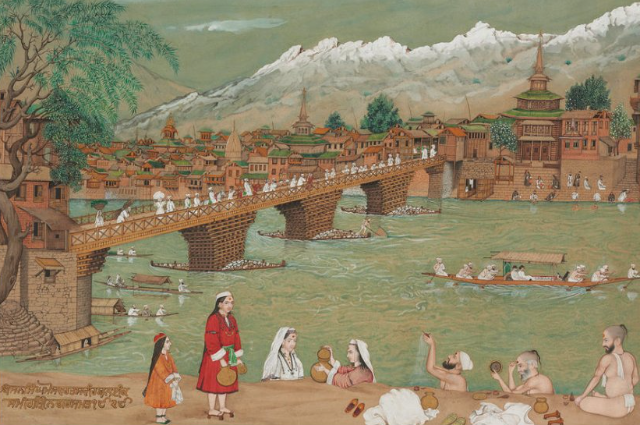
Imagine your home, your hometown, the places where you hang out, and the festivals that remind you of all the memories that you have had since your childhood. If you are living away from your town, these things feel more personal. And the essence of the festivals adds up to the nostalgia and a sense of yearning for the place you have lived in all your life.
But what will happen if someday the people of your town and your neighbours, with whom you have shared your life, happiness, and sorrow, turn against you and give you an ultimatum to leave your home and your motherland? Yes, they threaten to kill you if you don’t abandon your faith and start following theirs.
It is terrifying to even think of this kind of scenario, right? Unfortunately, this is the cursed truth of the Kashmiri Pandits.
The Kashmir, Which Is Forgotten.
Long before the political arena, militancy, slogans, and sirens, Kashmir was not just a place where people went to see snowfalls and shikaras. It was a place where wisdom and philosophy used to brood. All the great Rishis came to this land in the lap of the Himalayas to meditate and wrote texts that gave birth to many schools of thought. Adi Shankaracharya walked from Kerala to Kashmir to do the same, and he gave many of the great philosophy including the Advait Vedanta. Vasugupta had written the Shiv Sutras here; Rajtaringini was written by Kalhan, Natya Shashtra by Bharat Muni, Vigyan Bhairav Tantra, and many more scriptures were born here in this land, which is called the heaven on earth.
Kashmir Shaivism And The Kashmiri Pandits
With the above-mentioned great and timeless texts and philosophies, an absolute revolutionary philosophy was born in the valleys of Kashmir, and that was the Kashmir Shaivism.
Kashmir Shaivism emerged between the 8th and 12th centuries CE as one of the most sophisticated non-dual philosophical systems in the world. Rooted in texts such as the Shiva Sutras, Spanda Karikas, Tantraloka, and Pratyabhijna Hridayam, it proposed a radical metaphysics: that consciousness (Chit) is real, dynamic, self-aware, and creative. The universe is not an illusion to be escaped but a playful self-expression (lila) of Shiva.
In simple words, Kashmir Shaivism states that consciousness alone is real, and that this consciousness delights in becoming many without ever ceasing to be one.
Unlike ascetic or world-negating traditions, Kashmir Shaivism embraced life, art, sensuality, and emotion as valid paths to realisation. Its practices were subtle, experiential, and inward—often transmitted orally from guru to disciple. This made the community's continuity essential for its survival.
For centuries, Kashmiri Pandits carried this inheritance quietly, not as missionaries or knights of a philosophy, but as the humble keepers of the thought. The deepest philosophy of Kashmir Shaivism was rarely proclaimed out loud. But it was passed through gestures, tones, pauses, and the quiet presence of Shiva in everything. Much of the text was never written down on paper, as the philosophy of inner recognition never trusted loud spectacle.
So homes became classrooms, temples turned into serene libraries, and the children learned not by instructions, rules, or regulations but through atmosphere.
The flame of this sacred way of life was passed from generation to generation. The tradition survived invasions, conversions, and political upheavals, but it continued to live silently among the Pandits.
This system never expected exile.
Then Came The Darkest Phase
The Pandits had endured persecution for centuries, and still hadn’t succumbed to the brutality of invasion, conversion, and swords. They kept on living in the valleys, their root, and never abandoned their faith. But the late 80’s and early 90’s brought a brutal storm upon them, unlike anything they had faced before.
The loudspeakers that were once used only for the prayers for their fellow Kashmiris were now omitting the threats disguised as an ultimatum: Convert, Die, or Flee. The Pandits were warriors or warmongers who would start threatening back or fight with swords or guns. The militancy in the valley, backed by separatist political leaders and Pakistan, started paving its path violently. The Pandits were being killed here and there on the grounds of their faith. They had to do only one thing to save themselves, and mingle with their brothers of another faith, just by converting to their faith, abandoning theirs.
The practitioners of gentle philosophies just could not digest this new idea of so-called brotherhood. They kept on living in their motherland, practising their faith, hoping some day it would stop, and things would be better like before, but it didn’t.
The early 90’s changed things for the worse. The killings now take the form of a massacre. Not only the Kashmiri Pandits but also the Muslims sympathizers of the Pandits were killed in this massacre. Families upon families were wiped out, and their belongings were looted. And the thousands of Kashmiri Pandits had to choose what they had never imagined in their lives: fleeing their motherland.
The Exile And Aftermath
Once, the oldest natives of the valley are now living in refugee camps in Jammu. Some of the families spread into various parts of north India. The exodus of Kashmiri Pandits did not merely empty homes; it emptied contexts. Kashmir Shaivism was never a philosophy that could survive intact in isolation. It required presence—human, cultural, geographical. When the Pandits left the valley, this entire ecology collapsed.
What remained were texts without teachers, rituals without communities, and sacred spaces without breath.
Kashmir Shaivism relies deeply on oral and experiential transmission. Its central insights—spanda (vibration), svātantrya (freedom), pratyabhijñā (recognition)—are not grasped fully through study alone. They are realised through subtle guidance, embodied practice, and a culture that already assumes consciousness as sacred.
The exodus shattered this transmission. Lineages fractured. Teachers became refugees. Students were scattered or never formed. In camps and cities, survival replaced contemplation. A philosophy that requires inward spaciousness could not easily flourish where life was reduced to endurance.
Entire modes of interpretation—local, intuitive, embodied—vanished without record.
The Pandits in exile now only have remained as the custodians of the presence, of which they once were the practitioners.
Kashmir Shaivism survived as remembrance, not atmosphere. For younger generations born outside the valley, the philosophy often arrived as an inheritance rather than a realisation.
A tradition centred on recognition risked becoming one of nostalgia.
Yet exile also preserved something fragile and potent: longing. Longing keeps recognition possible. It keeps the lamp from being forgotten entirely.
Final Words
What is written above is not a story or work of fiction; this is the truth that very few know in our country. Today, even a little inconvenience irks us, let alone the injustice to a whole community. Movements, protests, and social media campaigns bend the authorities and people responsible for the injustice. We people of this great nation, often sympathise with people even outside of our country, but we have failed to do so for our own for the last 40 years. We have failed the Kashmiri Pandits again and again. We are so busy with the outward appearance of the divine that we let the wisdom of inner recognition, which the divine has blessed us with, slip completely from our minds.
We have forgotten the Kashmir Shaivism and also the custodians of this ancient wisdom.
The Pandits still await outside the valley, and so is their faith, Kashmir Shaivism.