
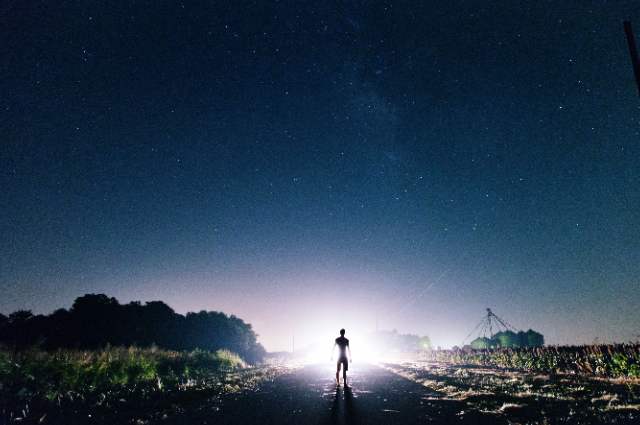
There are nights when the sky is not merely something we look at.
It becomes a question.
One night, I was looking at the sky in darkness. The Moon was there, surrounded by stars, and beyond them was something much larger than what my eyes could comprehend: darkness.
I kept looking.
And then my mind began to run.
If someone asked me, What is the fastest thing in existence? I might be tempted to say light. But that night I wondered whether there was something faster—the human mind itself. In a single second, it can travel from the Moon to a childhood memory, from a childhood memory to a question about God, from God to a galaxy, from a galaxy to death, and from death back to the question of existence.
My mind was doing exactly that.
I looked at the Moon and remembered something I had learned as a child: the Moon does not produce its own visible light; it reflects sunlight. The stars, however, shine because of processes taking place within them. That simple difference suddenly felt strangely profound.
One object appears luminous because it receives light.
Another appears luminous because something is happening within it, and I remembered mt teacher called it nuclear fusion.
And then another thought came:
How much of what I see is actually what exists?
I looked deeper into the darkness.
Our galaxy contains an unimaginable number of stars. And our galaxy is not alone. There are countless other galaxies, each containing their own stars, planets, gas, dust and perhaps worlds we will never see.
Then I remembered a picture of Narayana reclining upon Shesha naag, surrounded by galaxies, stars and worlds.
I knew the picture was an artistic representation, not a scientific diagram from an ancient observatory. Yet something about it affected me. It seemed to place the divine and the cosmic in the same visual field: Narayana at the centre, while universes appeared to surround Him.
And suddenly I wondered:
How many galaxies are there?
Where does the universe end?
Where did it begin?
What is beyond what I can see?
And if there is so much that I cannot see, how can I be certain that what I see is the whole truth?
That question eventually took me somewhere I had not expected:
dark matter and dark energy.
The universe that refuses to reveal itself
When I first encountered the phrase dark matter and dark energy, the definition seemed almost deliberately unsatisfying.
They were described as invisible and mysterious components making up roughly 95 percent of the universe on Google.
But that raised more questions than it answered.
Today, cosmology estimates that ordinary matter—the atoms making up stars, planets, living beings and everything familiar to us—accounts for only about 5 percent of the universe's mass-energy budget. Dark matter is estimated at 27 percent and dark energy at about 68 percent.
But there is an important distinction that is often lost in popular explanations: dark matter and dark energy are not the same thing.
Dark matter behaves, as far as we can tell, as a gravitationally influential form of matter. It does not emit, absorb or reflect light in the way ordinary matter does, yet its gravitational effects reveal its presence.
Dark energy is different. The term refers to whatever is responsible for the observed accelerated expansion of the universe. Its fundamental nature remains unknown.
So perhaps the first lesson of the dark universe is not that we have discovered some mysterious cosmic substance.
Perhaps it is this:
We have discovered how much we do not know.
And that realisation has a history.
The man who noticed that something was missing
In 1933, the Swiss astronomer Fritz Zwicky studied a cluster named the Coma Cluster, a huge collection of galaxies.
He measured the velocities of galaxies within the cluster and applied the virial theorem to estimate the amount of mass required for the cluster to remain gravitationally bound.
The result was shocking for him.
The galaxies were moving so rapidly that the amount of visible matter seemed insufficient to account for the gravitational binding of the cluster. The calculated mass was much larger than what the visible light appeared to suggest. Zwicky proposed that there must be additional unseen matter. He referred to it as dunkle Materie—dark matter.
It is tempting to tell this story as if Zwicky immediately discovered the truth and the scientific world simply laughed at him.
Reality is more complicated—and therefore more interesting.
His interpretation was initially treated with considerable scepticism, and alternative explanations were discussed. It took decades and many independent observations before the missing-mass problem became an established pillar of modern cosmology.
Zwicky's story changed something in my mind.
Because he had not seen dark matter.
He had seen its effect.
Something invisible was revealing itself through something visible.
And I began to wonder:
How many things in existence might be known not because we see them directly, but because of what they do?
The stars that refused to slow down
Decades later, another piece of the puzzle emerged.
Vera Rubin and Kent Ford studied the rotation of the Andromeda galaxy, M31, using an improved spectrograph. According to the expectations of classical gravity, stars farther from the central concentration of mass should generally orbit more slowly.
But that was not what the observations showed.
The rotation curve remained surprisingly flat: stars far from the centre were moving much faster than expected from the visible matter alone.
It was as though the galaxy contained something we could not see.
Rubin and Ford did not stop with one galaxy. Their work expanded to many spiral galaxies, and the evidence for unseen mass accumulated. By 1980, Rubin and collaborators had reported flat rotation curves across a substantial sample of spiral galaxies.
This is where the story becomes beautiful to me.
The scientists were not looking at dark matter.
They were looking at motion.
And motion told them that something invisible was there.
This was not the first time when science shows their interest towards dark matter and dark energy. It started in 1992, but without solid evidence, they left this subject by calling it an illusion.
But after this, one thing is clear: the universe gives us an extraordinary lesson: We do not always need to see a thing directly to know that something is there. We can see its consequences.
Dark matter does not announce itself with light.
It announces itself through gravity.
And suddenly my original question returned:
If the universe contains something that my eyes cannot see but whose effects are everywhere, how much confidence should I place in the limits of my senses?
Then I went smaller
I had begun by looking outward.
Now I wanted to look inward—into matter itself.
We ordinarily experience objects as solid.
A table feels solid.
A wall feels solid.
My own body feels solid.
But at microscopic scales, the classical picture of matter as tiny solid balls becomes inadequate. Atoms have nuclei surrounded by electrons, and the distances involved mean that most of an atom's volume is not occupied by its tiny nucleus.
Then quantum mechanics makes the picture stranger still.
Particles are described by quantum states and probability amplitudes. Quantum field theory goes further: what we call particles are understood as excitations of underlying fields.
This is where popular explanations often become misleading.
It is tempting to say:
“Everything is just energy.”
But physics is more precise than that.
Energy is a physical quantity associated with the state of a system. It is not simply another name for “everything that exists.” And quantum mechanics does not prove that the world is an illusion or that consciousness creates physical reality.
So I had to stop myself.
Perhaps I was beginning to make the exact mistake I was trying to investigate.
I was taking something mysterious in physics and turning it into whatever philosophical conclusion I wanted.
And that forced me to ask a harder question:
If modern physics does not prove that the world is an illusion, why does the idea of illusion feel so familiar?
That was when I remembered Māyā.
Māyā: Is the world false—or is my understanding incomplete?
In Indian philosophical traditions, particularly in Advaita Vedanta, Māyā is often discussed in relation to appearance, ignorance and the way reality is experienced.
But saying simply, “The world is fake,” would be an enormous oversimplification. So the question in my mind is:
Is reality exactly as it appears to us?
That question suddenly felt remarkably close to the question that had started my entire journey.
The eye gives me one picture.
The telescope gives me another.
The microscope gives me another.
Quantum theory gives me another.
And Vedanta asks me to go one step further:
Who is the one to whom all these appearances are appearing?
That question changes everything.
Because now I am no longer merely investigating the universe.
I am investigating the investigator.
“Tat Tvam Asi” — Who is the “I”?
The Upanishads do something extraordinary.
They do not merely ask:
“What is the universe made of?”
They ask:
“What is the Self?”
The Upanishads place the concept of Ātman at the centre of their inquiry, and the question of the Self is deeply connected with the question of ultimate reality, Brahman.
In the Chāndogya Upanishad, Uddālaka teaches his son Śvetaketu through a series of examples and repeatedly concludes with the famous statement:
“Tat Tvam Asi.”
Traditionally translated:
“That Thou Art.”
The statement occurs in the context of a teaching about the finest essence underlying the world and the Self.
And this is where my scientific question suddenly turns inward.
I had started by asking:
What is that invisible thing holding galaxies together?
Then:
What is dark energy?
Then:
What is matter really made of?
Then:
What is reality beneath appearance?
And now:
Who am I?
Not my name.
Not my profession.
Not my memories.
Not even merely my body.
But the one who is aware of all these things.
“Neti, Neti” — Not this, not this
Another profound Upanishadic approach is expressed through the phrase “Neti, Neti”—“not this, not this”—associated with the Bṛhadāraṇyaka Upanishad.
To me, its power lies in what it refuses to do.
It does not give me an easy object and say:
“Here. This is ultimate reality.”
Instead, it removes identifications.
Not this body.
Not this thought.
Not this sensation.
Not this object.
Not this limited description.
And perhaps that is where my scientific and philosophical journeys unexpectedly resemble each other—not because they are secretly the same discipline, but because both can expose the inadequacy of easy answers.
Science keeps discovering that the universe is stranger than our first models.
Vedanta keeps asking whether the Self is deeper than our ordinary identification with body and mind.
Neither permits me to stop questioning.
But is the soul dark energy?
Here I have to be honest.
I cannot scientifically claim that the human soul is dark energy.
There is currently no established evidence that consciousness is composed of dark energy, nor that the soul is a form of dark matter.
Dark energy is a cosmological concept describing the phenomenon associated with accelerated cosmic expansion. Dark matter is inferred through gravitational effects. Consciousness is a fundamentally different scientific and philosophical problem.
So I cannot honestly write:
“Science has proved that the soul is dark energy.”
It has not.
Nor can I say:
“Quantum physics has proved the Upanishads were scientifically correct.” It has not.
Because I am not interested in forcing science to agree with spirituality.
I am interested in asking why, despite using completely different methods, both modern science and ancient Indian philosophy can leave me standing before the same feeling:
The reality I experience may be far deeper than the reality I immediately perceive. That is a question.
Not a conclusion.
And perhaps questions are sometimes more valuable than conclusions.
The scientists want to know too
There is another thought that keeps returning to me.
Scientists know that dark matter exists through its gravitational effects, but they still do not know what dark matter fundamentally is. NASA currently describes candidates including possibilities such as WIMPs, axions and primordial black holes, but the underlying identity of dark matter remains unresolved.
And scientists are still trying to understand dark energy.
Why?
Because if we understood these hidden components of the universe, we would understand much more about how the cosmos formed, how galaxies developed, how structure emerged and what the ultimate fate of the universe might be.
That desire is not so different from the desire that first made me look at the sky. What is really there?
And perhaps there is an even deeper question underneath it:
If human beings eventually understand the fundamental structure of reality, would that knowledge give us extraordinary power?
Could we manipulate matter in ways we cannot imagine today?
Could we create things we currently consider impossible?
I do not know.
Science certainly does not give us that power merely because dark matter constitutes a large fraction of the cosmic budget.
Knowing that something exists is not the same as knowing how to control it. And that distinction matters.
The image of Narayana returned to me
When I think about that image now, I see it differently.
Narayana reclining amidst galaxies is not a physics textbook.
It does not prove that ancient Indian civilisation knew the modern cosmological percentages of dark matter and dark energy.
It is an artistic expression of a much older cosmological imagination: the divine not as something confined to a small corner of the world, but as intimately associated with existence itself.
And perhaps that is why the image stayed with me.
Because modern astronomy tells me that our galaxy is one among an enormous number of galaxies.
Cosmology tells me that most of the universe's mass-energy is not ordinary matter. And Vedanta asks me to turn the gaze inward and investigate the Self. Outward, the universe becomes unimaginably vast.
Inward, the question becomes unimaginably intimate.
And somewhere between those two directions stands a human being. Me.
You.
A consciousness capable of looking upward and asking:
What is all this?
Maybe the greatest mystery is not the universe
I began with the sky.
I thought I was searching for dark matter.
Then I encountered dark energy.
Then galaxies.
Then gravity.
Then gravitational lensing.
Then atoms.
Then quantum theory.
Then Māyā.
Then Ātman.
Then Brahman.
And finally, I arrived somewhere I had not expected to arrive at all:
myself, my soul.
Science has shown me that what I see is only a fraction of what exists.
Dark matter cannot be seen directly, yet its gravitational influence shapes cosmic structures. Dark energy cannot be seen directly, yet something associated with it appears to be accelerating the expansion of the universe.
Quantum physics has shown us that nature at its smallest scales cannot be understood through the simple categories of everyday experience.
Vedanta asks a different but equally unsettling question:
What if the greatest object of our ignorance is not the universe outside us, but the subject inside us?
I still cannot say that the soul is dark energy.
I cannot say that quantum mechanics proves Māyā.
I cannot say that the Upanishads predicted modern cosmology.
And I do not want to.
Because perhaps the beauty lies precisely in not forcing the answer.
The scientist looks at the invisible universe and says:
“There is something here. We do not yet know what it is.”
The seeker looks inward and asks:
“There is an awareness here. Who is aware?”
The Upanishadic voice responds:
“Tat Tvam Asi.”
And somewhere between the telescope pointed toward the galaxies and the mind turned inward toward the Self, I find myself standing exactly where I began:
beneath a dark sky.
Still looking.
Still questioning.
Still unable to see the whole.
But now I have begun to understand something.
Perhaps the purpose of looking into the universe is not merely to discover how large it is. Perhaps it is to discover how little we understand about the very act of seeing.
The universe contains galaxies we cannot count individually, matter we cannot see, forces whose nature we do not yet understand, and scales of reality that our senses were never designed to perceive.
And yet, within this almost incomprehensible universe, something astonishing has happened.
A small human being looked upward.
She saw the darkness.
And she asked:
“What is this?”
Then she asked:
“What am I?”
And finally, the question became even more difficult:
“Who is the one who is asking?”
Perhaps that is where my search truly begins.
Not with an answer.
But with the courage to remain curious in front of the unknown.