
My mother always told me, “Beta, the people who love you, never truly leave; they’re always with you, looking out for you, even when they aren’t physically present with us.”
Aren’t physically present with us? How can they check in on us? I found this hard to believe, until one night, my deceased grandmother visited me in my dream. She arrived 3 years later after she passed, on a random night.
She came in my dream wearing a light-blue color sari. She didn’t have a hunch back. She stood up straight, ensuring my favourite meal was being cooked for lunch. When she saw me come downstairs, she embraced me.
And then she says, “Aa gayi wapas Kerala se? Lunch mein dahi chawal aur bhindi bani hai, khaogi na?” (Translation: You’re back from Kerala? I’m getting curd rice and bhindi made for lunch. You’ll have it, right?).
The dream felt so real, that I came running out of my room half expecting my nani (maternal grandmother) to be in the kitchen. When I shared this with my mom, she smiled. She says “She hasn’t visited me since she passed. She loves you and is looking out for you.”
Silence of the Second Wave
The second wave of Covid-19 took away the rituals that help us understand loss. Grief, stripped of its structure, becomes harder to process. There are no final conversations, no gradual acceptance. Just abrupt endings.
I still remember my maamu calling my mother between 2 and 2:30 a.m., saying, “She’s gone.” The words felt procedural, almost administrative, like a notification rather than a goodbye. Half-asleep, I couldn’t comprehend what had happened. I mechanically made the funeral invite while my parents coordinated arrangements. It didn’t feel like a loss. It felt like logistics.
When I finally saw her, lying still, I didn’t break down. I hugged her. I waited for something, some overwhelming emotion, some clarity; but nothing came. The room was filled with people, but it felt hollow.
It was only during the ritual, when the skull was pierced to release the soul, that something inside me broke. The finality of it hit, not as a moment of peace, but as a confrontation. No ritual, no tradition, could compensate for the absence of a proper goodbye. And that is what the pandemic did to many of us, it turned grief into something unfinished.
Revisiting the Dream
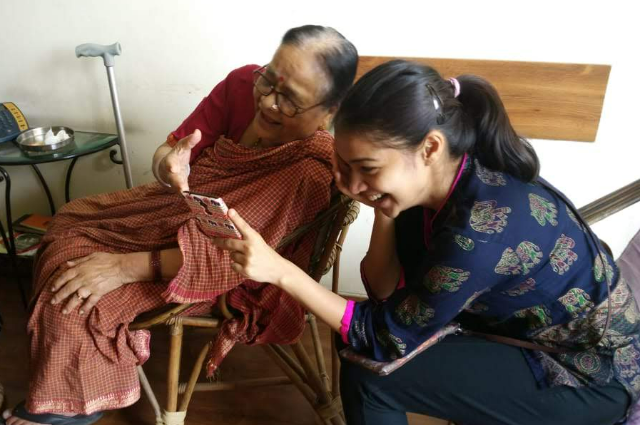
The first thing I noticed was her health. The frailty that the pandemic had forced upon her was gone. She wasn’t weak, she stood up straight, her posture commanding and effortless, requiring no support.
What stood out wasn’t just her presence, but her transformation. Free from the frailty that had defined her final days. She wasn't a "ghost"; she was a vibrant, living version of herself. She was happy, giving me the tightest bear hug and smelling like sandalwood.
Why We Dream of the Departed
Experiences like these are more common than we admit. Psychologists refer to them as “visitation dreams,” and studies suggest that a significant number of people who have lost loved ones report vivid, sensory experiences of them; especially during periods of unresolved grief.
These dreams often share patterns: the person appears healthier, calmer, and more at peace than they were at the time of death. The interaction feels unusually real. More structured, more coherent than ordinary dreams. For many, these moments aren’t just memories replaying; they feel like conversations that were never completed.
From a psychological lens, this can be understood through what is called the “continuing bonds” theory, the idea that we don’t detach from the people we lose, but instead find new ways to maintain a relationship with them. The mind, in its attempt to process loss, constructs spaces where that relationship can continue, even if only briefly.
But explanation doesn’t necessarily reduce meaning. Whether these dreams are neurological responses or something more spiritual, they serve a purpose, they give form to emotions that have nowhere else to go.
So, is this Goodbye?
I don’t know whether that night was my mind trying to make sense of an unfinished goodbye. What I do know is this: grief doesn’t always resolve itself through rituals, time, or logic. Sometimes, it finds its own way back to you. Quietly. Unexpectedly. When you’re finally still enough to feel it.
My Nani hasn’t visited me since that dream. Maybe she doesn’t need to. Not because she’s “always there,” but because the part of me was waiting for closure has stopped asking for it.
And maybe that’s what healing actually looks like. Not moving on, but learning to live with what was never finished. Without needing it to be.
. . .
References: