
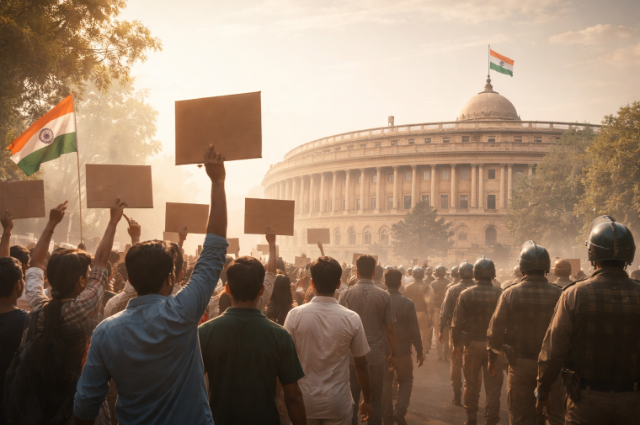
India’s Constitution promises its citizens the right to freedom of speech, expression, and peaceful protest. These rights form the backbone of any democracy. Dissent — the act of questioning or disagreeing with government policies — is not a crime in itself; it is often a sign of a healthy and active civil society. Yet in recent years, debates have intensified around how dissent is treated, especially when national security laws are invoked against activists, students, and public intellectuals.
One widely discussed case is that of Sonam Wangchuk, a Ladakh-based engineer, education reformer, and climate activist. Known for innovations such as the “ice stupa” project and for founding the Students’ Educational and Cultural Movement of Ladakh (SECMOL), Wangchuk received the Ramon Magsaysay Award in 2018 for his work in education and sustainability. In 2025, he led protests demanding statehood for Ladakh and Sixth Schedule protections to safeguard tribal land, culture, and the fragile Himalayan ecosystem. Following protests in Leh that reportedly turned tense, he was detained on 26 September 2025 under the National Security Act (NSA), a preventive detention law that allows authorities to hold individuals without trial for a specified period. His detention sparked nationwide discussions about the limits of protest and the scope of preventive detention laws.
Another major flashpoint in recent Indian politics was the Citizenship Amendment Act (CAA), passed in December 2019. The CAA provides a fast-track to Indian citizenship for non-Muslim migrants from Pakistan, Bangladesh, and Afghanistan who entered India before a certain date. Supporters argued that it offered refuge to persecuted minorities, while critics contended that citizenship should not be linked to religion. The law triggered widespread protests across several states, with university campuses becoming central sites of debate and mobilisation.
During the anti-CAA protests and the subsequent unrest in Delhi in 2020, student leaders such as Umar Khalid and Sharjeel Imam were arrested under the Unlawful Activities (Prevention) Act (UAPA), India’s primary anti-terror legislation. Authorities alleged a broader conspiracy behind the violence, while the accused and their supporters maintained that they were being targeted for their political views. The UAPA has been criticised by some legal experts for making bail difficult and extending pre-trial detention, though the government maintains that the law is essential for combating terrorism and protecting national security.
Concerns about the use of UAPA were also raised in the Bhima Koregaon case of 2018. Following violence near the village of Bhima Koregaon in Maharashtra, several activists and lawyers were arrested on allegations of links to banned organisations. Among them was Father Stan Swamy, an 84-year-old Jesuit priest and tribal rights activist. Arrested in October 2020, he remained in custody while seeking bail on medical grounds and died in July 2021. His death in custody led to strong reactions from civil society groups, who questioned the humanitarian and legal dimensions of prolonged pre-trial detention.
These cases have fueled an ongoing national conversation: How should a democracy balance the right to dissent with the need to maintain public order and national security? Governments argue that strong laws like the NSA and UAPA are necessary to prevent violence and protect sovereignty. Critics counter that such laws must be applied with caution, transparency, and strict judicial oversight to prevent misuse.
At the heart of this debate lies a fundamental question — can a democracy remain strong if dissenting voices feel silenced, or does unchecked protest risk destabilising the state? The answer may not lie at either extreme. Democracies thrive not merely on the existence of rights, but on the careful, fair, and accountable enforcement of laws. Public trust depends on institutions that are both firm in safeguarding security and equally committed to protecting civil liberties.
India’s democratic journey has always involved negotiation — between authority and accountability, between unity and diversity, between security and freedom. The current debates surrounding protest movements, preventive detention, and anti-terror legislation are part of that continuing story. As citizens, lawmakers, and courts engage with these questions, the strength of the republic will ultimately be measured by how well it preserves both its security and its constitutional promise of liberty.
. . .
References:
- Indian Express. “Explained: Sonam Wangchuk’s detention under NSA in Ladakh (2025).” https://indianexpress.com
- NDTV. “Sonam Wangchuk Arrested Under NSA in Ladakh (2025).” https://www.ndtv.com
- Wikipedia. “Sonam Wangchuk.” https://en.wikipedia.org
- Wikipedia. “Citizenship Amendment Act.” https://en.wikipedia.org
- Indian Express. “Citizenship Amendment Act Protests 2019 – Explained.” https://indianexpress.com
- Wikipedia. “Umar Khalid.” https://en.wikipedia.org
- Wikipedia. “Sharjeel Imam.” https://en.wikipedia.org
- LiveLaw. “Supreme Court Denies Bail to Umar Khalid, Sharjeel Imam (2026).” https://www.livelaw.in
- Wikipedia. “Unlawful Activities (Prevention) Act.” https://en.wikipedia.org
- Wikipedia. “2018 Bhima Koregaon Violence.” https://en.wikipedia.org
- Wikipedia. “Elgar Parishad.” https://en.wikipedia.org
- Wikipedia. “Surendra Gadling.” https://en.wikipedia.org
- Wikipedia. “Stan Swamy.” https://en.wikipedia.org
- The Hindu. “Stan Swamy Dies in Custody (2021).” https://www.thehindu.com
- Amnesty International. “India: Stan Swamy’s Death in Custody (2021).” https://www.amnesty.org