
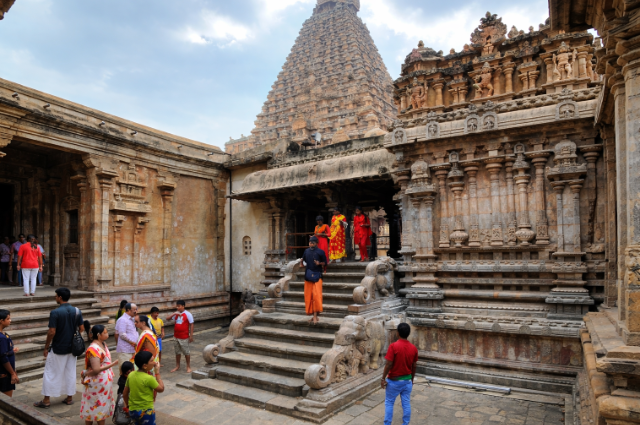
In the heart of Thanjavur, Tamil Nadu, stands a structure that has silently watched a thousand years of history pass by. Empires have risen and fallen, colonial rule came and went, and technology transformed the world. Yet the Brihadeeswara Temple remains almost exactly as it was when it was completed in 1010 CE.
Built by the Chola emperor Raja Raja Chola I, this temple is not just a place of worship dedicated to Lord Shiva. It is one of the most astonishing examples of ancient engineering, architecture, mathematics, and cultural organisation. Even today, historians, architects, and engineers continue to study it in an attempt to understand how such a monumental structure was built with the tools available a millennium ago.
The Birth of a Monument
Raja Raja Chola I ruled one of the most powerful empires in South Indian history. The Chola dynasty controlled vast territories across southern India and maintained strong trade networks with Southeast Asia, Sri Lanka, and China. During this period of prosperity and stability, Raja Raja Chola commissioned the construction of the Brihadeeswara Temple as a grand symbol of devotion, political power, and artistic excellence.
Construction of the temple reportedly took around 25 years and was completed in 1010 CE. For its time, the temple tower, known as the vimana, was the tallest man-made structure in Asia, rising approximately 66 meters (216 feet) high.
Even today, when standing before it, visitors often struggle to grasp the scale of the structure. The temple complex is massive, yet every part of it follows a precise architectural order rooted in ancient Indian temple design principles known as Vastu Shastra and Agama Shastras.
A Structure Built Without Modern Binding Materials
One of the most fascinating aspects of the Brihadeeswara Temple is the way it was constructed. The entire temple is built from granite blocks — a material known for its strength and durability. What makes this even more remarkable is that there are no modern binding materials, such as cement or mortar, used between the stones.
Instead, the massive stones are interlocked through precise geometric placement and weight distribution. This technique allowed the structure to remain stable for over a thousand years, even through natural weathering and occasional earthquakes.
Another puzzling detail is the origin of the granite. The Thanjavur region does not naturally contain large granite deposits. Archaeological studies suggest that the stones were transported from quarries located up to 60 kilometres away. Moving thousands of tons of granite without modern cranes, trucks, or machinery must have required extraordinary planning, manpower, and engineering skill.
The Mystery of the Tower Capstone
At the very top of the temple tower sits a massive stone block known as the "kumbam" or capstone. This single piece of granite weighs around 80 tons.
How ancient builders managed to place such a heavy stone at a height of more than 60 meters remains one of the temple’s greatest mysteries. One widely discussed theory suggests that the builders constructed a massive earthen ramp stretching several kilometres, possibly up to 6 kilometres long. Using this ramp, workers and animals could gradually drag the stone upward using ropes and wooden rollers.
However, archaeologists have not found definitive physical evidence of such a ramp, which keeps the debate alive among historians and engineers.
Architectural Precision and Astronomical Alignment
The Brihadeeswara Temple is not only a physical structure but also a masterpiece of scientific understanding. The design demonstrates an advanced knowledge of geometry, proportion, and astronomical alignment.
Many researchers have observed that the temple tower is designed so that its shadow rarely falls outside its base perimeter during midday. This suggests that the architects had a sophisticated understanding of solar movement and geometry.
The proportions of the temple are also carefully calculated. Ancient Indian temple architecture often used sacred numerical symbolism, connecting structure, cosmology, and religious philosophy.
Art, Culture, and Social Organisation
Beyond its engineering brilliance, the temple also offers a deep insight into the social and cultural life of the Chola Empire.
More than 100 inscriptions carved into the temple walls document detailed administrative records. These inscriptions mention temple staff, priests, musicians, dancers, accountants, and even security guards. They also record donations of gold, land, livestock, and grain.
Historical records indicate that the temple employed more than 400 dancers and musicians who performed ritual music and dance as part of daily worship. The temple functioned not only as a religious centre but also as a cultural institution, economic hub, and administrative centre.
The temple walls also contain extraordinary Chola murals. These paintings depict scenes from Hindu mythology as well as portraits of Raja Raja Chola himself. Many of these original murals were discovered beneath later Nayaka-period paintings during restoration work in the 1930s.
These artworks show stylistic influences that some historians believe may reflect cultural exchanges with regions like Southeast Asia and even Central Asia through trade routes.
A Living Monument
Unlike many ancient monuments that exist only as archaeological ruins, the Brihadeeswara Temple remains an active place of worship. Daily rituals have continued here for more than a thousand years without interruption.
In 1987, UNESCO recognised the temple as part of the "Great Living Chola Temples" World Heritage Site, acknowledging its outstanding cultural, historical, and architectural significance.
Today, millions of visitors, researchers, and pilgrims visit the temple each year. Some come for spiritual devotion, while others come to witness one of humanity’s most impressive architectural achievements.
The Unanswered Question
The Brihadeeswara Temple challenges modern assumptions about ancient civilisations. Without electricity, heavy machinery, or digital tools, the builders created a structure that has survived a millennium.
Every granite block, every carving, and every geometric proportion reflects an extraordinary combination of engineering knowledge, artistic mastery, and cultural vision.
More than 1,000 years later, the temple still stands not only as a monument of faith but also as a reminder of the remarkable capabilities of human ingenuity.
References:
- UNESCO World Heritage Centre. "Great Living Chola Temples." https://whc.unesco.org
- Archaeological Survey of India (ASI). Brihadisvara Temple Conservation Reports.
- George Michell. "The Hindu Temple: An Introduction to Its Meaning and Forms." University of Chicago Press.
- Nilakanta Sastri, K. A. "The Cholas." University of Madras Press.
- Indian National Trust for Art and Cultural Heritage (INTACH). Studies on Chola Architecture.
- Percy Brown. "Indian Architecture: Buddhist and Hindu Periods." Taraporevala Publishers.