
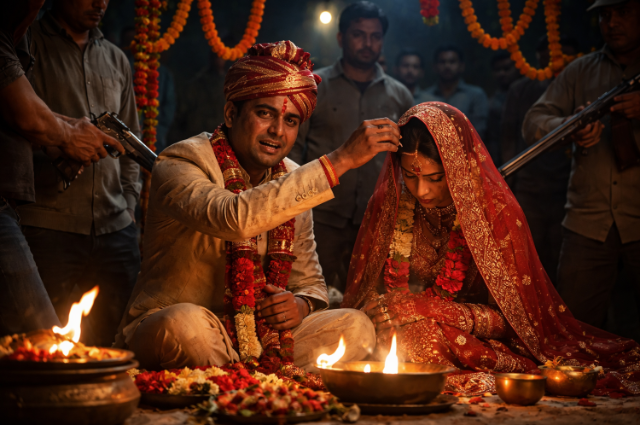
Marriage in India is often celebrated as a sacred union built on consent, family approval, and cultural rituals. However, in certain regions of western Bihar and eastern Uttar Pradesh, marriage has taken a darker and more coercive form. Known locally as Pakadwa Vivah (groom kidnapping), this practice involves bribing eligible bachelors and forcing them into marriage, often at gunpoint. While the practice may seem shocking or exaggerated to outsiders, Pakadwa Vivah is a documented social reality rooted in the economics of dowry, patriarchal social structures, and systemic inequality.
The Socio-Economic Roots of Pakadwa Vivah
The dowry system remains one of the strongest drivers of forced marriages in India, despite being illegal under the Dowry Prohibition Act of 1961. In regions where Pakadwa Vivah is prevalent, grooms with government jobs, engineering degrees, or medical professions are considered highly desirable and command extremely high dowries. Families often demand dowries ranging from ₹20 lakh to ₹1 crore, turning marriage into a financial transaction rather than a social or emotional bond.
For many families with daughters, such expectations are financially devastating. The pressure to secure a socially acceptable match pushes them into debt, land sales, or lifelong financial insecurity. In this context, kidnapping a groom becomes a cost-effective alternative. Families sometimes hire local criminal gangs to find suitable bachelors, paying a fraction of the demanded dowry. This transformation of marriage into an economic calculation reveals how deeply entrenched dowry culture is in these regions.
The Mechanics of Groom Kidnapping
Pakadwa Vivah typically follows a specific pattern. The targeted groom is often lured by someone he trusts—such as a friend, relative, or acquaintance—into a vulnerable situation. Once isolated, he is kidnapped and taken to a secret location. Victims frequently report physical assault, threats, and psychological intimidation to ensure compliance.
After being forced into submission, the groom is dressed in wedding attire and taken to the ceremony. The rituals are conducted at a rapid pace, often under armed guard. Viral videos circulating on social media platforms show grooms crying, trembling, and pleading while being forced to apply sindoor (vermilion) to the bride’s forehead—a symbolic act of marriage in Hindu culture. These ceremonies starkly contrast with traditional weddings, blending sacred rituals by forcing the groom.
Scale and Statistics of the Practice
Contrary to the perception that Pakadwa Vivah is rare, police and media reports suggest it has been widespread for decades. According to police data reported by multiple Indian news agencies, over 3,400 grooms were kidnapped for forced marriage in Bihar in 2017 alone. Similar figures were recorded in previous years, with approximately 3,070 cases in 2016, 3,000 in 2015, and 2,526 in 2014. On average, authorities reported nearly nine such kidnappings per day during peak marriage seasons.
The Tribune
Activists and researchers believe these numbers represent only reported cases, suggesting that the actual scale may be significantly higher. Many incidents go unreported due to social stigma, fear of retaliation, and informal settlements between families.
Why Many Victims Stay in Forced Marriages
One of the most complex aspects of Pakadwa Vivah is that many such marriages continue even after the initial bad treatment. Several social and psychological factors contribute to this phenomenon.
Firstly, social stigma plays a powerful role. A bride whose husband leaves after such a marriage faces intense societal judgment, reduced remarriage possibility, and lifelong labelling as “abandoned.” Families and community elders often pressure the groom to stay, framing departure as a moral failure that would “ruin” the woman’s life.
Secondly, emotional manipulation and guilt are used to discourage escape. Over time, victims may develop resignation or emotional adaptation similar to Stockholm Syndrome, where prolonged exposure to force leads to psychological acceptance of the situation. Additionally, practical barriers such as threats, fear of violence, and legal complexities further discourage victims from seeking annulment.
Legal Recognition and the 2023 Patna High Court Ruling
For decades, Pakadwa Vivah existed in a grey legal area. While kidnapping is a criminal offence, marriages performed through traditional rituals often face complicated legal challenges. Victims struggled to prove coercion, and courts sometimes treated the unions as valid due to the completion of rituals.
This changed in November 2023, when the Patna High Court delivered a landmark judgment declaring that marriages performed under pressure are legally void. The court ruled that forcibly applying sindoor or conducting rituals under threat does not constitute a valid marriage under Hindu law and emphasised that consent is a fundamental requirement for a lawful union.
The Times of India
This ruling provided kidnapped grooms with a legal pathway to annul such marriages and recognised them as victims of a crime rather than willing participants. However, legal recognition alone does not eliminate the social consequences of leaving such unions.
Pakadwa Vivah as a Reflection of Structural Inequality
Pakadwa Vivah is not merely a criminal act but a reflection of broader social and economic inequalities. It exposes the commodification of marriage, where human relationships are subordinated to financial and social status. The practice highlights the persistence of patriarchal norms, where women’s marriageability is tied to dowry, and men’s autonomy can be violated to maintain social order.
Moreover, the phenomenon reveals how informal justice systems and social customs can override formal law. Despite dowry being illegal and kidnapping being a criminal offence, community acceptance and weak enforcement have allowed Pakadwa Vivah to persist for decades.
The practice of Pakadwa Vivah challenges the romanticised narrative of Indian weddings. It demonstrates how tradition, economics, and patriarchy can converge to justify pressure and violence. While the 2023 Patna High Court ruling marks a significant step toward justice, societal change remains essential to dismantle the structures that sustain such practices.
Ending Pakadwa Vivah requires more than legal reform. It demands a fundamental shift in how society perceives dowry, consent, and marriage. Until marriage is recognised universally as a mutual choice rather than a financial transaction, the wedding where the groom is the hostage will remain a troubling reality.
References:-
- The Tribune. “Over 3,400 grooms abducted in 2017 for Pakadua Vivah in Bihar.”
- IndiaTimes / IANS reports on groom kidnapping statistics (2014–2017).
- The Indian Express. “Patna High Court sets aside 10-year-old forced marriage.”
- The Times of India. “Forcibly applying for a sindoor does not mean marriage: Patna High Court.”