
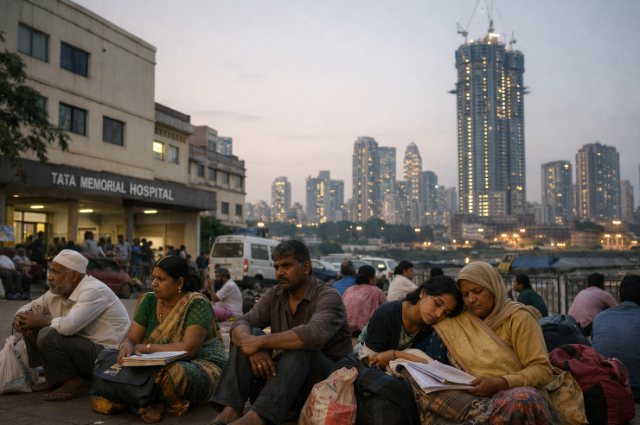
In January 2026, a 30-story Bihar Bhawan project worth ₹314.20 crore was approved by the Bihar Cabinet. The new high-rise building is planned to be built at the Elphinstone Estate area of the Mumbai Port Trust. It will be a 69-meter-tall building with facilities such as triple-basement parking, modern facilities, lodging facilities, and a dedicated dormitory for patients. "The basic aim of this initiative is to provide relief for the huge number of cancer patients coming from Bihar who are treated at Tata Memorial Hospital in Mumbai," the state government said. The project has faced widespread political and public protest — notably in Maharashtra.
On its face, the plan is sensible. Every year, thousands of Bihar’s cancer patients travel nearly 2,000 km to Mumbai for better cancer treatment. Many are from a lower economic background and find it extremely hard to secure cheap lodging near the hospital. Others have to make do with overcrowded rented rooms, and some sleep even on the pavements during long treatments. The proponents of the Bihar Bhawan claim that it would have a 240-bed dormitory to be used by patients and their attendants. They’re promising this dignity will be restored, that it’ll bring stability and relief in times of need. They also say that it is a human gesture and not a political one.
However, the real controversy is about the priorities involved. Spending over ₹314 crore to build a skyscraper in Mumbai is, in critics' views, an indirect statement of failure about the state of Bihar. They say that it would be better to invest that amount of money in constructing a first-rate cancer hospital in Patna or any other major city of the state. If the medical facilities in the state of Bihar were better, people would not have to go to other parts of the country for medical treatment. From this point of view, the Bhawan is not a solution; it is a symbol of the deficiency in medical services.
The magnitude of the project has fueled the critique. While the building will house 178 rooms for officials and guests, the patient dormitory will have 240 beds. Besides these, the building will also comprise a conference hall, a cafeteria, a medical room, and smart parking for over 200 vehicles. Some question the ratio of official accommodation to patient facilities. They wonder if the building is emerging as a high-rise guest house for bureaucrats rather than a welfare hostel for the poor. The government insists that the presence of a state in Mumbai necessitates administrative infrastructure and that such facilities are typical in all state Bhawans across India.
Regional politics in Maharashtra have added fuel to the controversy. Politicians from parties such as the Maharashtra Navnirman Sena and Shiv Sena (in its various incarnations) have been strong opponents of the project, demanding that the prime land in Mumbai be prioritised for local demands. They argue that there is an acute housing shortage in the city and open spaces are fast disappearing, so prime land should not be given away to build office space for another state government. They say that Mumbai is being looted as if it is common property, and this is yet another example of how Mumbai’s interests have been neglected. The tenor of the controversy has been incendiary, causing angry outbursts from politicians in Bihar who have firmly declared that they have a right to make investments as they deem fit.
The project’s supporters dismiss this regional argument entirely. They point out that there are already several other states that have Bhawans in Navi Mumbai, including Uttar Pradesh, Rajasthan, Karnataka, and several others. They say it is a case of cooperative federalism, with one state paying for construction and the other providing the land, both within constitutional provisions. The outrage, in their view, is political, not practical. They insist the building will not displace residents but will serve patients and bolster interstate relations.
This unfolding drama about Mumbai is also being played out with respect to Delhi. Bihar is all set to raze down and reconstruct Bihar Niwas in the national capital with an estimated cost of about ₹123 crore. The opposition parties claim the new system is rewriting political history, but the government says the old structure is outmoded and not suitable. Taken together, these projects create an impression of aggressive expansion of Bihar’s infrastructure outside the state. That broader context has increasingly fueled scepticism about spending choices and long-term vision.
Beyond the realm of politics, the project also involves emotional and symbolic concerns. For many in Bihar, a large and modern Bhawan in metropolises such as Delhi and Mumbai conveys a sense of visibility and pride, as if the state is stamping its authority at significant nodes of power. For its detractors, but pride is a poor substitute for performance, and the mark of progress would be reflected in fewer patients having to abandon Bihar for treatment. Building support networks outside the state should not take precedence over the consolidation of institutions within it.
The debate strikes a discordance between immediate relief and long-term reform. There is a need for accommodation in Mumbai today, and families are struggling now. Healthcare infrastructure in Bihar needs augmentation just as urgently. The Bhawan project inhabits the intersection of these two realities. Some see it as compassionate and overdue; others see it as costly and misguided.
When it is constructed, the building will be more than just concrete and steel. It will be a symbol of competing visions for governance, development, and responsibility. Whether it symbolizes welfare or misdirection will depend not just on how it plays out in Mumbai but also on how Bihar strengthens its systems back home. Until then, the outrage will stand as high as the tower itself.
References:
- https://www.indiatoday.in
- https://timesofindia.indiatimes.com
- https://www.thestatesman.com
- https://worldarchitecture.org
- https://www.thehansindia.com
- https://www.bhaskarenglish.in