
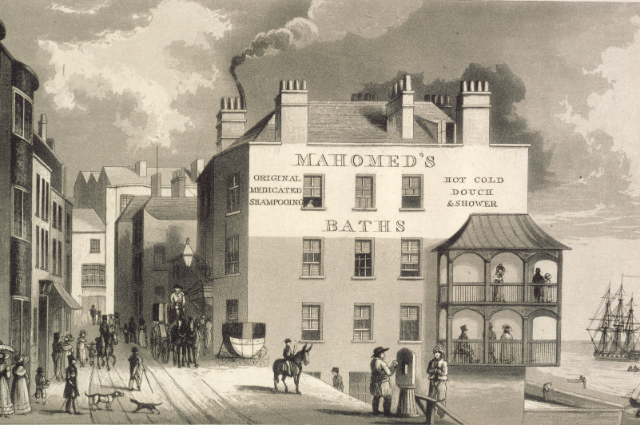
Shampoo is one of the most widely used household products. Shampoo removes dirt from your hair and leaves it soft and conditioned. Today, shampoo is a necessary part of everyday grooming. However, the term "shampoo" goes back several hundred years. The term originated in India as a Hindi word for massage and made its way to England over 250 years ago. Shampoo's history is tied directly to a single Indian immigrant who introduced British society to a traditional Indian custom.
The word shampoo finds its roots in the Hindi word champo, which means to press, knead, or massage. Thus, in the old days, shampooing was a massage, and not the liquid wash of the hair. The word shampoo came into the English language in 1762 when the British were in India. At that time, English people became aware of new customs and adopted new words from Indian languages to explain their experiences. Shampoo then evolved from a massage treatment to the hair-washing we know today.
Although this word became popular in Britain, the idea of washing hair had been around for thousands of years. In the Indus Valley, people used natural ingredients such as soapberries and Indian gooseberries (also known as amla) to make washes for their hair. Different parts of the world developed their own methods of hair care using locally available resources, so cleaning and maintaining hair were not a new concept. What is interesting here is that shampoo as an English word and its associated treatment began to take shape through the invention of an Indian entrepreneur named Sake Dean Mahomed.
Mahomed was born in Patna, India, in 1759. He served in the army of the British East India Company before going to Ireland with a friend and former commanding officer. He married Jane Daly and settled in Brighton, a seaside town in England that attracted wealthy visitors seeking health treatments. He had already tried his hand at business by opening the Hindustani Coffee House in London, said to be England’s first Indian restaurant. Although the restaurant failed, he continued to search for an opportunity to promote Indian culture into British society.
Mahomed and his wife opened a bathhouse in Brighton in 1815 with the name Mahomed's Steam and Vapour Sea Water Medicated Baths. They offered treatments inspired by Indian bathing and massage practices. The primary focus of this place was "shampooing", which was a combination of a massage using steam baths and scented oils. Shampooing was thought by Mahomed to be able to help with problems like rheumatism and joint stiffness. Mahomed introduced British bathers to a different perspective of bathing; one where massage and steam were essential elements.
At first, it was not easy to convince people to try it. The way people brushed their hair in Britain was very different from that of today, and some thought that washing their hair too frequently would make it fall out. There were also wigs and other ways to cover dirty hair, while powdered hair was in fashion. Mahomed had to convince his customers to try this new approach. He faced criticism and doubt, but he continued to market his services and gained fame for the results his clients reported.
The persistence of Mahomed soon led to acclaim. He was known as “Dr Brighton” and the shampooing surgeon for King George IV and King William IV. His treatments attracted well-to-do clients and helped shampooing to become fashionable in Brighton. Word spread outside the bathhouse, and the practice became associated with therapeutic bathing and massage. Mahomed’s work showed how a cultural practice introduced by an immigrant could affect life in another country, despite initial resistance.
But Mahomed did not invent bottled shampoo. It happened much later. Powdered shampoos date from the early 20th century and liquid shampoos from the end of the 1920s. Nevertheless, what Mahomed did was introduce and popularise the practice of shampooing in Britain. This also influenced the evolution of the English word. By the mid-nineteenth century, shampooing was connected with Victorian Turkish baths, where bathing and massage were combined. The word shampooing continued to change as hair cleaning became more associated with the treatment.
Mahomed died in Brighton in 1851, yet his influence can be seen in a word that is known throughout the world. His life exemplifies how language evolves through contact with, migration to, and daily existence. Words borrowed from other languages often take on new meanings as people use them to reflect their experiences. A Hindi word for press/massage developed into the English term for a popular hair care item.
The label on your shampoo bottle may appear common, but the term itself contains an interesting past. Shampoo's development was influenced by Indian massage methods, a Brighton bathhouse, and ultimately the modern bathroom. As it moved from culture to culture and generation to generation, shampoo demonstrates how much our language, English, has developed through the adoption of words and customs from other areas of the globe.
References:
- https://www.englishgrammar.org
- https://www.thehindu.com
- https://en.wikipedia.org
- https://malaysia.news.yahoo.com