
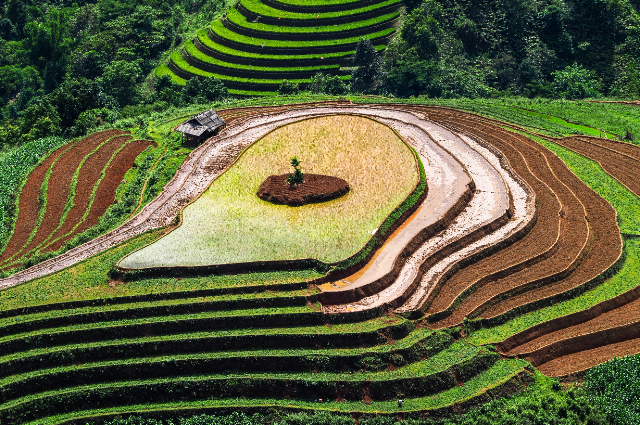
A peaceful farming community in northern Vietnam has become at the centre of controversy after plans for a $1.5 billion resort golf club run by the Trump Organisation were approved. What was touted as a project to boost tourism, attract foreign investment, and improve relations between Vietnam and the US left thousands of villagers without homes, land, or even the graves of their ancestors. Hung Yen province residents have seen the project as a reminder that economic development is not always light on the poor.
This development will consist of luxury villas, five-star hotels, commercial zones, parks, and championship golf courses. Eric Trump told journalists that the project would be “the envy of all of Asia.” Vietnamese officials have promoted it as an opportunity to create jobs, promote tourism, and attract foreign investment. But behind these promises lies a conflict between development and the rights of the local population.
More than 4,000 families in a farming and village-rich region of Hung Yen province will be affected. Families with generations of family on their land are asked to leave under government-approved compensation. Residents feel they will not have the opportunity to rebuild their lives in other parts of the country if the government makes these compensations. Farmers fear losing land on which their families have grown for decades.
One of the most emotionally charged parts of the project has been the relocation of ancestral graves. In Vietnam, the burial place of a family is very culturally and spiritually significant, and many Vietnamese people do not believe it is right to disturb the graves of their ancestors. As the project progresses, families have been forced to exhume the bodies of their parents, grandparents, and even great-grandparents to clear the land for the golf course.
Hoang Anh Xa of the area wondered why his family should move graves that are older than 1967, before Vietnam had begun its modern state. But another farmer, Tran Minh Hai, said the issue is more than land. “It is a spiritual thing,” he said, echoing the feelings of many villagers who see the project as an attack on their family history.
Already, the process of removal has transformed the appearance of village cemeteries. Graves have been opened, broken nameplates are scattered across the area, and many burial sites are marked with big paint strokes showing that the body has already been removed. For the elderly, it has been heartbreaking to watch as cemeteries disappear.
Many villagers say they had initially welcomed the news that agricultural land would be available, thinking that it would provide a boost to the region. But once they learned the exact terms of payment and the displacement of houses and graves, their support waned. Some residents say they only received a small amount for moving their family graves, and others say the money offered for farmland is well below market value. Nevertheless, many families refuse to move despite mounting pressure.
International media have also been commenting on the timing of the development. Some suggest Vietnam moved too quickly to approve the project while trying to improve its economic ties with the United States during trade talks. Vietnam was in danger of American tariffs increasing sharply on its exports, so maintaining good diplomatic relations was very important. Some reports also suggest the authorities moved too quickly to approve the project by cutting environmental reviews and shortening public consultation periods for the development. Officials deny this, and say the development is legal.
Rather than developing the hotel itself, the Trump Organisation has licensed its name to the resort through its Vietnam partner. But opponents contend that the development raises questions about the nature of business and diplomacy. While government officials view the resort as an expression of better relations with Washington, residents feel they are paying the price.
Yet despite the wrath of critics, construction continues. The Vietnamese claim that the project will benefit the wider economy through an increase in tourism, jobs, and investment. But many locals worry that these promises are empty words compared to the immediate loss of their homes, farmland, and family legacy.
The golf course was meant to give Hung Yen a relatively affordable asset for development, but infrastructure projects can be double-edged swords in many developing nations. This conflict is not simply about land, being compensated for it, and how those lives were obtained.
While construction nears completion to turn the countryside into a destination out of a film blanketing most villagers fight for what they feel can't be replaced with luxury. What was once a local land dispute has given way to something larger than themselves. Today it also represents the dilemma of how best to balance development with human dignity, and ensuring that economic progress does not come at any price of a community's historic contribution, its heritage, and its most profound cultural values.
References:
- https://www.golfindustry.asia
- https://thevietnamese.org
- https://sundayguardianlive.com
- https://www.jezebel.com