
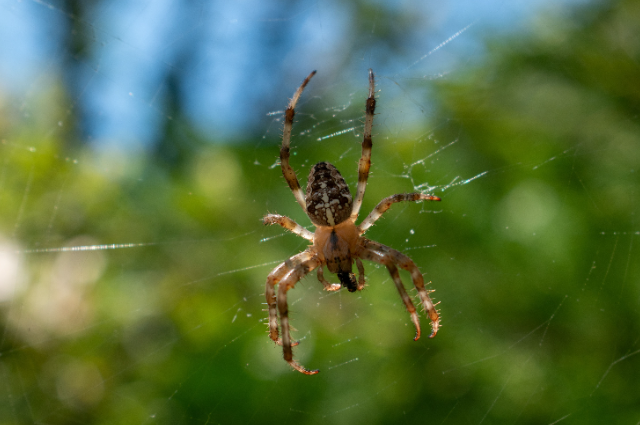
Many people jump, scream, or swat at spiders on the wall with their shoes. The fear doesn’t stop there. Even looking at a spider picture or envisioning spider proximity can trigger a fear response. This fear is so widespread that it has its own term: arachnophobia.
Messy, tangled webs are not ideal. Still, they have to be somewhat better than the unwelcome bug guests’ spiders help keep at bay, right? In fact, arachnophobia doesn’t just deter people from basements or clogged outdoor spaces. It can be crippling enough to prevent people from everyday activities or even whole sections of their homes.
Spiders may be creepy. Well, maybe not creepy. Spiders may look creepy. With their many eyes and speedy eight-legged appearances, they can be unsettling even in the best of lighting. Most of the unsettling reputation spiders built for themselves is due to the media, such as movies, social media, and stories of the mythical monster spiders. In fact, the majority of spiders actually have no desire to harm humans and are unlikely to be a threat.
Fear may originate from our evolution, according to some scientists. In prehistoric times, people could avoid venomous animals and therefore increase the likelihood of their survival. Caution towards creatures could have developed. This caution should have expanded to many insects. This instinct is a fear of venomous creatures like snakes or spiders. The vast majority of spiders, however, pose no threat to humans.
Most of the time, fear of creatures like spiders is one-sided. Usually, a spider's first instinct is to run from or hide from a human. This is because to a spider, a human is a giant, dangerous creature that could kill a spider with one movement.
Fear of spiders is irrational because spiders are pest eaters. The ecological balance of spiders as the top predators of small insects is really important to us. Without spiders, many insects could get out of control and spread disease.
Spiders help drive down the pest population. Spiders are even pests in a farm or a garden. This can help reduce the expensive process of pest control that involves using poisons to kill the insects.
Even outside of nature, spiders carry on their pest control jobs. Spiders eat the insects that humans don't want, like flies and ants. So spiders really help the population of household pests.
It is quite surprising that at present, spiders are very much a part of scientific and medical research. What we have found is that spider venom is a complex mixture of chemicals, which in turn has a great effect on spiders. While the venom does help spiders to catch their food, some of the components in it also have medical We have seen that in the tarantula’s venom, researchers have identified compounds that have been successful in blocking pain in the brain. In time, these may lead to new pain medication. Also, unlike opium-based pain killers, which are addictive and have very serious side effects, the spider-based pain remedies may be a better option.
Also in the medical field, researchers are looking at what other health issues spider venom may help out with -- epilepsy, heart conditions, cancer, and neurological diseases. Some of this is still in the early stage, but what we are seeing is that the animals we fear may, ay in fact, have the solutions to some of our most serious medical issues. Also, what is amazing about spiders is their silk.
While we think of spider webs as very delicate things, what we don’t know is that spider silk is one of the strongest natural substances out there. At the same time, it is very flexible and lightweight.
Due to these special properties, es scientists have studied the uses of spider silk in many industries. Scientists have utilised spider silk for sutures, implants, clothing, and sophisticated textiles. Certain experiments have even yielded spider silk-based materials that can absorb projectiles and are lighter than traditional body armour.
Spider silk could also be used to create biodegradable alternatives to plastic, resulting in the creation of less plastic waste. It is one of the most promising materials being studied today, because it is so strong, flexible, and sustainable.
Despite all these benefits, people still have a fear of spiders. But professional treatment can help very well for severe arachnophobia. Therapies such as CBT or exposure therapy help them learn how to face their fears gradually. Those in recovery often feel more confident in situations that would have caused them to panic.
The spider story teaches us that not everything is what it seems. The spider is the perfect protector of ecosystems, a predator of insects and a reservoir of scientific knowledge.
And the next time you see one pop out of a corner of your room or spin a web in your garden, try to look at it differently. Instead of an annoying stranger, we could think of it as a small, amazing animal helping to keep our world healthy and maybe even saving medicine. There are a few things so necessary to man and so terrible. The spider is one of nature's most misunderstood heroes.
References:
- https://hurak.com
- https://my.clevelandclinic.org
- https://www.greenpestmgmt.com
- https://imb.uq.edu.au
- https://exhibits.library.cornell.edu
- https://exhibits.library.cornell.edu