
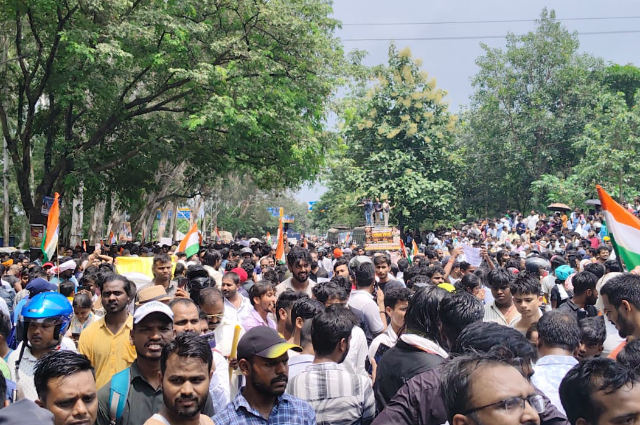
Nationwide attention has turned to Jharkhand as protests break out over a hunger strike initiated by student leaders and activists following alleged irregularities in state recruitment examinations. Among the prominent figures is 35-year-old student leader Devendra Nath Mahto, who has been at the forefront of the student agitation and whom supporters have likened to climate activist Sonam Wangchuk. The fast comes at a time when hundreds of candidates are demonstrating against recurring problems in recruitment exams conducted by the Jharkhand Public Service Commission (JPSC) and the Jharkhand Staff Selection Commission (JSSC).
Mahto launched his indefinite fast following weeks of rallies and sit-ins that failed to produce a concrete response from authorities. On the fourth day of his fast, Wangchuk spoke directly with him over a video call, urging him to drink water to prevent severe health complications. Heeding the activist's advice, Mahto agreed to take water and salt while maintaining his fast against the government's handling of the exams. Around the same time, five more protesters joined the hunger strike, drawing increased national attention to the movement. Mahto has spoken of a "now or never" moment for thousands of aspirants who have spent years preparing for government posts.
The latest wave of protests started shortly after the results of the 14th JPSC Civil Services Preliminary Examination were declared on July 5. Students claimed several irregularities were committed during the examination process. Demonstrators organized a 24-hour march on July 25 and held a 24-hour sit-in at Ranchi’s Jaipal Singh Munda Stadium on July 29. The protesters come from diverse academic backgrounds and have appeared for different recruitment tests, united by shared concerns over transparency and fair selection processes.
The protest grounds feature distinct stages, while another demonstrator is fasting separately near the statue of Jaipal Singh Munda. Three leaders of the Jharkhand Loktantrik Krantikari Morcha (JLKM) are fasting on one stage, while four other protesters are observing a hunger strike on a second stage.
Mahto has become the most visible face on one side of the protest. He is a member of the JLKM, a regional political party founded in 2024 by Jairam Kumar Mahato, more commonly known as "Tiger" Jairam Mahato. Two other members of the party joined Mahato on the fast. Because of his prominent role and determination to continue fasting, supporters began referring to him as "Sonam Wangchuk 2.0," drawing parallels to Wangchuk’s use of hunger strikes to rally public support for systemic reforms.
Mahto previously contested as an Independent from the Silli constituency in 2019, securing 1,445 votes, and had drawn over 1.32 lakh votes from the Ranchi Lok Sabha constituency during the 2019 parliamentary elections. He contested from Silli again under the JLKM banner in 2024, securing 41,725 votes. According to his party colleague Prem Naik, Mahto faces several pending criminal cases stemming from his long history of participating in student demonstrations.
Another group of hunger strikers has established a second stage at the venue. Rupesh Kumar Pal, 30, from Ranchi, stated that he has sat for roughly 14 to 15 exams since 2017. Fellow protester Habiba, 27, noted that she has appeared for nearly 15 to 20 recruitment tests in the same timeframe. Joining them on fast are 39-year-old Rahul Kranti of Lesliganj and 28-year-old Sabita Kumari of Ranchi.
Throughout the protest area, demonstrators have put up portraits of B.R. Ambedkar, Mahatma Gandhi, and Bhagat Singh, framing their fast as a peaceful movement for accountability and justice against administrative apathy. Meanwhile, Brahmanand Kumar Mahto of Ramgarh is conducting an indefinite fast near the Jaipal Singh Munda statue; despite enrolling in 2023 for a silkworm rearer position, he has yet to receive an active appointment.
Authorities have opened a probe through the Crime Investigation Department (CID). However, student groups initially resisted closed-door negotiations, insisting on open talks and concrete administrative actions.
In addition to independent student activists, members affiliated with political organisations—including the National Students’ Union of India (NSUI) and the Akhil Bharatiya Vidyarthi Parishad (ABVP)—have voiced support for the agitation. The ABVP has demanded a Central Bureau of Investigation (CBI) probe, the resignation of the state education leadership, and fast-track court proceedings to address the allegations of irregularities.
Despite receiving backing from various political quarters, organisers have repeatedly insisted that the movement remains non-political. Demonstrators at the stadium premises have consistently raised slogans emphasising student unity and warning political parties against co-opting their platform.
While the comparison to Sonam Wangchuk brought Mahto and the Ranchi fast into the national spotlight, the agitation reflects years of accumulated frustration among youth competing for limited state employment. With multiple hunger strikes active, official investigations underway, and political factions monitoring the situation closely, the coming days will determine how the administration resolves the students' core demands.
References:
- https://www.thehindu.com
- https://timesofindia.indiatimes.com
- https://www.indiatoday.in
- https://theprint.in