
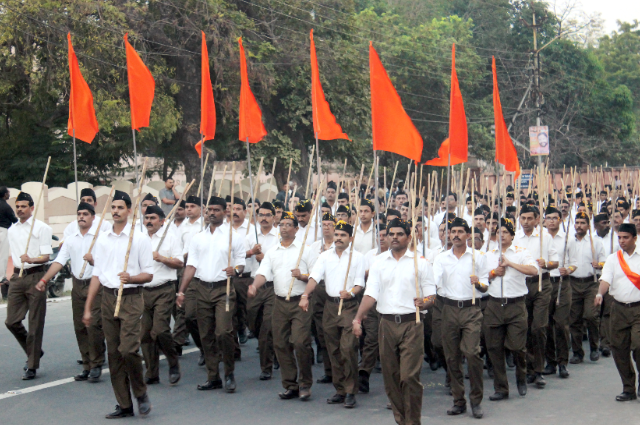
The Rashtriya Swayamsevak Sangh (RSS) considers the shakha the foundation of its organisation. The word shakha means “branch” in Hindi. It refers to a regular gathering where volunteers (swayamsevaks) engage in physical activity, games, singing, prayers and discussions. Founded by Dr Keshav Baliram Hedgewar in Nagpur in 1925, the RSS established the shakha system to foster discipline, character building and a sense of nationhood. Although the organisation has expanded into other parts of society, it still refers to the shakha as its main center of activity.
A typical shakha is one hour long, and generally held in an open area in the morning or evening. The shakhas are attended by adults, while activities in the evening are attended by students and children. The RSS claims that the meetings take place on a regular basis all year and start and end at specific times. Regular participation helps to foster discipline and social activities.
A shakha typically begins by saluting the saffron flag, known as the Bhagwa Dhwaj, which is the RSS’s guiding symbol. Thereafter, people run or exercise, such as Suryanamaskar (Yoga), or play some games. Some groups may also train with wooden sticks. The activities are designed to increase physical fitness, coordination, teamwork, and confidence. Participants wear ordinary, appropriate clothes for shakhas every day and a uniform for shakhas that are held for celebrations or formal events.
Games are an important part of the shakha ritual. Traditional games like kabaddi and kho-kho help to train people to cooperate, be alert and work together. In addition, the RSS plays games for group with names and themes associated with Indian history and national identity. Games like this help you protect a friend or help another participant. According to the RSS, these games encourage people to act together. Many games also express the RSS’s sense of patriotism and its ideas of India’s national identity.
In addition to exercise, there are also songs, Sanskrit verses and discussion. The members sing patriotic songs, recite short verses called subhashit, or engage in talk on current events or social issues. Such discussions serve to introduce the values of RSS and to stimulate participants to consider their roles in society. After the exercise session is completed, everyone stands in rows and salutes the flag while reciting the prayer, “Namaste Sada Vatsale Matrubhoome,” in praise of the motherland. Many commands and sections of the prayer are in Sanskrit.
The RSS says the purpose of a shakha is not just exercise and recreation. It is to train people to be disciplined, responsible, and willing to serve society. As new members become involved in the group, they may gradually be given small responsibilities and learn the ropes of o activities. Experienced volunteers will guide new participants, and some who become deeply involved will choose to work full-time for the organisation. These are known as pracharaks and may be posted to different parts of the country to support RSS activities.
Similarly, each shakha has its own structure. The karyavah of the shakha leads activities, while the mukhya shikshak leads physical training and games. There are also groups of volunteers, known as gats, led by an experienced volunteer, a gatanayak, who helps to lead and guide activities and give participants an opportunity to take responsibility. In these groups, RSS seeks to keep volunteers in regular contact and establish connections beyond the daily meeting.
Although shakhas are still the centre of the organization’s business, the RSS has evolved to accommodate different situations. In areas where volunteers cannot meet every day, there are also weekly shakhas. The RSS holds various kinds of online shakhas, including ones for IT professionals, lawyers, doctors, etc. The RSS also holds training camps and celebrates various festivals (eg., Vijayadashami, Raksha Bandhan, Makar Sankranti, etc.).
This explains why the RSS has a community presence. Regular meetings allow volunteers the opportunity to learn the customs and practices of the group and to develop relationships with members in other locations. The RSS takes the shakha system seriously and explains that it enables them to train people to work for social welfare and the nation; but its emphasis on Hindu cultural identity and nationalism has made its ideology an interesting part of public debate.
The shakha is really a place to play games, to practice self-discipline, to pray, to chat, and work together with others. The RSS uses the shakha to create a support base, to recruit committed members, and to teach its worldview to the next generation. A study of the shakha reveals how the RSS gradually extends its operations into new locales and how it begins to shift the outlook of its members.
References:
- https://joinrss.com
- https://rssfacts.org
- https://www.rss.org
- https://e-pao.net
- https://organiser.org
- https://www.britannica.com