
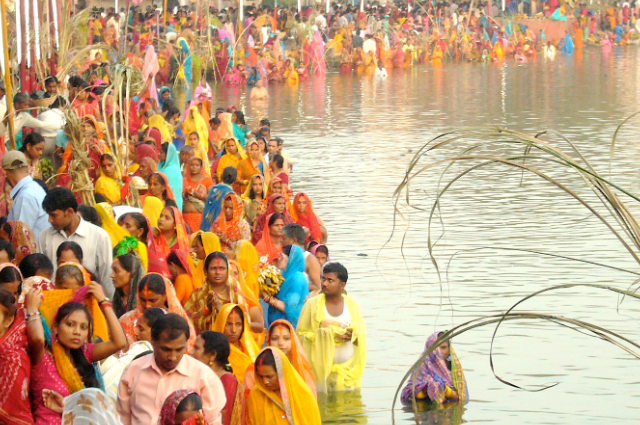
Thousands of devotees flock to rivers, ponds, and other water bodies in India every year for Chhath Puja. Devotees gather for four days to worship the Sun God and Chhathi Maiya and stand in water to offer prayers. However, with celebrations underway in Delhi, one question kept cropping up: how clean are the rivers in which these rituals are performed? The festival also brought to light the problems faced by India’s rivers as devotees bathed in the polluted Yamuna.
The Chhath Puja is mainly celebrated in Bihar, Jharkhand, and eastern parts of Uttar Pradesh, but communities in other parts of India also celebrate the festival. It starts with Nahay-Khay, where devotees take a ritual bath and cook for themselves as per hygiene regulations. After Kharna comes fasting and offering things like jaggery kheer and wheat rotis. They then fast for 36 hours, taking no food or drink. They collect near the water bodies and offer Arghya to the setting and rising sun in the last two days.
Cleanliness also features heavily in these festivities. The devotees wash all their utensils and prepare their food in a clean area. Also, their hands and feet are cleaned before the celebrations. In most villages, residents have come together to clean plastic, weeds, and trash from riverbanks and ponds. They create paths, erect temporary steps, and decorate the ghats with flowers and banana plants.
Yet the conditions of the water can be very different from the cleanliness expected during the rituals. This is the case in Delhi, where hundreds of people gathered on the Yamuna River for Chhath Puja in November 2026. Despite efforts to cleanse the riverfront, many were seen sitting in untreated sewage, industrial waste, and other pollutants.
The Yamuna was also a political issue. MP Manoj Tiwari took a dip in the river at Sonia Vihar and lauded the work of Delhi Chief Minister Rekha Gupta in cleaning the river, while MLA Kuldeep Kumar of AAP challenged him to bathe at Kalindi Kunj, where the water was more polluted. The matter became a political issue during the festival.
A video of dead fish near Sonia Vihar went viral on social media. Delhi ministers accused AAP workers of putting the dead fish in the river to create a false impression of pollution. AAP leaders rejected the charge and demanded a probe. These claims were debatable, as no water samples had been taken to ascertain the cause. The incident showed how the state of the river had become a political issue, but the real quality of the water was yet to be measured.
But the Yamuna is not the only river that is facing challenges. The Ganga, which is also linked to religion and daily life, has also been targeted for clean-up efforts. India launched the Namami Gange program in 2014 to clean up and rejuvenate the health of the river. The goal is to construct sewage treatment plants, stop untreated wastewater from reaching the river, and better manage industrial waste.
But new findings indicate that the job is far from done. In November 2026, a Bloomberg article examined satellite images and water samples from various points along the Ganga. It said water clarity had not improved in much of the river and some samples had levels of pollutants above the permitted limits. These problems were attributed to untreated sewage, industrial effluent and weak enforcement.
The government said there were improvements over the entire length of the river, not just in a few samples. The government said it was due to new sewage treatment works and upgrades in Haridwar and Kanpur. The government said industrial compliance in the Ganga basin had improved between 2017 and 2025 but admitted some pollution continued in some areas and efforts must continue.
This is more than simply cleaning rivers for festivals; it means cleaning river banks. Sewage treatment plants have to function. Industrial waste must be monitored. Local authorities must ensure that untreated wastewater does not enter rivers. This requires a working partnership between government, industry, and Communities. “The treatment plants built under Namami Ganga projects have proved their worth. But they won’t work in the long run without constant enforcement and maintenance.
Chhath Puja links religious rituals with the environment and provides us with multiple ideas on how to do it. For example, in Sajhauti, Bihar, the people of the village jointly clean the river banks and ghats to prepare for the festival. But the setting shows that they are also conserving the shared water body. The community alone cannot clean the lily pads to improve the river water quality.
At Chhath Puja, the crowds at the Yamuna also spoke of the difference between worshipping and protecting a river. Rivers are places of worship, livelihood, and a vital natural resource for millions of people. The biggest mistake is to think that people should worship and clean the rivers and other water bodies only during the religious festivals. Throughout the year, it is important to keep the same care and respect for the rivers and other water bodies. Then we will really take care of rivers, like people take care of worshipping rivers during festivals.
References:
- https://en.wikipedia.org
- https://timesofindia.indiatimes.com
- https://www.indiawaterportal.org
- https://www.thehindu.com
- https://www.telegraphindia.com
- https://www.ifc.org