
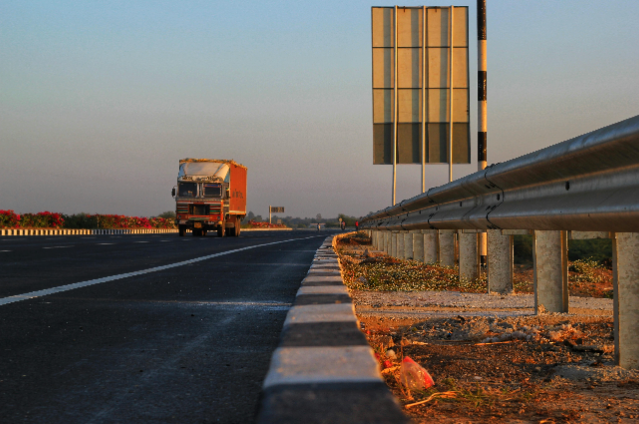
If you have ever driven on an Indian highway, it is a safe bet you have seen “Horn OK Please” painted on the back of trucks. For decades, this phrase, like the trucks themselves, was ubiquitous. It was a definitive aspect of road culture. Despite this, many people still wonder what it means.
To many foreign visitors, the phrase may look peculiar. In many countries, a horn should only be sounded in an emergency. In India, it is different. Sounds of the horn have always been part of the driving ritual. Traditionally, they were used to make a presence known, to warn, and to signal. Within these confines, “Horn OK Please” painted on trucks was a safety phrase and a road culture symbol that blended seamlessly with the actual road rituals.
The phrase is really a shortened version of “Horn Please.” Indian highways used to be very narrow, congested, and in a poor state of maintenance and repair. On top of that, trucks had poor rear visibility and were heavily laden. Because of these constraints, the phrase suggested that drivers should inform the truck in advance that they were overtaking, as the truck would not have the means to check.
The phrase “OK” is shrouded in an enigma that has given rise to several theories. One describes it as signifying “overtaking ok” and hypothesises that older trucks had small lights to indicate such a thing. Another claims it originated in wartime when people drove and ‘skimped’ on gas with ‘On Kerosene’. A third proposed that it originated in advertising from an ‘OK’ detergent. These and other theories are examples of explainable stories that help to keep the phrase in the public discourse. The continuous absence of an answer to the origin of “OK” is likely why it has been so difficult to eliminate from conversation.
Eventually, the meaning transcended instructions. The phrase solidified itself as iconic truck art and highway culture. Movies, songs, and the memories of many road trips helped cement its place in popular culture. The artistry and decoration that was done to trucks in India was not done for utility; it was to express, and was almost like moving folk art. The artistry that was done on trucks in India displayed many vibrant colours and painted many different things, like deities. What became a slogan was easily integrated and appreciated by even people who had no prior knowledge of the meaning of the slogan. “Horn OK Please” was a nationwide visual tradition.
Social aspects were included. Truckers often spent weeks on end out of town and on the road. Trucks became homes, identities, and personalities all in one. Painted phrases included many different aspects of life, including pride, survival, and superstition. Among truckers, “Horn OK Please” was a slogan and a reminder in the coded language of long-distance trucking. This slogan meant you needed to use the horn if you were to pass.
A lot of things have changed since that time. Road systems have been developed, and vehicles improved. New vehicles have things like rear-facing cameras, sensors, and improved mirrors. Roads have many regulated and predictable lanes. Today, driving systems are a result of developments in road and vehicular systems. The old systems of sound communication have changed to be systems of visibility. Driving today is governed by systems and structures of infrastructure.
Even with the advancements, there has been an increase in noise pollution. Evidence shows that in many cities, the noise from traffic exceeds safe levels. This has increased the risk of stress, sleep issues, cardiovascular strain, hearing damage, and all the other ailing symptoms caused by slower traffic. This problem has caused almost continuous honking in urban traffic, which is supposed to be sound communication with the environment.
There has been a gradual transformation of the perception of sound communication. Older honking styles were seen as interactive systems, but recently have become almost anonymous systems of sound communication. That change in meaning is part of why phrases like “Horn OK Please” now feel out of place in modern traffic discourse.
As the public became aware, authorities began to stop unnecessary honking. In 2015, Maharashtra banned the phrase ‘noise’ from the horns of commercial vehicles, citing how it encouraged excess horn usage. It was not just words but also behaviour: a constant reminder that loudening is okay can be reinforced even when conditions no longer call for it. Similar campaigns took place in other regions to create “no honking” zones, silent corridors, and awareness campaigns at traffic signals.
Despite these efforts, enforcement is uneven. On many of the highways, especially outside of the big cities, drivers continue to use their horns as a default communication channel, either out of habit or to avoid unpredictable traffic conditions. The improvements are real, but behavioural change takes more time than road construction.
Nowadays, the phrase “Horn OK Please” is slowly disappearing from new cars, but it remains on older trucks and on the backs of people on rural roads. For some drivers, it is a custom passed down through generations that connects them to life on the road, and for others, it is merely an aesthetically pleasing thing to pass by.
Its story is an illustration of how transport and society are evolving unceasingly. What was a warning sign about unsafe roads quickly became a cultural symbol, then a brand identity for an entire profession, and now fades under modern rules.
And maybe that’s what makes this so interesting. It’s not just about a phrase on a truck; it’s about how communication changes when roads, machines, and people all move at different speeds.
References:
- https://www.etvbharat.com
- https://awaaz.org
- https://timesofindia.indiatimes.com
- https://www.forbesindia.com
- https://en.wikipedia.org