
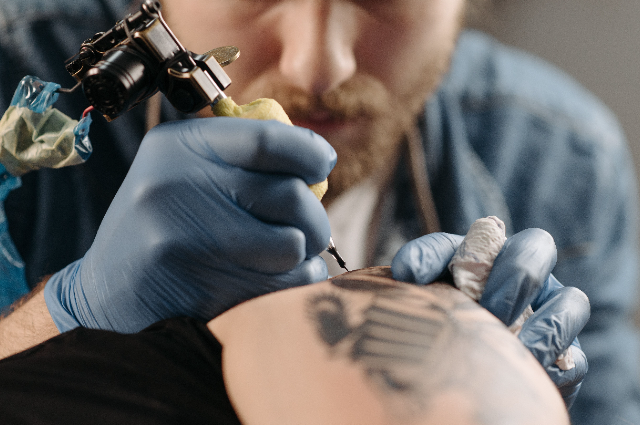
Samuel F. O’Reilly changed the world of tattooing in 1891 by making an invention inspired by one of Thomas Edison’s forgotten machines. Edison had created an electric pen for copying, but it was never popular. But O’Reilly saw something that no one else had seen: the pen’s fast needle movement could be used to push ink into the human skin. Changing Edison’s design and creating a machine made specifically for tattooing, O’Reilly transformed a failed invention into a device that changed tattooing forever.
Samuel O’Reilly was born in 1854 in Connecticut to poor Irish immigrants. His early life was difficult. As a teenager, he and two friends were arrested for burglary and sentenced to two years of hard labour. He was released and joined the United States Navy. O’Reilly’s time in the Navy was brief, and reports varied about whether he completed his service or left early. But his time with sailors introduced him to the tattoo culture of the Navy.
During the nineteenth century, sailors in particular were more likely to have tattoos. Many had tattoos that represented their travels, friends, beliefs, or experiences on board ships. Tattoos became an integral part of sailor life, although outside these communities, some thought of them negatively. O’Reilly turned aside the stigma and studied tattooing as an art. He learned the skill and began working as a tattoo artist. In 1888, he opened his own tattoo shop in New York City.
Around the same time, Thomas Edison had created a machine that would surprise O’Reilly. In 1875, Edison invented the electric pen, which he patented the next year. The electric pen helped people make multiple copies of their writing and drawings by punching small holes into a stencil using a rapidly moving needle, then inking the design onto another sheet of paper.
The electric pen did not work as a writing tool and was soon forgotten. But O’Reilly liked the machine for something completely different. He loved its very fast-moving needle. He wanted to use it to puncture skin and put ink underneath.
At that time, tattooing was done by hand. Artists pushed needles into the skin several times to create a tattoo design, making it slow and laborious. But O’Reilly felt that tattooing could be made much quicker and more flexible with an electric machine. He started applying Edison’s ideas for his own work.
O’Reilly made several significant changes to the electric pen. He increased the strength of the pen for tattooing, added an ink reservoir, and made it work with multiple needles. Edison’s original pen was designed for paper, not human skin, and O’Reilly’s design was designed specifically to put ink on the skin and make tattooing faster and easier.
O’Reilly received a patent for what was essentially a tattooing machine on December 8, 1891. He quickly gained attention, and tattoo fans began to seek him out for tattoos. The machine allowed the tattooist to work much faster than with their hands and increased the accuracy of tattoo designs.
O’Reilly also had a strange connection to Edison when he invented the machine. O'Reilly knew that Edison's electric pen had inspired his machine, but he had changed the design enough that his tattoo machine was considered a different invention. This became important when it was asked who should be credited for the machine.
O’Reilly’s former friend and rival, Elmer E. Getchell, also claimed his tattoo machine and supported Edison during the dispute. The matter eventually reached federal court, where the judge found that O’Reilly’s invention differed from Edison’s original electric pen based on features like the ink reservoir, and O’Reilly was allowed to keep his claim to the tattoo machine.
O’Reilly’s invention did not stop there. He became a well-known tattoo artist, sometimes called Professor O’Reilly. He tattooed sailors, workers, and wealthy clients, including members of high society. By the 1890s, tattooing had begun to move beyond the traditional associations with sailors and soldiers, and O’Reilly helped to spread the practice.
His machine became one of the first modern tattooing machines. The concept of the electric tattoo machine became the basis for later designs that tended to make tattooing much quicker and more precise than hand application. What had failed as a piece of office equipment had been given a second chance.
Samuel O’Reilly’s story is more complicated than simply saying that he stole Edison’s invention. He took Edison’s electric pen as inspiration, but he changed the machine and made a new design for a completely different purpose. Edison created the technology that caught O’Reilly’s attention, but O’Reilly saw its potential for tattooing and turned that idea into a patented machine.
What began with a struggling young man, a short Navy career, and an interest in sailor tattoos eventually became a major change in body art. O’Reilly took a forgotten machine, gave it a new purpose, and helped create the technology behind tattoo machines used for generations. His story shows that sometimes an invention does not need to be completely new to change the world. Sometimes, all it needs is someone who can see what it could become.
References:
- https://www.coffeeordie.com/article/sailor-edison-tattoo
- https://www.atlantictattooremoval.com/history-of-tattoos/
- https://www.nyhistory.org/blogs/edison-and-the-tattoo
- https://www.huffpost.com