
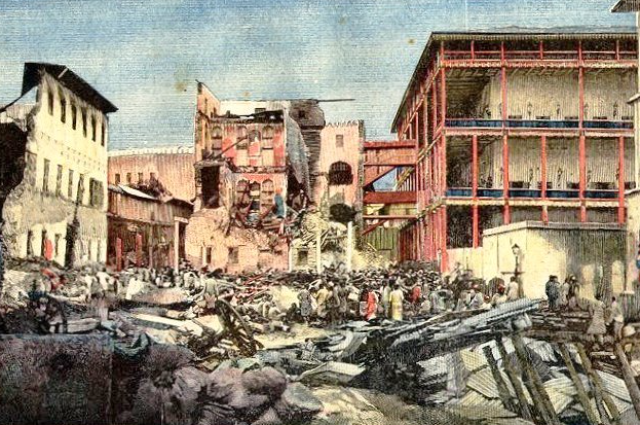
Most wars rage for months or years, but the Anglo-Zanzibar War of August 27th, 1896, was over in 38 minutes. The war began when Sultan Khalid bin Barghash seized the Zanzibar throne without British permission. As he was not British and Britain did not recognise him, they demanded that he leave the palace. He refused, and British warships destroyed much of the palace and forced Khalid to flee. The real story of this war lay in Britain's determination to rule Zanzibar and decide who would be its next emperor.
In the late 19th century, Zanzibar, a small island-sultanate off the east coast of Africa (present-day Tanzania), served as a trading and political hub for European nations fighting for influence in East Africa. In 1890, Britain and Germany made the Heligoland-Zanzibar Treaty, which allowed Britain to exert more influence in the region. With the Treaty, Zanzibar became a British protectorate with its own sultan and government, but without freedom.
The British were also interested in choosing Zanzibar’s ruler. According to the protectorate, any new sultan would have to gain British approval. British leaders also wanted to end slavery and change the administrative structure on the island. All of these factors created tensions between people whose wealth and social standing depended on the current system. The sultanate remained, but its ruler could no longer make important decisions without considering Britain’s demands.
The succession crisis began on August 25, 1896, when Sultan Hamad bin Thuwaini suddenly died. Hamad was a close friend of Britain, and his sudden death was a concern for colonial authorities. They hoped that Hamoud bin Mohammed would succeed him and help the British achieve their objectives, such as abolishing slavery.
But Hamad’s cousin, Khalid bin Barghash, claimed the throne quickly. He occupied the palace and declared himself sultan without the British’s approval. Khalid had tried to claim the throne once, but the British forced him to relent. This time he refused to relent and challenged the British monarchy and their plans for Zanzibar.
The dispute over which prince deserved to be on the throne was not just one of status quo. Britain also wanted a leader who accepted its influence and would support its policies. Khalid’s autonomy threatened that arrangement. By refusing to recognise him, Britain showed that the sultan needed approval from the imperial power holding the protectorate.
In the midst of the dispute, Khalid amassed around 2,800 supporters, including palace guards, soldiers and civilians. He positioned artillery around the palace and took command of the armed royal yacht, Glasgow. The palace became the focus of his resistance as his forces prepared for a possible attack by the British.
Some Royal Navy warships sailed into Zanzibar’s harbour, including the cruisers HMS St George and HMS Racoon and the gunboats HMS Thrush and HMS Sparrow. British sailors and marines were supported by Zanzibari troops loyal to the British-backed administration. Rear-Admiral Harry Rawson led the naval forces, while British consul Basil Cave demanded Khalid’s surrender.
After receiving approval from the British government, Cave started fighting. When approval arrived, the British issued an ultimatum to Khalid. The latter had to leave the palace and hand over his weapons by 9 a.m. on August 27. Khalid believed that the British would not attack. Around 8:30 a.m., he got a message from the palace saying he would not lower his flag. Cave threatened that if Khalid didn’t obey, British forces would open fire on Khalid.
The clock had run out at 9 a.m. The British started their bombardment around 9:02 am. Their shells decimated the Zanzibari army and set the mostly wooden palace on fire. Even the royal yacht Glasgow fired at a British warship but soon sank. Khalid lost his life under heavy fire from British ships.
The bombardment ended around 9:40 a.m., giving the war a total length of 38 minutes. Around 500 Zanzibaris were killed or wounded, and one British sailor was seriously injured. Khalid escaped to the German consulate before leaving Zanzibar for German-controlled East Africa.
By late afternoon, Hamoud bin Mohammed had been installed as sultan. He complied with British demands and ran his country much less independently than he had in the past. Britain had achieved its immediate objective: remove a ruler who questioned its authority and replace him with someone more willing to cooperate.
The Anglo-Zanzibar War is widely considered to be the shortest recorded conflict in history, with some reporting it as 40 or 45 minutes long. But the war’s significance goes well beyond its short duration. The British refusal to accept Sultan Khalid revealed the shackles on Zanzibar’s political freedoms under the protectorate. The battle showed how Britain used force to determine who would rule and how that ruler would rule.
References:
- https://www.britannica.com
- https://www.historic-uk.com
- https://en.wikipedia.org
- https://www.historytoday.com