
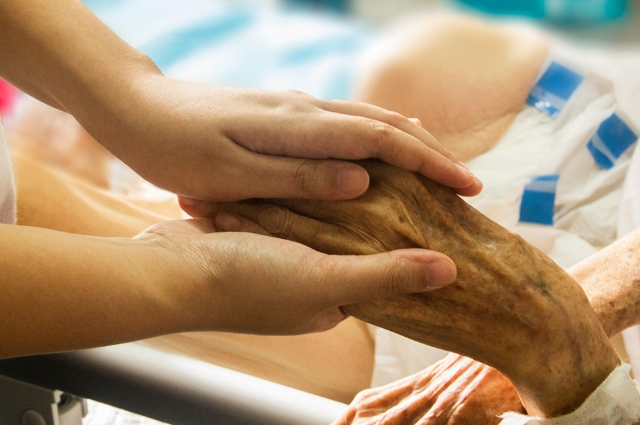
Image by 🆓 Use at your Ease 👌🏼 from Pixabay
Living a dignified life is the goal of most people, while dying peacefully is the ultimate desire. Still, humans aren’t capable of predicting their journey, events, time and circumstances of life and death. Right to live a dignified life is assured and backed by our constitution as well through its fundamental rights, law and order and judicial systems. But is living a dignified life enough?
The upward and linear curve of our lives can become a U-curve at any point in time, when everything can come to a standstill. One can make sure through grit and with the help of the law to ensure a dignified life, but what if someone is left on the mercy of others, vegetative, unconscious, or terminally ill? The life support system will artificially pump the lungs, which will keep the zigzags of ECG machines going, but your brain is in oblivion, and there is practically no scope for treatment. This is where the right to die with dignity emerges in the form of Euthanasia.
What does the Constitution say?
Among our fundamental rights, one of the most significant is Article 21 – Right to Life, which ensures a dignified life for an individual, whether a national or a foreign national living in India. One such fundamental right that remains firm in all circumstances, even when a national emergency is declared, and other rights are abridged by the government in pursuit of national interest. But this one, it stays, protects the individual from state action, legal procedures and any type of injustice.
In its implicit meaning, it covers many other rights as propounded by our honourable Supreme Court with every succeeding verdict. Hence, the right to life implicitly also ensures, for instance, the right to clean air, the right to privacy, the right to information and the right to die with dignity, which is intrinsic in today’s world.
The right to live is also followed by the right to die with dignity.
Commenced under the famous Aruna Shanbaug case in 2011, where the Supreme Court of India for the first time recognized Passive euthanasia in India for those patients whose treatment is not possible in medical science. The right to die with dignity was recognised in the landmark Common Cause v. Union of India 2018, which also provided a living will, where an individual can create directives for their medical preferences if they are incapacitated in future. In the same case, the procedure for passive euthanasia, which was quite cumbersome earlier, was simplified. earlier it needed approval from medical experts in addition to judicial magistrates, later on in 2023 it was modified to make it simpler, and now it does not include approval from a judicial magistrate.
WHAT IS PASSIVE EUTHANSIA?
Passive euthanasia is a legal way to end the suffering of a patient who is physically or mentally disabled or in a vegetative state, completely dependent on others, and has no chance for treatment in medical science. For the meaning of the word “passive”, it means withholding/withdrawing life support, whereas, on the contrary, in ACTIVE it includes direct intervention like lethal injection. As far as India is concerned, India allowed Passive Euthanasia in 2011 in a landmark case called the ARUNA SHANBAUG case.
WHAT IS THE ARUNA SHANBAUG CASE?
Aruna Shanbaug was a young nurse at King Edward’s hospital in Mumbai, a victim of sexual assault, unfortunate in her life for the trauma she faced on herself and on the legal front. Although this landmark case, filed by activist Pinki Virani in 2011, led to the development of Passive Euthanasia in India, she herself could not get the chance to utilise it.
In her story, a janitor of the same hospital, Sohanlal Bhartha Valmiki, sexually assaulted her. As she remained in the hostel of the same hospital, she was in dismal condition 12 hours after the incident in the basement of the hospital, with a dog chained around her neck, filled with blood, and almost unconscious. Soon she was declared incurable with brain stem contusion, cervical cord injury and cortical blindness due to lack of supply of oxygen (It is a condition in which she could technically “see”, but her brain could not register images).
The worst parts of her case were that the culprit was never accused of rape, as it was sodomy. He was accused of attempted murder and theft (ran away with her watch and earrings). Other than this, Sohanlal further accused her of imparting discrimination on him based on caste, and he justified his act as revenge.
After taking care of her for some years, her sisters and brothers, nearly 8 in number, started distancing themselves from her, as they were not willing to take her with them to their houses, so she was abandoned in the hospital, where she was taken care of by the hospital staff itself. An activist and journalist, Pinki Virali, filed a case in 2011 to end her suffering and demanded passive euthanasia. Although the court allowed Passive Euthanasia after a team of experts declared her incurable and in a vegetative state, the implementation required consent from parents, spouse or other close relatives; in the absence of any of these, the by a “next friend”. In the case of Aruna Shanbaug, the court declared the KEM hospital staff as the next friend, and not Pinki Virali. The hospital did not want her treatment to end, so they declined passive euthanasia for her.
Hence, passive euthanasia was not the end of her suffering; she died in 2015 due to Pneumonia after 42 years of remaining in a vegetative state.
Therefore, the Harish Rana case turned out to be the first passive euthanasia case in India after so many years of making it legal. He was bedridden for more than a decade after a fatal accident, backed by his family, who nursed him for 13 years with no improvement in his condition. He was given a farewell by his close allies.
So far as our country is concerned, for procedural issues, like medical boards, some states have taken the initiative, like Goa, Karnataka and Maharashtra, and a few other like Odisha, are taking steps in compliance with the directives of common cause.
The future of euthanasia is in the hands of medical science.
The SC in the Harish Rana case have proved its proficiency in delivering justice to the terminally ill, and now the future path needs to be brightened up by the medical experts, who have been in a dilemma for multiple concerns related to euthanasia in India. In a country where doctors are considered God, it is difficult for them to decide on ending the treatment and leaving the patient as such; they can now practically and efficiently make decisions for the future of such patients. Though medical sciences have evolved at a wider and faster pace to benefit humans in multiple disabilities and diseases, there remain some constraints to what doctors or their sciences can do for prevention and cure. By understanding and remembering such constraints, the forces of nature should be let loose on such patients rather than artificially pursuing the longevity of their suffering.
Another imperative role rests with the administration and judiciary to avoid the misuse of this law, and prevent it from turning into a legal way of attempting murders under the guise of euthanasia, and patients are generally deprived of treatments. The procedure for this need not be oversimplified for misuse and maintain its sanctity.
Euthanasia around the world
In the world, there are only a few countries that have legalised assisted dying, like Canada, Australia, New Zealand, Spain, Switzerland, Belgium, Luxembourg and Austria. In the US, 10 states have legalised the practice, including Washington. Oregon was one of the first to offer this in 1997, and on the model of Oregon, the US model of assisted dying has been framed. Since 1997, in Oregon, more than 4000 people have received a prescription for a lethal dose of medication, which means they follow the idea of active euthanasia.
Switzerland was the first country in the world to establish the principle of the right to die in 1942, with the assistance of organisations like Dignitas, which also follows self-administered lethal medication. Netherland and Belgium are the only European countries to have allowed this to children.
While many countries have already implemented assisted dying in their law, many are still in the pipeline, like the UK and Wales, where the bill was presented in 2024, approved by the House of commons and remains in house of Lords.