
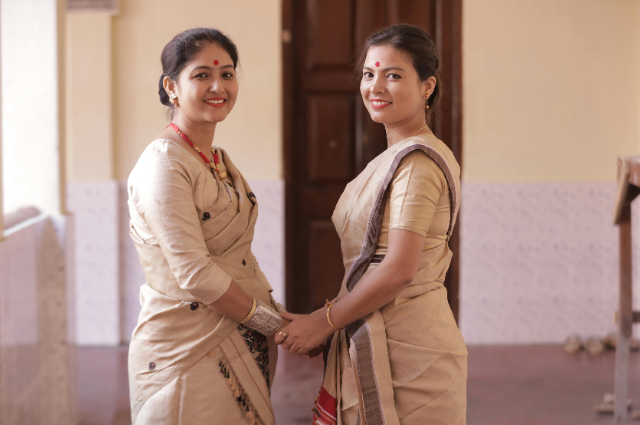
“There is no force equal to a woman determined to rise.” - W.E.B. Dubios
What does it mean to be empowered? In modern changing times, we often come across the idea of women's empowerment, but what does it mean to be a woman and be empowered?
The foundation of this idea lies behind a simple fact that women need to be empowered. In a traditionally male chauvinist society, a woman who wants to outshine needs validation and huge courage to empower herself. Empowerment for women is often visualised in qualifications, big fancy corporate boardroom jobs, classic formal suits, beauty standards, fancy bags and bold confident expressions.
India has a history of women who chose to fight for their rights and freedom and stood against the evils of society. There is a centuries-old tradition of suppression of women in India since the later Vedic ages, and the tendency of women to keep rising till they get wherever they determine to.
When British rule started in India, the condition of women in India was deplorable. Polygamy, illiteracy, child marriage, poor healthcare, sati pratha, pardah system. They spent most of their lives living under their veils; it wasn’t just the pallu of their saree, but a wall between their dismal lives and brighter futures that shine on the other side of the wall, and the wall they could not easily surmount.
Here is the story of some empowered Indian women from different states who were courageous enough to become examples for others.
RUKHMABAI RAUT
It was before independence, when child marriage was a norm in India, not being immune to it, RUKHMBAI was married at the age of 11 to a 19 year old man Dadaaji Bhikaji, but as the time came for her to live with her husband, she rather chose to fight a legal battle over “restitution of conjugal rights”, where she was threatened either to live with her husband or she may end up in jail, and she wisely chose the latter. In her legal battle and relentless struggle, when her case received global attention, her marriage was dissolved, and the Age of Consent Act of 1891 was passed, which raised the legal age for women.
BHURI BAI
The first tribal woman who dared to take traditional Pithora paintings beyond the walls of the huts to big canvases is Bhuri Bai. Girls in her village, after achieving puberty, were deemed to be “impure” to receive the blessings of their deity, Lord Pithora, which was only the man’s prerogative. But her instincts made way for her when she met famous artist Jagdish Swaminathan, who suggested to her to paint on a sheet of paper. Her contemporary themes converted the traditional and ritualistic Bhil Pithora paintings into contemporary Bhil. Presently, she works as an artist with Adivasi Lok Kala Academy in Bhopal, Madhya Pradesh. Her artwork is displayed in museums worldwide, and she has been honoured with many awards by the state government and the Padma Shree in 2021.
BIRUBALA RABHA
There is no denying the fact that since independence, India has broken many odds which has been restricting our growth, but some of them still persist; one such activity is witchcraft. And a woman fighting against this menace in Assam is honoured with the Padam Shree award for saving 35 lives; she is Birubala Rabha. In 1985, her son, who was suffering from some mental disease, was branded as a witch, and the quack said he would die in three days. But her son survived, and Birubala’s hope was ignited after this. She pledged to raise her voice against it. After her initiative, the Assam government also passed the Prevention of and Protection from Witch Hunting Act, 2015, in which she played a pivotal role. Plunged inside the huge walls of patriarchy, whose walls demean the women who speak out, Birubala conquered the walls by breaking bricks each day, and her resilience made her invincible.
RAJNI BECTOR
There is a usual timeline that we consider ideal for girls. But this woman, who was married at 17, graduated after her marriage, sets an example that there is no timeline for achieving our greater goals. None other than the business tycoon, Mrs Rajni Bector, the owner of Cremica, bagged the Padma Shree award and made her city, Ludhiana, Punjab and womanhood proud. With an initial investment of Rs. 20000, which she turned into a turnover of Rs. 5 crores in five years, Mrs Bector carved her name on the pages of history. The IPO of her company was oversubscribed 198 times, making it unforgettable in the business world. All leading brands like McDonald's, Café Coffee Day, Barista, Air India and many more are her regular customers. Success is not about timeline, it’s not about gender, it’s about determination, talent, efficiency, creativity, hard work and in some cases, a relentless support from one’s partner, like Mrs Bector’s husband.
WAGHMARE, JAYSHREE OVHAL, JYOTI THAROT, ANITA WAGHMERE
In the barren lands of rural Maharashtra, where drought is the usual climate, people often experience nutritional deficiencies, especially targeting women and their hormonal, physical and mental health. Amongst all this, some women from the village Dwarakatai Waghmare, Jayshree Ovhal, Jyoti Tharot, Anita Waghmere, decided to change their fortunes. To end their malnutrition and decades-old vice, they attended a Krishi seminar where they came across some agricultural techniques to grow vegetables in arid regions. In some parts of their fields, they started growing vegetables and fruits to fulfil their and their family’s nutritional needs.
The late Kenyan Nobel Peace Laureate Wangari Maathai well said, “The higher you go, the fewer women there are. “
Unfortunately, this is not the story of women in India or the Global South nations; this is the sad reality of women around the world who are usually considered too emotional to handle the political offices and corporate boards. But an example at the last would be the PM of New Zealand, Jacinda Arden who was recognised for handling the epidemic most effectively during the COVID pandemic. So, every time a woman makes a difference, it kindles a light of hope.
As Chimamanda Ngozi Adichie said in her TED talk, “we should all be feminists”. That culture does not make people; people make culture. If it is true that the full humanity of women is not our culture, then we can and must make it our culture.
Reference
- https://timesofindia.indiatimes.com
- https://www.indiatoday.in
- https://thebetterindia.comhttps://thebetterindia.com