
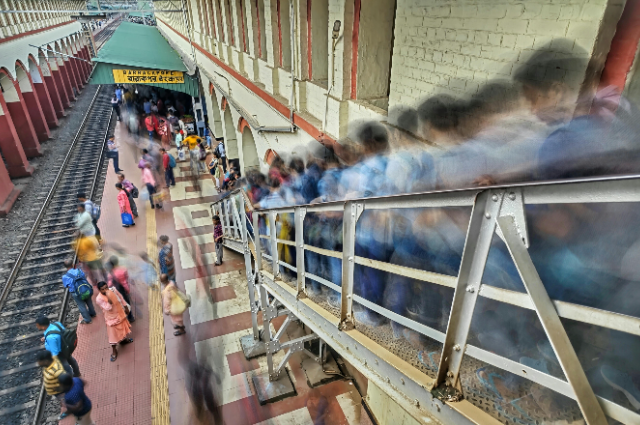
In India, every major train accident sparks immediate questions about signals, tracks, or human error. While these elements are undeniably important, a deeper and often ignored issue lies beneath many rail tragedies: chronic overcrowding far beyond design limits.
Passenger trains are engineered for a fixed capacity. A typical long-distance rake is designed to safely carry around 2,400 passengers across its coaches. Yet on busy routes, festival seasons, or migration periods, the same train may be carrying close to 5,000 people. This mismatch between design intent and operational reality has serious safety consequences.
Overcrowding fundamentally alters how a train behaves. Excess passenger load increases the total mass of the train, extending braking distances and placing additional stress on wheels, axles, suspension systems, and couplers. Infrastructure that is calibrated for a certain load is forced to function beyond its safety margins, leaving little room for error during emergencies.
In the event of an accident, overcrowding becomes deadly. Coaches designed for a limited number of occupants suddenly contain double that number. Aisles are blocked, doors become bottlenecks, and evacuation slows dramatically. Survivors of past derailments have repeatedly described being trapped not by wreckage alone, but by the sheer density of people inside the coach.
Overloading also contributes indirectly to derailments. Heavier trains exert greater lateral forces on curves, especially on ageing tracks or routes not upgraded for higher axle loads. Minor track defects that might otherwise be manageable can escalate into catastrophic failures when combined with excessive weight.
Despite the risks, overcrowding has become normalised. Millions of daily commuters and migrant workers accept standing for hours, sitting on floors, or hanging from doors as routine. This normalisation hides the reality that such conditions would be considered unacceptable in most global rail systems.
The reasons are complex. Passenger demand far exceeds supply, and railways remain the most affordable long-distance transport option. Expanding capacity requires massive investment and time, so authorities often tolerate overcrowding rather than deny travel, especially for economically vulnerable populations.
However, treating overcrowding as inevitable is a policy failure. Safety must include capacity management alongside s upgrades and technology improvements. Real-time passenger counting, increased train frequency on high-demand routes, better crowd control at stations, and stricter enforcement of coach limits can significantly reduce risk.
Train accidents are rarely caused by a single fault. They emerge from layered vulnerabilities piling up until the system fails. When trains designed for 2,400 people routinely carry 5,000, the rail network operates in a constant state of compromise.
Addressing this reality is essential not just for efficiency but for protecting human life.
. . .
References:
- Research Designs and Standards Organisation (RDSO), Indian Railways – Coach Design and Load Standards.
- Comptroller and Auditor General of India (CAG) Reports on Railway Safety and Capacity Utilisation.
- Ministry of Railways, Government of India – Annual Railway Safety Reports.
- World Health Organization (WHO) – Transport Safety and Mass Evacuation Studies.
- National Transportation Safety Board (NTSB) – Passenger Load and Evacuation Research.