
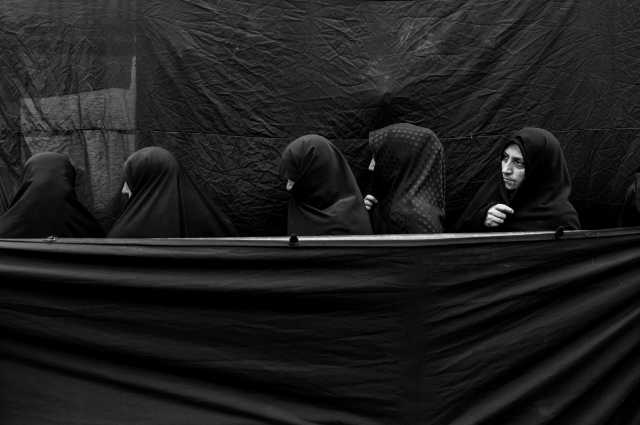
The Skin as a Map of State Power:
History is often written in the ink of grand treaties and battlefield maps, but for millions of women throughout the 20th and 21st centuries, history was written on their own skin—or rather, by what they were forced to cover it with. While many modern debates about dress codes centre on school uniforms or corporate "business casual," there exists a much darker chapter of governance: the state-mandated enforcement of clothing at the barrel of a gun.
The most jarring example of this remains the Islamic Republic of Iran, particularly following the 1979 Revolution. It is a story of how a piece of cloth—the hijab—was transformed from a symbol of personal faith into a tool of state sovereignty and a literal uniform of submission.
The Sudden Shifting of the Veil
To understand the weight of the Iranian mandatory hijab laws, one must look at the whip of the 1930s. In 1936, Reza Shah Pahlavi enacted the Kashf-e hijab, a decree that banned all Islamic veils. Police were ordered to physically rip veils off women in the streets. Ironically, the "liberation" was enforced with the same brutality that the "restriction" would be decades later.
By the time the 1979 Revolution arrived, the pendulum swung back with violent force. What began as a populist movement against a corrupt monarchy was quickly hijacked by a clerical elite. By 1983, the parliament decided that the "morality" of the nation rested solely on the shoulders of its women. Article 638 of the Islamic Penal Code was established, stating that women who appear in public without a proper hijab can be sentenced to imprisonment or a fine.
The Architecture of Enforcement: The Morality Police
For decades, the criteria for "proper" dress were intentionally vague, giving the state infinite power. A few strands of hair showing, a coat that was too short, or lipstick that was too bright could result in:
- Arbitrary Detention: Being bundled into a van and taken to a detention centre.
- "Re-education": Forced classes on Islamic values.
- Physical Violence: Reports of beatings and pepper spray were common during "arrests."
This reached a breaking point in September 2022 with the death of Mahsa (Jina) Amini, a 22-year-old woman who died in the custody of the morality police after being arrested for
"improper hijab." Her death ignited the "Woman, Life, Freedom" movement, the boldest challenge to the regime’s control over women’s bodies in forty years.
Beyond the Hijab: The Global Context of Control
Iran is not an isolated case of "sartorial authoritarianism." History shows that when a government wants to signal a total break from the past or a total commitment to an ideology, it starts with women’s wardrobes.
| Country/Regime | The Mandate | The "Reasoning" |
| Afghanistan (Taliban) | The Burqa / Full Face Covering | Total erasure of women from public life. |
| Cambodia (Khmer Rouge) | Black Pajamas / Uniformity | Destruction of class distinctions and identity. |
Saudi Arabia (Pre-2018) | The Abaya | Strict Wahhabist interpretation of public morality. |
In Taliban-controlled Afghanistan, the enforcement is even more absolute. Women are not just told what to wear; they are told they cannot be seen or heard. The mandate of the burqa isn't just about clothing—it is about visual elimination.
The Psychology of State-Mandated Dress
Why do governments care so much about a hemline or a headscarf? It is rarely about the fabric itself. It is about territory.
In authoritarian regimes, the female body is treated as a battlefield where the state asserts its identity. By controlling what a woman wears, the state signals its control over the private sphere, the family, and the moral fabric of the nation. It is a daily, visible reminder of who holds the power. When a woman steps out of her house, the first thing she must do is acknowledge the state’s authority by dressing according to its dictates.
The Resistance: Fashion as Defiance
Where there is oppression, there is creative subversion. In Iran, the "White Wednesdays" movement saw women wearing white headscarves to protest the law. "My Stealthy
Freedom" became an online sanctuary for women to post photos of themselves with their hair blowing in the wind—a simple act that, in their context, was a revolutionary crime.
Even the way a scarf is worn—pushed back to the middle of the head, showing a defiant "manteau" (coat)—becomes a language of resistance. These women are not just "dressing up"; they are reclaiming their autonomy, one square inch of skin at a time.
The Cost of a Cloth
The government that tells women what to wear at gunpoint is never just interested in clothing. It is interested in silence. Whether it was the forced unveiling of the 1930s or the forced veiling of the 1980s, the common denominator is the removal of choice.
As we look at these historical and current regimes, it becomes clear that the true measure of a free society isn't what its women wear, but whether they have the right to choose it for themselves without a gun pointed at their reflection.
. . .
References:
- Milani, F. (1992). Veils and Words: The Emerging Voices of Iranian Women Writers. 2. Amnesty International Reports on the "Woman, Life, Freedom" protests (2022-2023).
- Human Rights Watch: "The Taliban's War Against Women" (2024).
- Secor, L. (2016). Children of Paradise: The Struggle for the Soul of Iran.