
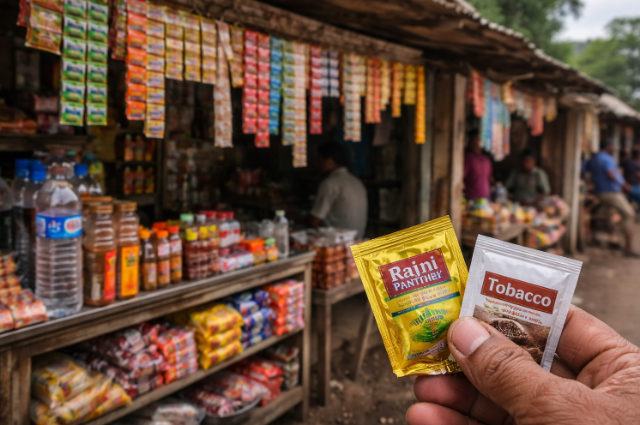
In 2012, India took what appeared to be a monumental step for public health. Under the Food Safety and Standards (Prohibition and Restrictions on Sales) Regulations, the government banned the manufacture, storage, and sale of gutka—the addictive, carcinogenic cocktail of areca nut, tobacco, lime, and paraffin that has long been the scourge of the Indian mouth.
On paper, the ban was a masterstroke. In reality, it birthed one of the most cynical and effective regulatory workarounds in corporate history: the twin-sachet system.
Today, a decade after the Supreme Court flagged this loophole, the data paints a grim picture. According to the Household Consumption and Expenditure Survey (HCES) 2023-24, gutka consumption hasn't just survived; it has exploded. The share of rural households consuming gutka has risen nearly sixfold, leaping from 5.3% to over 30.4%. While the law banned the "product," it failed to account for the "process,—and the cost is being paid in the lives and livelihoods of India’s most vulnerable.
The Anatomy of the Loophole
The 2012 ban targeted "gutka" as a pre-mixed food product containing tobacco and nicotine. Manufacturers, with a stroke of dark genius, simply un-mixed it.
They began selling two separate pouches: one containing pan masala (the flavoured areca nut and spices) and the other containing pure tobacco. Technically, neither sachet violated the ban individually. The pan masala was sold as a "mouth freshener," and the tobacco was sold as "chewing tobacco."
Sold as a bundle for as little as ₹5, the consumer becomes the manufacturer at the point of sale. They tear both, dump the contents into their palm, and create the banned substance in seconds. This "twin-sachet" strategy effectively neutered the ban, allowing gutka to remain ubiquitous while bypassing food safety regulations (Dsouza et al., 2023).
A Crisis of Priorities: Tobacco vs. Education
The HCES 2023-24 data reveals a heartbreaking distortion in how rural Indian families allocate their meagre resources.
The Education Gap: Rural households currently allocate only 2.5% of their total consumption to education.
The Tobacco Takeover: In contrast, 4% of their expenditure goes toward tobacco products (National Institute of Public Finance and Policy [NIPFP], 2025).
In the central belt of India, Madhya Pradesh, Uttar Pradesh, Bihar, Chhattisgarh, and Rajasthan, the crisis is at its peak. In rural Madhya Pradesh, six in ten households are regular gutka consumers. In Uttar Pradesh, more than 50% of households are caught in the loop.
This isn't just a health statistics issue; it is a developmental catastrophe. For every rupee spent on a sachet of gutka, a rupee is being diverted from a child’s textbook or a nutritious meal (Goel et al., 2024).
Experts estimate that if a poor household redirected its tobacco spend toward food, it could add over 500 calories to the daily diet of its children. Instead, the "hunger suppressant" qualities of nicotine are being used to mask the very poverty the addiction helps perpetuate.
The Economics of Addiction: A Poor Man’s Burden
The survey data highlights a cruel irony: the poorer the household, the higher the likelihood of tobacco use.
In rural India, over 70% of households in the bottom 40% of the income distribution consume tobacco. In states like Bihar and UP, that number rockets to 85%.
Tobacco expenditure accounts for 1.7% of the income of the poorest rural households, compared to just 1.2% for the richest 20%.
For an informal laborer, gutka serves a dual purpose. It is a "cheap thrill" after a back-breaking twelve-hour shift, and more dangerously, it is a metabolic hack. It suppresses appetite and provides a stimulant buzz that allows a worker to keep going when they cannot afford a full meal (Nazar et al., 2021).
This creates a feedback loop: the labourer uses gutka to survive the day, and the cost of the gutka ensures they remain too poor to afford the nutrition they are suppressing.
The Hidden Social Cost
The Ministry of Health and Family Welfare attributes 13 lakh deaths annually to tobacco use. The fallout includes lung cancer, COPD, and a terrifying prevalence of oral and esophageal cancers directly linked to smokeless tobacco.
The economic math for the country is equally devastating. A jarring statistic reveals the true "tax" on society:
For every ₹100 the government collects in excise tax from tobacco, a staggering ₹816 is imposed on society in healthcare costs and lost productivity.
The government is essentially trading long-term national health and economic stability for short-term revenue, while public healthcare systems—already underfunded—buckle under the weight of tobacco-related illnesses (Goel et al., 2024).
Cultural Myths and Regulatory Inertia
Why does the "loophole" persist despite being flagged by the Supreme Court in 2016? The answer lies in a combination of weak enforcement and deep-rooted cultural myths.
Tobacco is often woven into the social fabric of rural life. It is offered at weddings, used in religious ceremonies, and shared as a gesture of camaraderie. Furthermore, many users still believe myths that gutka aids digestion, relieves dental pain, or acts as a stress-reliever.
On the regulatory side, the "twin-sachet" system survives because of a lack of political will to tackle the powerful tobacco lobby and the complexity of enforcing a ban on two seemingly "legal" separate ingredients (Dsouza et al., 2023).
Manufacturers argue that they are simply providing "ingredients," and what the consumer does with them is beyond their control—a defence that has held up for over a decade despite its obvious absurdity.
Breaking the Loop
The HCES 2023-24 data is a wake-up call. It shows that as incomes rise, households are not naturally shifting their spending toward "better" things like education and nutrition. Instead, the grip of addiction is tightening.
To fix this, the government must move beyond symbolic bans and address the loophole in logic.
Unified Regulation: Treat pan masala and tobacco as a single product category when sold in tandem.
Taxation Parity: Increase taxes on smokeless tobacco to match cigarettes, removing the "cheap" advantage (Nazar et al., 2021).
Nutrition Integration: Health policies must stop operating in silos. Anti-tobacco campaigns should be integrated into food security and education programs (Azim Premji University, 2026).
Until the "two-sachet" loophole is closed, the gutka ban will remain what it is today: a legal fiction that allows a deadly industry to thrive in the pockets—and the mouths—of India’s most vulnerable citizens.
References
- Azim Premji University. (2026). The composition and affordability of Indian diets: Analysis of household consumption expenditure data. CSIE Working Paper 5.
- Dsouza, V., Kembhavi, P. M., Rao, P. P., K., & Hebbar, P. B. (2023). How does the Indian news media report smokeless tobacco control? A content analysis of the gutka ban enforcement. PLOS Global Public Health, 3(3), e0001724. https://doi.org
- Goel, S., Walia, D., Bhojani, U., Bhatnagar, N., & Chopra, M. (2024). Is India on a path to reduce the tobacco industry’s influence in tobacco control? Insights from the Global Tobacco Industry Interference Index (2019–2023). Frontiers in Public Health, 12. https://doi.org
- National Institute of Public Finance and Policy (NIPFP). (2025). Beyond Necessities: A Closer Look at Per Capita Consumption Expenditure on Tobacco and Alcoholic Beverages during the last Decade. Working Paper 432.
- Nazar, G., Sharma, N., Chugh, A., Abdullah, S., Lina, S., Mdege, N., John, R., Huque, R., Bauld, L., & Arora, M. (2021). Impact of tobacco price and taxation on affordability and consumption of tobacco products in the South-East Asia Region: A systematic review. Tobacco Induced Diseases, 19, 1–17. https://doi.org