
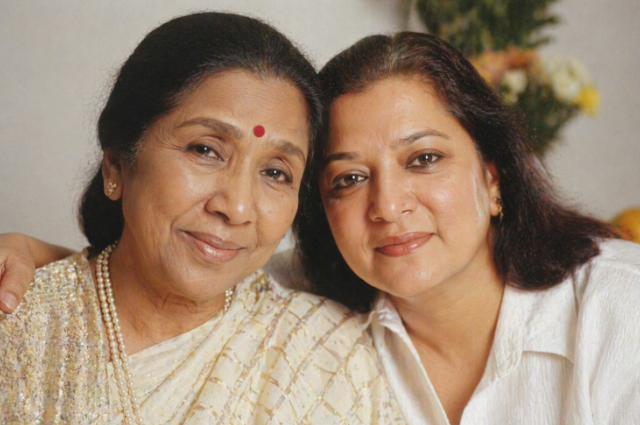
In the landscape of Indian cinema, the name Asha Bhosle stands as a symbol of resilience, versatility, and an almost supernatural vocal range. For over seven decades, her voice has shaped the emotional memory of millions—moving effortlessly between playful cabaret, devotional bhajans, and aching heartbreak.
But beyond the microphone, away from the glow of recording studios, lies a quieter, more complex story. A story not just of survival—but of loss. At its centre is her daughter, Varsha Bhosle.
This is not merely a story of celebrity. It is a deeply human narrative about inheritance—of strength, of expectation, and of pain.
The Matriarch of Survival
To understand Varsha, one must first understand the world she was born into.
Asha Bhosle’s journey to becoming a legend was anything but easy. Growing up in the same household as Lata Mangeshkar, she lived for years in the shadow of an already towering legacy.
Her early life was marked by rebellion and hardship. At just sixteen, she married against her family’s wishes—only to find herself in an abusive relationship that ended in separation while she was pregnant with her third child.
Left with little support and three children to raise, she returned to the only thing she had: her voice.
She sang what others refused. She took discarded songs and turned them into immortality.
That instinct—to survive, no matter what—defined her life. And inevitably, it shaped her motherhood too.
Varsha: Between Inheritance and Identity
Born into a family defined by excellence, Varsha Bhosle carried both privilege and pressure.
She was gifted—intellectually sharp, artistically inclined, and fiercely articulate. While she explored music, her truest voice emerged through writing. As a political columnist for platforms like Rediff, she became known for her bold, often polarizing opinions.
She was not just “Asha Bhosle’s daughter.” She was her own mind.
And yet, that distinction was never easy to sustain.
In a family where strength was almost expected, vulnerability had little space to breathe. Varsha’s emotional struggles—often described as intense and unpredictable—stood in contrast to the image of resilience that surrounded her.
A Relationship of Closeness—and Shadow
After her marriage ended, Varsha returned to live with her mother at Prabhu Kunj.
Their bond was deeply intertwined. They were, in many ways, each other’s emotional anchors.
But proximity to greatness comes at a cost.
It is never easy being the child of a sun. You are either blinded by the light, or forever living in its shadow.
For Varsha, that shadow was heavy.
She struggled for years with clinical depression—largely in silence. In an era where mental health remained stigmatized, especially within high-profile families, her battles were often confined to private spaces.
There had been earlier attempts. Signs. Warnings.
But some struggles are not easily contained.
The Tragedy of October 2012
On October 8, 2012, the story took a devastating turn.
While Asha Bhosle was abroad, news broke that Varsha had died by suicide at their residence. She was 56.
The method—using a licensed firearm—added a stark finality to an already painful narrative.
For a woman who had survived poverty, abuse, and professional rejection, this loss was something else entirely. Not a battle to fight—but an absence to endure.
Aftermath: Survival Without Resolution
Grief, in such cases, does not arrive as a moment—it becomes a condition.
Asha Bhosle returned to the stage, as she always had. But something had shifted. The performances carried a different weight—quieter, heavier, more internal.
Because some losses do not heal. They settle.
Varsha’s death briefly opened conversations around mental health in India—especially within privileged spaces where suffering often remains hidden behind success.
It exposed a difficult truth:
Even in homes filled with music, recognition, and love, silence can grow.
Themes That Define Their Story
Identity
Varsha’s lifelong struggle to be seen as an individual beyond a legendary surname.
Resilience
Asha’s ability to continue, even after losing a child—an endurance that goes beyond strength.
Mental Health
The invisible battle that often remains unspoken, especially in high-achieving families.
Public vs Private
The contrast between a celebrated public figure and a grieving mother behind closed doors.
The Song and the Silence
Today, when Asha Bhosle sings a melancholic note, it carries more than musical expression—it carries memory.
Their story reminds us that survival is not always about overcoming. Sometimes, it is about continuing in the presence of what cannot be undone.
Asha Bhosle remains a symbol of strength. But the story of Varsha Bhosle lingers as something equally important—a reminder of fragility, of mental health, and of the unseen costs of legacy.
The music continues.
But the silence it leaves behind tells its own story.
References
- Bhosle, A. (Various Interviews). Reflections on Life and Music. Filmfare and Stardust Archives.
- The Hindu. (2012, October 8). Asha Bhosle’s daughter Varsha commits suicide.
- Rediff.com. (Archive). Selected Columns of Varsha Bhosle.
- Bharatan, R. (1995). Lata Mangeshkar: A Biography. (Reference to family dynamics)
- The Times of India. (2012). The troubled life of Varsha Bhosle.
- Saksena, N. (2015). The Divas of Indian Cinema. (Analysis of Asha Bhosle’s personal resilience).
- NDTV News. (2012). Family and Friends remember Varsha Bhosle.
- India Today. (2012). Death in a Lonely Mansion: The Varsha Bhosle Story.
- Marathi Sahitya Review. (2013). The Literary Contributions of Varsha Bhosle.
- Journal of Clinical Psychiatry (India). (2013). Case studies on celebrity stress and genetic predisposition to depression