
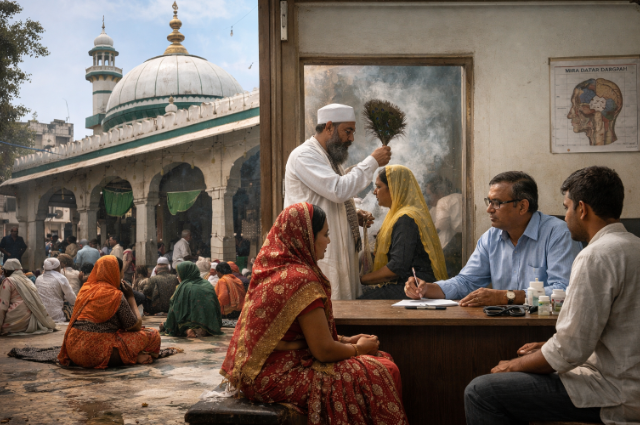
Schizophrenia is a mental illness in which the mentally ill individual hears or sees things that don’t actually exist in reality. It is treated through proper medication and care, however when it reached the streets of South Asia, particularly India, it took on a form of treatment rarely seen in clinical psychiatry.
The concept takes advantage of the “jinn” factor in India. Here, aside from schizophrenia, any mentally ill person is believed to be possessed by jinns. Schizophrenia, therefore, became evidence that mentally ill patients are in fact, possessed by an evil spirit.
Following this misconception, the Dargahs (religious shrines) were flooded with mentally ill people, seeking relief from the evil spirit through rituals and prayers. One such dargah was the Mira Datar Dargah dedicated to the martyr Hazrat Saiyed Ali Mira Datar in Unava village.
The Architect: Milesh Hamlai (CEO of Altruist)
Altruist is an NGO which deals with mental health patients. Milesh Hamlai runs the NGO and has successfully treated over 38 thousand patients with the help of his psychiatrists. He observed the people waiting in line at dargahs instead of the medical clinics for treatment, as they believed the issue to be spiritual and not medical. He could’ve educated the patients to consult a psychiatrist but he educated the healers at the dargah and introduced to them his own brilliant ideas.
He held meetings with the Mujavirs (priests) and convinced them that the patients needed strong rituals to get rid of the evil spirits. He never replaced the concepts of healing through faith in the patient’s brains but he modified it, uniting faith and science when it was mostly faith at work.
Now, it was not that Hamlai was unfamiliar with the illness and just wanted to profit from the religious beliefs of people. He was quite knowledgeable and had experienced the life of a schizophrenic in his home. His brother was a patient of schizophrenia, and that served as a great motivator for him to start finding a cure that worked both ways and didn’t require people to change their beliefs. He has been recognised for his services in the mental health sector for over two decades.
Mechanism: The Referral Slip
Hamlai desired to flag his astonishing ideas in Gujarat at the Mira Datar Dargah. He combined faith and medicine to create a greater workflow.
It was simple. The patient and their family would visit the Dargah, requesting the Mujavir to perform the ritual. The Mujavir will do so and then hand the family a “referral slip” with the details of a suitable psychiatrist from Altruist. He will ensure the patients that he had made the prayer, and for the prayer to work, the patient had to take the “Dava” (actually antipsychotics disguised as spiritual-awakening pills), which would be recommended by the psychiatrist.
Both the culture and medicine found a way to work.
Why it works: Psychological analysis
The core beliefs of the people of Unava village were not changed. They were still reluctant to choose to look for a cure at a dargah. The belief was just tweaked a little by Hamlai for the greater benefit of both the patients and his NGO. They were spared the pain of having to visit the hospitals and their loved ones being called “mentally ill”, “crazy” or “possessed”, they were brought out of the taboos, although unknowingly, but for their greater good.
The mujavirs had to gain their trust by convincing them that they were still treating them through the traditional religious method. They were shown acceptance and the right treatment at the same place, making Hamlai’s genius plan work exceptionally well.
Challenges:
- The Business Conflict
Nobody likes their job being taken over by someone else. The same was the condition of the mujavirs at the dargah. They didn’t want the doctor to intervene in their business. They were traditional people, and being mujavirs, probably didn’t believe in medicine or science as well. The fear of them being more likeable or the mujavirs running out of business and losing control of it lingered quietly till Hamlai sat down with them and convinced them that their role at the dargah would remain the same, in fact, increase, and people would still trust them with their rituals and prayers.
- The Credit War
If two kinds of professionals are working under the same roof for the same cause, who will get the credit for success?
The mujavirs held their place at the dargah since long time. The doctors were providing the medicine for actual healing. At the end, the doctors gave up their ego and decided to let the mujavirs deal with the popularity.
Current status and impact:
The practice is recognised as a “Best Practice” and has treated thousands of patients in India. The method is now not only used to treat schizophrenia but also psychosomatic disorders, anxiety, depression, and somatic symptom disorders. (Somen Saha, 2021)
A research reports patients’ positive feedback from the Dava and Dua centre, one of them says,
”I spent a lot on the dora dhagga (religious practice of wearing sacred thread from priests or religious healers) and bhuvagiri (Hindu traditional healers who cast off evil eye and remove black magic), but did not get any relief. When I came to Dava-Dua centre, I realised that I was suffering from mental illness…(and) immediately started the treatment.”
Another patient shared that she suffered from symptoms of anger, fear and sleeplessness and had bad dreams which were not reduced after seeking traditional treatment. She believed she was the victim of black magic. After failure from faith healing, she turned to hope and belief in modern medicine, which is reflected in her words,
“I came to this centre because one patient from a neighbouring village got treated… before the treatment, I had more faith in BHUVAGIRI, but now I realise the importance of the treatment.
. . .
References:
- Somen Saha, A. C. (2021). Unique collaboration of modern medicine and traditional faith-healing for the treatment of mental illness: Best practice from Gujarat. Journal of family medicine and primary care.
- Shields, L et al. (2016). How can mental health and faith-based practitioners work together? A case study of collaborative mental health in Gujarat, India. Transcult Psychiatry