
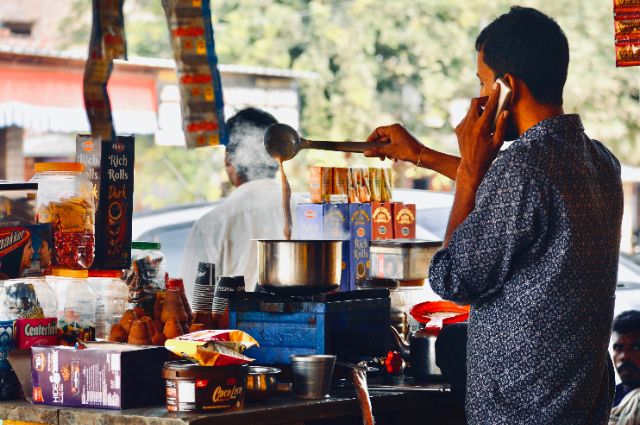
The word adda may sound like a simple term for hanging out, but in Bengali culture, it represents a deep-rooted cultural tradition of gossip.
Which means that adda is a way for people to come together, gossip, eat food, drink and have fun.
It has such an importance in the Bengali culture that it was officially added to the Oxford English Dictionary in 2004.
In 1989 book “The Great Good Place” author Ray Oldenburg, explains the "First Place" is your home and the "Second Place" is your work.
The “Third Place” is a neutral ground like a tea stall, a park, or a coffee house where people enjoy the company of each other.
In today's life, we are seeing it vanishing people are no longer seen sitting together and gossiping enjoying togetherness.
Everyone is busy in their life .
History of Adda
Adda was never just gossip, it was a way of thinking.
The modern version of adda began to take place in the 19th century during the British colonial era.
As Western education spread into India, it spread western education between people. The British used to call a new middle class of educated Bengalis "Bhadralok”.
These people, coming from a middle-class background, used adda as a way to connect and discuss global politics, literature, and art. During the fight for independence, the addas became a center for nationalist ideas, where people met in secret or in public to plan protests against colonial laws.
One of the most famous locations for this tradition is the Indian Coffee House on College Street in Kolkata. It was opened in the 1930s, it provided a warm environment where students and intellectuals could sit and talk for hours over a single cup of coffee. Unlike high-end restaurants, the Coffee House was a democratic space where people of different religions, castes, and classes could talk freely without being forced to order expensive meals.
It helped people from different regions, castes, languages, and backgrounds come together.
Modern Day practice of Adda
Nowadays, Adda is not just conversation, discussion , debate, gossips, it is everything combined.
People come together and discuss about literature, arts, science and technology, sports, entertainment, cinema, politics, jokes, memes, gossip, the list is endless.
And it can take place anywhere like in the privacy of a drawing room, a local teashop, a park or the canteens of college, university, office, metro station, terrace.
At that time it was mostly men because it was uncommon to see a woman participating in an adda with men.
But now there is no discrimination, women equally sit together with men.
The Bong people are known for their foodie behaviour, the most common thing in adda is tea, food and drink. An adda is incomplete without a cup of tea.
In family ceremonies, people sit together with Bengali Snacks (Jolkhabar) like Chai (Tea), Beguni (Eggplant Fritters), Shinghara (Stuffed Savoury Pastry), and Jhalmuri. They share conversation, listen to each, share opinions, gossips, sing, crack jokes, laugh out loud, eat food, drink. These help them break their social distance and connect them.
Benefits of the Adda culture
Adda has its benefits too, especially in the "third age" we popularly call old age.
Research suggests that having friends in the third age is highly beneficial, and it helps with happiness and satisfaction. Friends provide support, companionship, and acceptance, which are crucial to an older age sense of self-esteem.
And creating close ties with friends, as well as the presence of a spouse, are linked to increased survival rates of the aged.
Adda plays a crucial role in maintaining the physical and psychological we of adults as well as older adults in kolkata.
This researcher spoke to the residents of kolkata across various age groups about adda culture. In the words of Shyamal Kanti Sen, a 67-year-old resident of Salt Lake, says "Adda after a morning walk is like an energy drink to me. Be it sunny, rainy or cold, I never miss my morning walk. More than the walk itself, the adda that follows at the nearby teashop is the reason I get up early in the morning.”
The other age groups also have the same thoughts “Adda has been a part of my life since I was a teenager and it will be a part till my last day," said Arup Sekhar Roy, a 32-year-old photographer from Kolkata.
These research not only explains how rooted are bengali people with the adda culture but also how it benefits them in there day to day life.
The Decline of Adda
Despite its long history, the traditional adda is currently facing a slow "extinction" in many Indian cities.
After thCOVID-19 period and the lockdown made it difficult for people to meet physically. The adda groups were dismantled.
Other reasons like Hustle culture, expensive monitization of “Third place”, and replacement of old buildings also made it difficult for people to meet for adda.
After day to day hustle in the corporate life, people get no time to spend together.
The 9 - 5 jobs made people’s lives more stressful, and people have only the weekend to enjoy or have fun.
Today, rowaks are an increasingly rare sight. They represent the mark of a fading culture. As old houses are replaced by fancy apartment buildings, these once-present platforms are disappearing from Kolkata's streets. There are often the surviving rowaks are seen blocked by gates, used for storage, or flattened to make parking spots. This shift reflects changes in how people relate to their neighbourhoods and the public space. Private life has moved to indoors and online, and street life has narrowed.
And the replacement of tea stalls with expensive air-conditioned cafes, where a single coffee can cost as much as a full meal. In these spaces, the "Wi-Fi password is the new social contract," and the focus is on looking at a laptop rather than talking to a stranger.
With time people shift to other ways for adda.
New ways of Adda
People who were well-privileged with technology shifted their adda to the virtual world, especially the younger generations.
The tradition of adda has moved online.
Many people now participate in "digital adda" through WhatsApp groups, Facebook, Instagram, Discord, Twitter, and Reddit.
These online communities allow people with similar interests to connect, especially in a world where real-world clubs.
Nowadays many companies like Misfits, let's so, Calcutta adda, decoding Draupadi. They work for making strangers social gathering possible. These companies replace scroll with offline gatherings. They help interact with the people with similar interests.
They turn "adda" into active, inclusive spaces where sports, board games, discussions, eating, and having fun is possible.
The offline meetups helps in reducing social anxiety, stress, and gives relaxation.
The elderly people struggled on that front and as the lockdown restrictions were relaxed with time, they resumed their addas at their favourite spots. Hectic work schedule, the addiction to smartphones and social media and migration of younger people from Kolkata to other Indian cities and abroad mean that the adda culture is endangered.
References:
- https://www.bbc.com
- https://www.downtoearth.org.in
- https://homegrown.co.in
- https://www.steelcase.com
- https://etda.libraries.psu.edu