
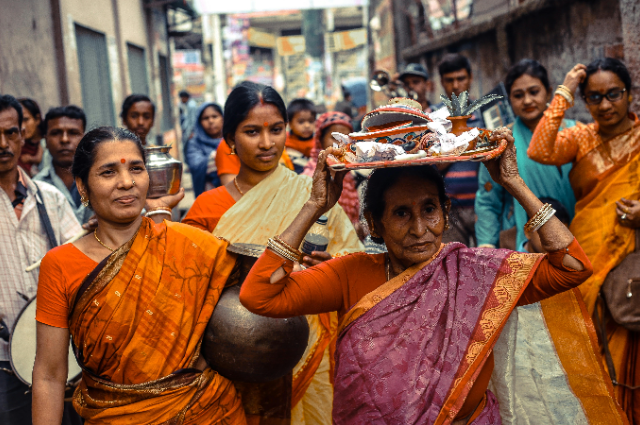
In several rural regions of India, a tradition known as the Jogini system is still practised despite being officially banned in parts of Telangana, Andhra Pradesh, Karnataka, and Maharashtra. In the jogini system, the young girls who mostly belong to lower castes are given to the temple as devdasi. They were dedicated to Goddess Yellamma or Renuka by their own family due to reasons like poverty. Once this ritual of dedication takes place, these young girls are considered Nitya Sumangali, which means they are symbolically married to the goddess and she can never become a widow. This also means that she is never allowed to love or marry a man.
This religious practice is where she is trapped for her lifetime, where these young girls dedicated as goddesses lose control over their own lives, their choices, their rights, their future, and even their bodies. What appears to be a religious tradition hides a painful reality of lifelong exploitation.
These religious practices don't begin with exploitation; instead, it starts when people truly trust priests and rich upper caste people. The upper caste makes religious rituals to take advantage of the lower caste's families and young girls into a cycle of superstition, societal pressure, and exploitation.
It starts when a lower caste family is struggling with bad luck, illness, or extreme poverty. In such situations, the village priests claim that the goddess is angry and she must be appeased. In villages where devotion to goddess Yellamma or Renuka is strong, the families are told that if they offer their daughter to the goddess, it will calm the divine anger and it will bring blessings to the family.
The family is pressured by the village to donate their daughter.
This dedication usually happens when the girl is extremely young, between five and ten years old, so she can not understand or question what is happening to her. During the ritual ceremony, a Thaali (Mangalsutra) is tied around her neck or hand if she is too young in the name of the goddess, symbolising a marriage between the girl and the deity. She is now declared a Jogini and is told that she is spiritually married to the goddess, and she belongs to the temple. She can no longer live like any other child; she has to follow rituals, she has to accept what is told to her, and her life changes forever.
The most horrific part comes when she reaches puberty; a ritual is held to mark this stage of her life because she is believed to be married to the goddess. She is considered to belong not to herself but to the temple and the village. This belief makes her lose control of her own body. This ritual is the reality of patriarchy in the disguise of belief.
When she got her first menstruation, she became closer to femininity, fertility, and divine power. She was supposed to be seen as more sacred, but in reality, instead of receiving respect, her puberty is seen as the point when men can start taking advantage of her body. A young woman, the society that once saw her as a goddess now sees her with evil eyes.
The first night became a chance for men to take advantage of her body, where many times her first night is claimed by an upper-caste landlord, a village headman, or even a priest.
It has been seen that often this ritual is done through an auction where people with money bid on her as if she were not living, as if her emotions weren't real, her body wasn't her own.
The temple where she belongs, the goddess she was married to, never saved her.
She was taken by the man who won this auction.
They give the family a small payment or cover of the ritual expenses in exchange for sexual rights over the girl.
After this ritual, the people of the village no longer see her with the same respect in everyday life, as she is a jogini no man will marry her and she is forced to serve as sex slave for the men in the village where she is treated as public property and she is not allowed to say no when a patron calls she has to go.
Many joginis continue to live in their parent’s homes, but still they are financially dependent on the men of the village.
Once she gets pregnant, she faces societal pressure of abortion, but in the case of giving birth to the child, many grow up without knowing who their father is, and they carry the stigma attached to their mother’s status.
The patriarchal society pushes the daughters of Joginis into the same repeating cycle.
In the days of festivals, the Jogini is shown great respect. People bow to her, touch her feet, and treat her as someone sacred. She carries the Bonam, a sacred pot offered to the goddess, which she put it on her head during religious celebrations. In these moments, she is seen as a vessel of the goddess.
But once the rituals end, that respect disappears. In everyday life, she is treated worse than a sex worker. She has no legal protection, no stable income, and not even a little support from society. They are disrespected by the same society that once called them goddess. She faces isolation.
This suffering does not end here. When she grows older, she is no longer considered useful or attractive to the men, so she is abandoned without any savings or social support, and she becomes a disposable devi.
As a result, many elderly joginis are seen begging outside the same temples where they were once seen as goddesses, and this is known as Jogwa, where they ask for alms from devotees.
The Jogini system also creates a serious health crisis. Cases of HIV, AIDS, and other sexually transmitted diseases have been reported to be high among Jogini as they are not allowed to say no or she can demand protection. They face fear, social pressure, and financial dependence on the men. It makes it impossible for her to refuse or demand safety.
The Reality on the Ground
The Jogini system has been reported mainly in rural parts of southern India. It is especially prevalent in some districts of Telangana such as Mahbubnagar and Nizamabad, and in parts of Karnataka, including Belagavi. Even though the system is widely criticised, it still survives in some villages where there is poverty and caste discrimination.
Legally, the practice has been banned for many years. Laws such as the Devadasi (Prohibition of Dedication) Act were created to stop the dedication of girls to temples and protect them from exploitation, but it still happens under the name of tradition.
The terms used for the jogini system can also change depending on the region. In parts of Karnataka and Maharashtra, they are called Devadasis, and in Telangana, they are known as Jogini or Mathamma.
Reference :
- 'The Gods Are Not Going To Save Us Just Because We Are Married
- Joginis: The religious sex slaves of Telangana - The News Minute
- International Dalit Solidarity Network (IDSN): Forced Prostitution & The Devadasi System
- National Institutes of Health (NIH): HIV in India: The Jogini Culture
- Centre for Economic and Social Studies (CESS): Status of Jogini System in Telangana
- CLPR (Centre for Law & Policy Research): Policy Brief on Devadasi Legislations
- V6 News (Telugu Coverage): Special Story on Jogini Culture