
Most of the People Today, especially the younger generations, have never seen or lived this moment before.
The young generation has seen it in textbooks, old footage, stories.
It told us about a time where humans were curious to explore the moon.
The Apollo 17 mission in 1972 was the final crewed NASA mission to the Moon, that marked the last time humans have walked on the lunar surface.
For Gen Z, It is unreal they have never seen or experienced it . But this time NASA's new Artemis II mission is something we are experiencing for the first time in over fifty years we humans are not just remembering the journey to the Moon. We are living it again.
The Mission and It's Impact
The NASA’s Artemis II mission has been launched from Kennedy Space Center on 1st April and ended by a splashdown on 11th April earlier this month, it was a 10 days mission of training the Orion spacecraft. It was carrying four astronauts beyond Earth’s orbit and around the Moon. It is a test flight that was designed to validate systems, check performance, and prepare for future missions.
This is the first time since 1972 that humans have moved beyond low Earth orbit and the Artemis II has completed the first crewed lunar flyby in over 50 years, it has validated the Orion spacecraft’s life-support and thermal protection systems for future Mars-bound journeys.
It tested the new technology of high-speed 4K laser communications and "organ-on-a-chip" radiation experiments.
This mission also carried a heavy geopolitical and cultural weight by solidified the U.S led Artemis Accords through international cooperation and it boost United States of America’s new era of the space economy.
The Crews
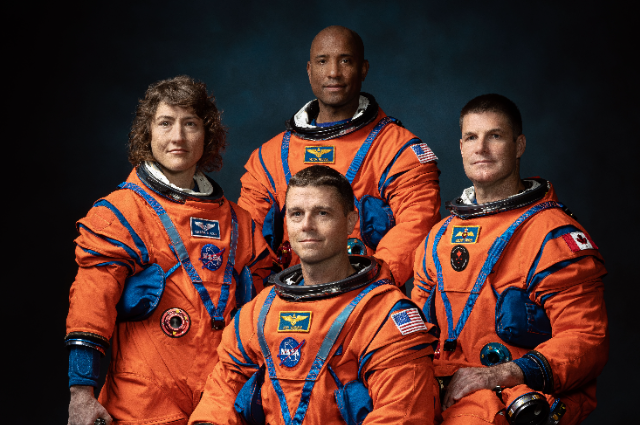
The Artemis II test Orion spacecraft flight carried crews consists of four astronauts: Astronauts Commander Reid Wiseman, Pilot Victor Glover, and Mission Specialist Christina Koch, and CSA (Canadian Space Agency) Astronauts Mission Specialist Jeremy Hansen, who successfully completed a historic 10-day lunar flyby mission. This crew was the first to fly the Orion spacecraft. The traveling farther than any human in history.
The Rockets & The Spacecraft
The Artemis II serves as the critical bridge to lunar landing missions. The first time humans will travel beyond low Earth orbit since the Apollo era. The NASA launched the Space Launch System (SLS) technology rocket, the Orion spacecraft it was nicknamed "Integrity" as it carries a crew of four on a high-altitude trajectory to test life-support and communication systems in deep space. A vital early milestone in the mission is the deployment of the four solar array wings extending from the European Service Module. These wings stretching to a total span of 63 feet must lock perfectly into place to provide the electrical power necessary for the spacecraft’s complex avionics and crew modules. By completing a lunar flyby and utilizing a "free-return" trajectory. This 10-day flight validates that the integrated hardware and ground systems are ready to safely transport astronauts to the Moon’s surface on subsequent missions.
Mission Timeline & Key Events
The spacecraft remained in high Earth orbit for about a day, where the crew conducted a manual pilot demonstration to test Orion's handling capabilities. Mission controllers then gave Orion's European-built service module a command to conduct the translunar injection burn on April 2 an approximately six-minute firing to send the spacecraft on a trajectory that simultaneously carries the crew around the Moon, while also harnessing lunar gravity to slingshot them back to Earth.
After the burn completion, NASA astronauts Reid Wiseman, Victor Glover, and Christina Koch, along with CSA astronaut Jeremy Hansen, became the first people to leave Earth's orbit since the Apollo program in 1972.
On april 6, Artemis II crew completed a historic 7-hour lunar flyby, becoming the first humans to view the far side of the Moon directly. They captured high-resolution, shadowed images of geological features like the Orientale basin to enhance scientific understanding.
Science Aboard
The AVATAR (A Virtual Astronaut Tissue Analog Response) investigation. This groundbreaking study uses organ-on-a-chip technology. A tiny thumb-drive-sized devices engineered with living human bone marrow cells to act as biological "avatars" for the astronauts. By exposing these personalized cellular models to the harsh environment of deep space, the scientists can monitor the real-time effects of intense cosmic radiation and microgravity on human health.The data gathered from these chips is a game-changer for the future of interstellar travel.
By observing how the bone marrow, the engine of our immune system and blood production reacts to the stressors of the Van Allen Belts, NASA can develop more effective shielding and medical countermeasures for long-duration missions.
The Artemis II was a successful mission by returning safely on April 11, 2026. It marks the first crewed lunar mission since 1972. Making it a pivotal moment for Gen Z and the "Artemis Generation." The long 10 days , 250,000 mile voyage testing the Orion capsule inspires Young Generation to re-engage with space exploration, science, and career paths in STEM. Unlike Apollo, Artemis II gave a hope to Gen Z that they will explore more in the deep of space.
Reference: