
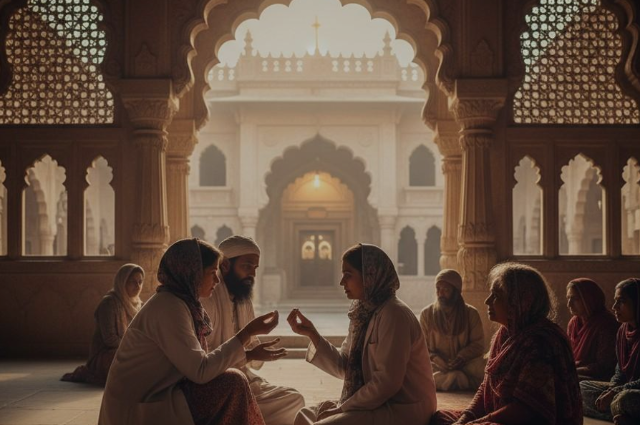
In India, mental health is neglected by families due to societal values and mental health care does not begin in hospitals but begins in religious places by practicing their rituals. For thousands of families across whole India psychological issues are not taken care of but it is called the “Voice of Jinns”. Bipolar mood swings become “divine disturbance.” Paranoid schizophrenia is called “possession”.
One of the biggest crowded shrines is the Mira Datar Dargah in Unava, a small town in Gujarat’s Mehsana district. The shrine , dedicated to the martyr Hazrat Saiyed Ali Mira Datar, is widely known as the “Supreme Court” for cases of spirit possession. Families come travelling long distances, often after exhausting all other options, believing that supernatural forces are responsible for their beloved one’s suffering. Clinically, however, many of these individuals are living with conditions such as schizophrenia, conversion disorder (historically called hysteria), severe depression, or bipolar disorder.
For decades, this gap between belief and biomedicine created a silent crisis. Psychiatrists waited in government clinics that remained largely empty while religious shrines overflowed with patients. Traditional mental health programs in India often attempted to replace faith with science, assuming that education and awareness would gradually eliminate superstition. Yet this approach frequently failed. Attempting to directly challenge it often produces resistance. The breakthrough at Mira Datar Dargah came when one social worker chose not to fight belief but to work within it.
The story behind the change
Milesh Hamlai, the founder of the Ahmedabad based NGO Altruist is the architect of the base of mental health care in India. Hamlai’s own brother suffered from schizophrenia. Through that personal struggle, he witnessed how families oscillate between medical advice and social stigma. In many communities, consulting a psychiatrist implies that something is “mentally wrong”, a label that carries shame and stigma. Seeking help at a religious place is culturally acceptable and even respected. Hamlai realised that the issue was not lack of treatment availability. It was people's lack of trust on psychiatrists and more faith on the shrines.
His innovation, sometimes referred to as “The Divine Referra”. When families bring a patient to the Dargah for exorcism rituals, the Mujavir performs the traditional prayers. Instead of sending the family away afterward, the Mujavir hands them a referral slip and instructs them to visit a clinic located within the Dargah ground. Mujavir explains this to the patient as the patient must take Dava (medicine) and do Dua (prayer) as it will work faster and weaken the spirit. The medication, often antipsychotics or mood stabilizers provided through government support. The patient complies because it comes from the faith and security of religious beliefs that it will help them.
Psychologically, this idea worked because it does not force families to abandon their faith and trust in shrines, but it helps them by treating their conditions with medicine, with the help of faith. Challenging a deeply held belief often creates defensiveness. People protect what gives their lives structure. But when medicine is reframed as part of that structure, resistance dissolves. There is no battle between science and spirituality. This idea showed that Spirituality and Science can co-work by keeping them side by side. Over time, trust grew. Mujavirs noticed that patients who took medication became calmer, less violent, and more stable. Doctors noticed that patients were more consistent with follow-ups when the recommendation came through the shrine. What began as cautious cooperation evolved into a functioning ecosystem.
Since 2008, tens of thousands of patients have been treated through this partnership. The impact extends beyond symptom reduction. Families who once stayed in Unava for months, spending money on repeated rituals and accommodation, now see improvement faster. Financial strain decreases. The cycle of debt slows. Recovery becomes not just medical but social and economic.
Users who received the combined psychiatric and faith-healing treatment expressed a strong belief in both. They believed both to be an essential part of the same treatment. As people receive relief from pain and other ailments from the medication, their belief in the system gets reaffirmed. This leads to an increase in referrals through family, relatives, and friends.
Proven success:
It is now recognised as the “Best Practice model of India ” in Indian healthcare. The model started at the Mira Datar Dargah in Gujarat and the Erwadi Dargah in Tamil Nadu. It has been so successful that the National Human Rights Commission (NHRC) recommended using it across all of India.
The Economic Point of View:
The Dawa-Dua (Medicine and Prayer) model represents a highly cost-effective and sustainable approach to mental health care in the absence of available work by using already existing cultural and religious shrines to provide psychiatric services. Economically, the program helps to reduce the financial burden on families by eliminating expenses on ineffective traditional rituals, highly costly medicine, and long-distance travel to specialised hospitals, while simultaneously protecting the social capital of Indian rural communities. Its growth is evident through its expansion across multiple Indian states, benefiting patients from 17 different regions, and its recognition by international bodies like the World Health Organisation as a scalable model for social psychiatry. The unity between medical practitioners and mujavir, the project creates a unique community workforce that enhances local capacity for early treatment of the mental health issues and vocational rehabilitation, ultimately aiming to recover from irritability and lost productivity caused by untreated mental illness.
The Dawa-Dua program represents a landmark shift in community mental health by integrating psychiatric medicine with traditional faith-based practices to reach populations that might otherwise avoid clinical help. By establishing clinics directly within religious sites like the Mira Datar Dargah and the Erwadi Dargah, the initiative transforms faith healers from perceived obstacles into allies who help identify and refer patients for scientific treatment. This integrated model effectively breaks a massive treatment gap and dismantles the heavy stigma surrounding mental illness by respecting patients' cultural and spiritual frameworks rather than challenging them.
Reference:
- Altruist. (n.d.). Community mental health initiatives at Mira Datar Dargah
- India’s mental health care and faith-based healing.
- A case study of collaborative mental health in Gujarat, India.
- Satyamev Jayate. (2014). Nurturing Mental Health (Season 3, Episode 5). Star Plus.
- Researchgate.net