
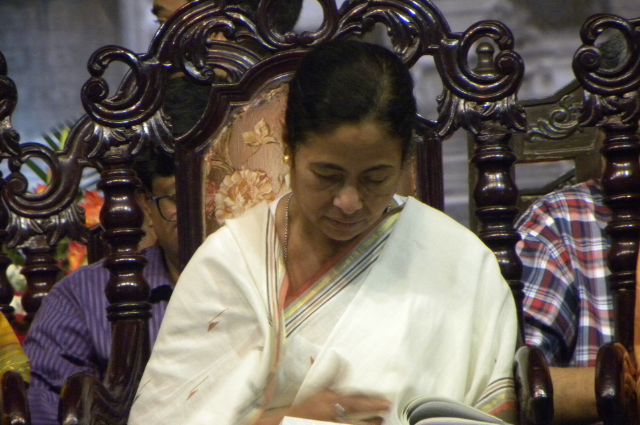
In May 2026, West Bengal witnessed a major polṄṅṅitical change. After dominating the state for 15 years, Mamata Banerjee and her Trinamool Congress (TMC) party were removed from power, with the BJP securing a massive 207-seat majority. The woman who once toppled a 34-year-old communist government saw her stronghold crumble in a single night.
For many, this was not just an election loss; it was the end of an era marked by dictatorship, corruption, and a severe decline in law and order.
Who is Mamata Banerjee?
Born in 1955 into a lower-middle-class family in Kolkata, Mamata Banerjee overcame early financial hardships to enter politics in the 1970s. She rose to prominence in 1984 by defeating veteran Communist leader Somnath Chatterjee to become an MP. Despite surviving brutal political attacks in the 1990s, she formed the All India Trinamool Congress (TMC) in 1997. She later served in several prominent Union Cabinet roles, notably becoming India’s first female Minister of Railways.
Breaking 34 Years of Left Rule: The Rise to Power
Her rise to power was driven by two major agitations against land acquisition: Singur and Nandigram. She promised “Maa Maati Manush” (Mother, Motherland, and People), positioning herself as the protector of poor farmers.
In 2011, she ended the world’s longest-serving democratically elected communist government. As she became the Chief Minister of Bengal, she was initially seen as a saviour who lived simply and stood with the people. She became the face of a leader who lived for ordinary citizens.
When She Misused Law and Order
During her tenure as Chief Minister of West Bengal, Mamata Banerjee’s administration faced significant scrutiny for allegedly running state affairs heavily from her personal residence at Kalighat rather than the official secretariat. Alongside this, critics accused her government of using state police to target critics and suppress free speech through social media arrests.
Her governance drew widespread criticism during post-poll violence, and many people alleged that TMC workers extorted businesses and demanded illegal commissions from poor citizens to access state welfare schemes.
One of the reasons for losing public trust was the Saradha Chit Fund Scam and the Narada Sting Operation, both of which exposed major political and financial controversies in West Bengal. These incidents heavily impacted the image of the All India Trinamool Congress (TMC) government.
In the Saradha Chit Fund case, investors were promised high returns through alleged investments in real estate, tourism, and media. Instead, the group reportedly used money from new investors to pay older investors. The scam allegedly defrauded over 1.7 million depositors of an estimated ₹2,500 crore to ₹4,000 crore, wiping out the life savings of thousands of poor families.
After this, another sting operation exposed further controversies. Journalist Mathew Samuel, founder of Narada News, created a fictitious company named Impex Consultancy Solutions. He approached several TMC ministers, Members of Parliament (MPs), and legislative members (MLAs), requesting favours in exchange for cash bribes. The tapes featured many TMC leaders, including Suvendu Adhikari.
Despite the massive political outrage, the TMC went on to win the 2016 state elections. Later, the case was handed over to the CBI in 2017.
Mamata Banerjee has also faced criticism over alleged interference in Enforcement Directorate investigations and controversies regarding the protection of judicial officers during mob attacks. She dismissed many of these claims as politically motivated accusations against her leadership.
She stated on multiple occasions that there would be no NRC or CAA (Citizenship Amendment Act) in West Bengal. She led numerous large protest rallies, calling the laws discriminatory, and passed a resolution against them in the state assembly.
She also faced criticism after reacting strongly to a Supreme Court judgment that cancelled nearly 25,000 teacher appointments in the state.
Critics have also accused her government of repeatedly targeting and harassing central forces. Mamata Banerjee publicly alleged that central forces were brought in from other states specifically to vandalise homes and target locals. Following these allegations, residents and political workers reportedly clashed with central forces, leaving multiple CRPF jawans injured.
Her administration was also criticised for rejecting certain welfare schemes introduced by the Union Ministry of Women and Child Development and for failing to adequately establish central fast-track courts and emergency helplines for crimes against women.
Many people alleged that they were threatened or pressured not to vote for opposition parties. According to several local accounts, TMC workers allegedly warned citizens to vote only for their party. Some voters also claimed that workers used methods such as tapes, perfumes, or Vicks on voting buttons to allegedly identify voting patterns.
Cases such as Murshidabad and Sandeshkhali further damaged her public image.
Social Issues and Women’s Safety
Mamata Banerjee also faced criticism over several controversial statements on social and women’s safety issues, causing many people to lose trust in her governance.
On October 10, 2025, a 23-year-old MBBS student was allegedly gang-raped in Durgapur, West Bengal. Following the incident, Mamata Banerjee reportedly questioned why the survivor was outside late at night, saying, “How did she come out at 12:30 at night?” and “Women should not be allowed to come outside at night.”
Her controversial remarks continued in several cases, with critics accusing her of attempting to protect her party or questioning evidence presented against accused individuals.
One of the most significant incidents that shook Bengal was the RG Kar rape and murder case. On August 9, 2024, a 31-year-old female postgraduate resident physician at R.G. Kar Medical College and Hospital in Kolkata was raped and murdered inside the college premises.
Initial reports claimed that the college authorities informed her family that she had committed suicide. Later autopsy reports mentioned severe injuries, while public outrage grew over alleged attempts to suppress the case.
A mob reportedly linked to the Trinamool Congress (TMC) later entered the RG Kar Medical College and Hospital and attacked protesters. Protesters alleged that evidence inside the hospital was vandalised during the attack.
Later, both the Supreme Court and Calcutta High Court strongly criticised the state administration’s handling of the situation.
Following the incident, doctors and citizens across India organised cease-work strikes, marches, and hunger strikes in protest. In October 2024, over 50 senior doctors from RG Kar Medical College, Kolkata, and North Bengal Medical College reportedly submitted resignations alongside junior doctors.
Later, a man named Sanjay Roy was convicted in the case. However, instead of awarding the death penalty, the court ordered the state to provide compensation of ₹17 lakh to the victim’s family. Additional District and Sessions Judge Anirban Das stated that the case did not fall under the “rarest of rare” category required for capital punishment.
Many people strongly criticised the verdict and the overall handling of the case. Some citizens even boycotted Durga Puja celebrations as a form of protest, while Mamata Banerjee appealed to the public to continue celebrating. The victim’s family reportedly described this appeal as insensitive.
This incident significantly damaged Mamata Banerjee’s image among many women voters in Bengal.
Strong Opposition Campaign
The BJP worked for many years to build a strong base in Bengal. Leaders like Suvendu Adhikari, who was once close to Mamata Banerjee, led an aggressive campaign. They travelled extensively across towns and villages, speaking directly to voters and focusing on local problems while promising better governance.
The BJP also capitalised on public outrage by directly challenging the TMC on issues of justice and women’s safety.
The party fielded Ratna Debnath, the mother of the RG Kar victim, as a BJP candidate in the Panihati assembly constituency. This campaign carried a powerful emotional message that connected justice, public safety, and women’s security with voters, especially women and youth.
In 2026, the election became one of the toughest political battles in Bengal’s history. In a shocking result, Mamata Banerjee lost her own seat to rival Suvendu Adhikari. Losing her personal constituency was a major blow to both the leader and her party.
After the results were announced, TMC leaders expressed anger and disappointment. Mamata Banerjee stated that she would not resign, claiming there had been a conspiracy against her party and promising that the TMC would continue fighting politically.
However, election data reportedly showed that voters across the state, especially in rural and farming regions, heavily supported the opposition.
The historic 2026 West Bengal Assembly elections marked the definitive end of Mamata Banerjee’s 15-year tenure, as the BJP secured a majority and Mamata Banerjee shockingly lost her Bhabanipur constituency to rival Suvendu Adhikari.
Her political downfall may have happened suddenly in one night, but it was driven by years of anti-incumbency fueled by recruitment scams, economic struggles, institutional corruption, fund delays, and public outrage over major law-and-order incidents such as the RG Kar and Sandeshkhali cases.
Many voters ultimately chose change and demanded what they believed would be better governance.
Following the transition of power, local officials and citizens reopened the Asansol Durga Temple, which had reportedly remained closed for 15 years, and the occupied Aranyaj Free School in Jharkhali was also reopened. The new administration quickly implemented the Ayushman Bharat healthcare scheme, accelerated land transfers to the BSF for border fencing, and introduced the “Annapurna Bhandar” welfare scheme to provide ₹3,000 monthly assistance to women.
To directly address public grievances, the administration also launched a weekly “Janata Darbar” initiative.
These rapid policy changes were presented as immediate steps toward improving governance and rebuilding public trust
References:
- https://en.wikipedia.org
- https://www.ndtv.com
- https://thefederal.com
- https://www.tbsnews.net
- https://www.udayindia.in
- https://www.hindustantimes.com
- https://www.nytimes.com
- https://en.wikipedia.org