
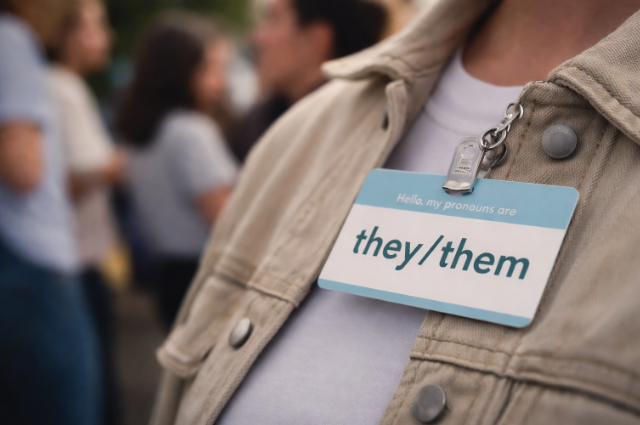
In everyday conversation, people use the word “they” without hesitation. When someone says, “Someone left their phone here,” nobody pauses to question the grammar. No one demands to know whether the person is singular or plural. The sentence flows naturally, understood by everyone. Yet the moment the same word is used to respect someone’s identity—“They prefer to be called by these pronouns”—a sudden confusion appears. The language that was effortlessly understood seconds ago is now declared too complicated.
This contradiction reveals something deeper about society. The resistance is not really about grammar or language. It is about discomfort, prejudice, and a long history of denying identities that do not fit traditional expectations.
India has always been far more diverse in gender and sexuality than many people are willing to admit. Ancient texts, temple carvings, and folklore contain references to people who did not conform to rigid gender categories. Communities such as the hijra community have existed for centuries, recognised socially—even if marginalised. Yet modern society often pretends that LGBT identities are some kind of “Western import,” a recent trend suddenly appearing in the 21st century. This claim ignores both history and reality.
One of the most common myths surrounding LGBT identities is that acknowledging them somehow threatens culture or tradition. But cultures are not static museum artefacts; they evolve with time. India’s social structure has already undergone massive changes over centuries—whether it was the abolition of practices like sati, the criminalisation of untouchability, or the gradual expansion of women’s rights. Each of these changes was once fiercely opposed in the name of tradition. Today, many of those same changes are widely accepted as necessary steps toward justice.
The debate around pronouns exposes a similar pattern. Critics often argue that learning someone’s preferred pronouns is inconvenient or unnecessary. But language constantly adapts to respect people. Titles like “Doctor,” “Professor,” or “Judge” are used without resistance because they acknowledge someone’s position. Calling a married woman by her chosen surname or respecting someone’s religious title is considered polite. Yet when a person simply asks to be referred to with pronouns that reflect their identity, the request is suddenly portrayed as unreasonable.
The inconsistency is striking.
Behind these arguments lies a deeper issue rarely discussed openly in Indian society: the silent pressure to conform. Many LGBT individuals grow up hiding who they are, not because they are unsure of their identity, but because they know the consequences of being honest. Families often prioritise social reputation over emotional well-being. The fear of gossip, stigma, and rejection becomes stronger than the willingness to understand.
The result is a quiet but devastating reality. Many LGBT individuals are pushed into forced marriages, expected to “correct” themselves through social pressure. Others live double lives—presenting one identity to their family and another to the outside world. Mental health struggles, isolation, and fear become constant companions. These experiences rarely appear in public discussions because silence protects the illusion that everything is normal.
Another myth often repeated is that LGBT rights are already “too visible.” Some argue that discussions about pronouns, gender identity, or sexual orientation are unnecessary or exaggerated. But visibility does not mean equality. Representation in media or occasional public discussions does not erase the everyday discrimination people face in workplaces, schools, and even within their own families.
The truth is that the difficulty people claim to have with pronouns is rarely about the word itself. It is about acknowledging that someone’s identity may exist outside traditional categories. Accepting that possibility challenges long-held assumptions about gender, family, and social roles.
Yet language has always been one of the simplest tools for showing respect. A pronoun is just a small word, but it carries recognition. It signals that a person’s identity is being acknowledged rather than erased.
Opponents sometimes argue that accommodating pronouns forces society to change its linguistic habits. But society has always adapted its language when necessary. Words enter and leave everyday speech constantly. New technology creates new vocabulary. Social awareness reshapes how people speak about race, disability, and mental health. Language evolves because society evolves.
What makes the debate around pronouns different is that it forces people to confront biases that are often hidden beneath polite silence.
In India, conversations about sexuality and gender identity are frequently avoided altogether.
Schools rarely provide comprehensive education about these topics. Families often treat them as taboo subjects. As a result, myths spread easily: that LGBT identities are temporary phases, that they are influenced by foreign culture, or that they can be “fixed.” None of these claims is supported by credible psychological or medical research, yet they continue to circulate widely.
The darker truth is that denial is easier than understanding. It is easier to dismiss someone’s identity than to question long-standing beliefs. It is easier to laugh at pronouns than to acknowledge the emotional cost of being constantly misidentified.
But ignoring a reality does not erase it.
Across India, countless people are quietly challenging these norms—students questioning outdated attitudes, activists advocating for legal protections, and families slowly learning to accept identities they once feared. Change is happening, but it is uneven and often fragile.
Language, in this context, becomes more than grammar. It becomes a test of empathy.
Using someone’s correct pronouns does not require a complete transformation of society. It requires something far simpler: the willingness to listen and respect another person’s sense of self. The word “they” has existed in English for centuries as a singular pronoun. It already functions naturally in everyday speech. The supposed complexity is largely imaginary.
What remains is a choice.
A society can decide that acknowledging diverse identities is unnecessary, inconvenient, or uncomfortable. Or it can recognise that dignity often begins with the smallest gestures—like the words used to address another human being.
The question, ultimately, is not whether pronouns are grammatically correct or linguistically complicated. The real question is whether a society that prides itself on the values of respect and coexistence is willing to extend that respect to people whose identities challenge traditional expectations.
If a single word can affirm someone’s existence, refusing to use it is not really about language.
It is about power.
And that leads to a difficult but unavoidable question: when a society chooses discomfort over empathy and silence over understanding, is it protecting its traditions, or simply justifying an injustice it no longer wants to confront?
REFERENCES
- https://www.oed.com
- https://en.wikipedia.org
- https://en.wikipedia.org
- https://www.overachievermagazine.com
- https://www.hinduamerican.org
- https://www.youthkiawaaz.com
- https://iciset.in
- https://minorityrights.org
- https://journals.sagepub.com
- https://www.betterlyf.com
- https://www.npr.org
- https://queer.ucsc.edu