
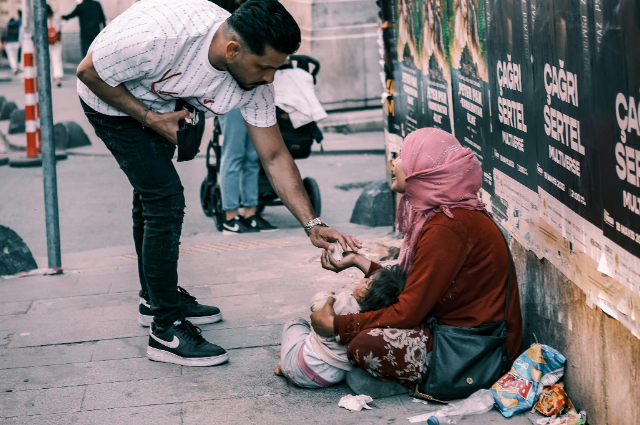
India’s poverty narrative is emotionally powerful: crowded shelters, overburdened welfare schemes, and millions dependent on state support. Yet buried within this reality is a less discussed distortion. For instance, where financially stable “professional beggars” exploit public sympathy and, in some cases, access benefits meant for the genuinely destitute. The issue is not about denying structural poverty; it is about understanding how loopholes and weak verification systems allow welfare diversion to occur.
One of the most cited examples is Bharat Jain from Mumbai, often described in media reports as the “world’s richest beggar.” His estimated net worth has been reported at approximately ₹7.5 crore, with ownership of a flat in Parel and rental shops in Thane. Despite this asset base, he reportedly continues to beg at high-footfall locations, earning daily cash income that can rival entry-level salaried jobs. Another reported case from Indore involved Mangilal, who was allegedly found during a municipal anti-begging drive to own multiple properties, vehicles, and to be operating informal lending activities. While individual details may vary over time, the pattern is consistent: sustained tax-free street earnings reinvested into appreciating assets.
The critical question is not whether such cases exist — documented media coverage confirms they do — but how they intersect with welfare allocation. Government housing schemes such as the Pradhan Mantri Awas Yojana (PMAY) and urban shelter programs operate under eligibility criteria based largely on income documentation, self-declaration, and local verification. In an economy where a significant portion of earnings remains cash-based and unrecorded, verifying true financial status becomes structurally difficult. A person who declares minimal income but controls unaccounted cash flow can appear eligible on paper.
When that happens, distortion occurs. Welfare housing is a scarce resource. Urban local bodies operate with limited units relative to demand. If even a fraction of beneficiaries misrepresent their financial status, genuinely homeless families move further down waiting lists. The cost is not symbolic — it is material. A diverted housing allotment means one less secure roof for a migrant labourer family or a widow without assets.
The mechanism enabling this is rooted in three systemic weaknesses. First, the informal cash economy. Daily alms in busy metropolitan zones can amount to ₹1,000–₹2,500, translating into annual income comparable to lower-middle-class wages, yet remaining undocumented. Second, fragmented identity and verification systems at municipal level. Local surveys often rely on physical observation rather than integrated financial audits. Third, weak enforcement consistency. Anti-begging drives periodically remove individuals from public spaces, but long-term financial scrutiny is rare.
This does not imply that most beggars are frauds. India continues to face multidimensional poverty across nutrition, healthcare, and employment. However, the existence of professionalised begging, sometimes linked to organised syndicates, introduces adverse selection into welfare systems. When policymakers design schemes for the poorest but operate in low-information environments, opportunistic actors exploit gaps. Over time, public trust erodes. Tax-paying citizens grow sceptical of welfare expenditure. Political narratives shift toward tightening eligibility, which can inadvertently harm the truly vulnerable.
The psychological layer intensifies the distortion. Public almsgiving operates on emotional immediacy. A commuter handing over ₹10 at a traffic signal conducts no background verification. Over the years, steady inflows accumulate. When reinvested in property or informal lending, this income compounds. The street becomes an untaxed micro-enterprise. In extreme cases, individuals who are asset-rich but income-poor on record may still qualify for benefits intended for those with neither assets nor income.
Behind the camera of India’s growth story — skyscrapers, startup culture, digital governance campaigns — persists a shadow economy that complicates welfare targeting. Corruption in this context is not always dramatic bribery. It is a procedural weakness. It is the tolerance of unverifiable income streams. It is fragmented data between the municipal, taxation, and welfare departments. A system that cannot reconcile asset ownership with declared income invites manipulation.
Policy responses must therefore move beyond sporadic crackdowns. Digitised asset linkage, integration of property records with welfare databases, and periodic financial audits for beneficiaries in high-risk categories would reduce leakage. Simultaneously, rehabilitation schemes such as the SMILE initiative aim to transition individuals away from street dependence through structured support. Without strict monitoring, however, rehabilitation risks becoming cyclical rather than transformative.
The darker implication is moral hazard. When individuals observe that visible poverty yields steady, unregulated cash flow plus potential welfare access, incentives distort. Informal earnings can outperform formal low-wage employment. If verification remains weak, the rational economic choice for some is to remain in visible deprivation while privately accumulating assets. That undermines both ethical norms and fiscal efficiency.
The phrase “taking homes from the genuinely poor” is not rhetorical exaggeration. Welfare housing operates under budget constraints. Every misallocated unit displaces someone else. In cities where informal settlements expand and rental markets remain unaffordable, the opportunity cost of fraud is high. The victim is rarely visible; it is the unnamed family still waiting.
India’s challenge is not eliminating compassion. It is aligning compassion with accountability. Emotional charity without structural verification sustains opacity. Welfare without cross-checked data invites diversion. Public anger directed blindly at all beggars is misplaced; so is naive denial of exploitation. A balanced approach requires acknowledging both systemic poverty and opportunistic misuse.
Until documentation systems match the scale and complexity of India’s informal economy, welfare leakage will not just continue — it will normalise. And when leakage becomes normal, injustice becomes invisible. The crorepati beggar is not merely an anomaly; he is a symptom of a deeper structural failure where opacity is profitable, and verification is optional.
Every misallocated home, every diverted subsidy, every manipulated eligibility form quietly reshapes the social contract. The state promises protection to the weakest, taxpayers fund that promise, and yet the benefits sometimes flow to those who understand how to exploit the cracks. The tragedy is not that a few individuals gamed the system. The tragedy is that the system allowed it — repeatedly.
Behind India’s digital dashboards and development slogans lies a harsher reality: growth without governance breeds shadow wealth, and compassion without accountability breeds distortion. The genuinely poor do not lose loudly. They lose silently — pushed further down waiting lists, further away from secure housing, further into generational instability.
If welfare meant for the homeless can be captured by those who already own property, then the question is no longer about poverty. It is about credibility.
And if a system cannot distinguish between desperation and deception — who, in the end, is it really protecting?