
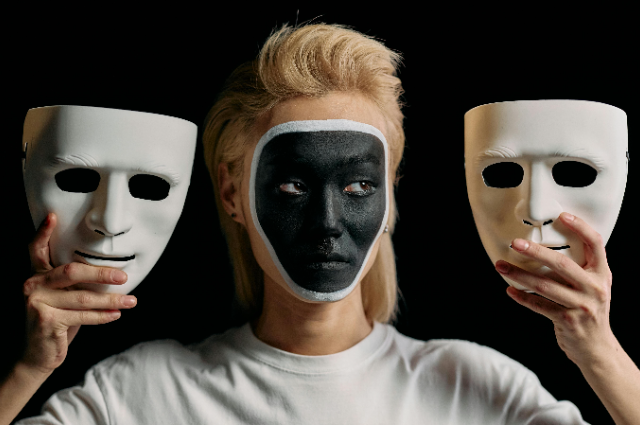
In a society that values stability and rewards normalcy, matching the societal template of ‘normal’ becomes a survival skill.
Masking is the voluntary suppression or alteration of emotions to fit into social norms and avoid social stigma. Chronic self-monitoring and regulation are leveraged to avoid rejection and stigma. If, according to the masses, masking helps people survive socially, then why does it leave them exhausted? When people are conditioned to project themselves as normal and to fit in with a larger crowd, they tend to develop an unconscious ability to hide their true selves and emotions. This is what masking is about.
When an individual makes a conscious effort to inhibit their emotions, instead of neutralising the stress, they merely suppress its outward expression. Internally, this results in the accumulation of stressors, hence triggering deeper distress and a diminished sense of purpose. This especially becomes emotionally taxing for one when suppression manifests as severe psychological distress, including clinical depression, anxiety, and substance abuse.
In addition to this, when this burden becomes too much, the avenues for help are often hindered by social stigma. Society’s glorification of ‘being strong’ is frequently framed through metaphors like ‘fighting’ an illness, which labels vulnerability as a burden. This social judgment compares individuals to mask their suffering even further to avoid being perceived as non-compliant.
Another major consequence of masking is the exacerbation of suicidal thoughts and behaviours. Robin Williams represents one of the most striking real-world examples of masking. He created a comedic persona centred around constant positivity. Behind this curated public image, he struggled with severe depression, anxiety, and substance abuse. His death by suicide in 2014 exposes how individuals can become so accustomed to performing normalcy that their distress remains invisible to society.
The gravity of this hidden crisis is reflected in global statistics. According to the World Health Organisation (WHO), approximately 7,26,000 people die by suicide every year. Ultimately, masking becomes a systemic requirement rather than a personal choice.
The “constant productivity nightmare” of modern stage capitalism has transformed the human being into a factory floor, where the act of masking is a mandatory operating system. To exist within this current economic system, individuals must engage in what Mark R. Leary and Robin M. Kowalski define as rigorous impression management.
Impression management refers to the act of altering the impressions one presents to other people or society as a whole. The study by Leary and Kowalski explains how impression management can pervade people’s minds to the point that they are ready to fundamentally alter their entire personality.
In a setting where one's livelihood depends on appearing perpetually resilient and indifferent to human emotions, the discord between one's internal state and the required professional facade turns into a rift that must be bridged through constant performance. This performance is constructed through impression construction, where individuals meticulously curate their identities and mannerisms in a way that helps them fit the role constraints that prioritise output over humanity.
The idea of masking is fundamentally related to emotional dysregulation. When a person performs ‘normalcy’, the transition from masking to emotional dysregulation often goes unnoticed. The active building of a facade to meet ‘role constraints’ eventually exhausts their inner mental energy.
This exhaustion triggers and wishes cycle where the mask no longer functions as a coping mechanism, but as a cage. The distress, having been denied an outlet, begins to manifest as a failure of self-regulation. This is the point where fatigue turns into a perpetual state of burnout.
Attempting to suppress a negative emotion often results in the emotion returning with greater intensity. Individuals become more prone to emotional outbursts because their emotions have not found a safe space in the first place.
In a productivity-obsessed culture, the productive worker is the symbol. Whenever a person can no longer maintain the symbol due to internal collapse, as a result of masking, they experience a total loss of self-worth, leading to what researchers call thwarted belongingness.
The real tragedy of masking is that when the internal cost becomes too high, the fear of social stigma forces the mask even tighter. Individuals feel that if they show their true dysregulated state and vulnerability, they will be a burden to their loved ones. This perception is a primary driver of suicidal ideation.
The “exhausting science of masking” proves that looking normal is not the same as being well. By valuing the metric of being productive over the health of the human, we create a world where the only way to survive is to alter one's real self.
. . .
References: