
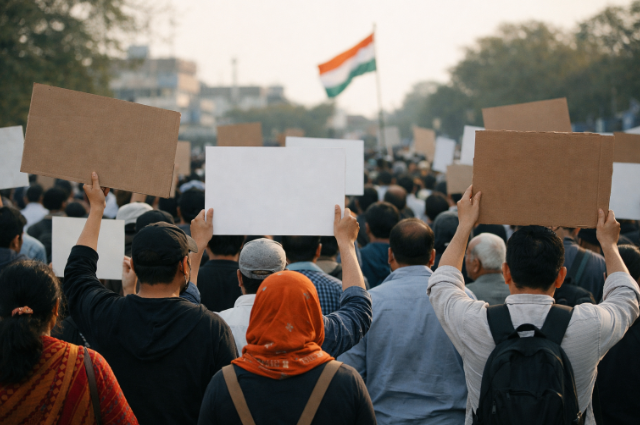
The Constitution of India establishes, in Article 19, that citizens have the fundamental right of freedom of speech and expression. Although these rights are not absolute and are subject to “reasonable restrictions,” the state has repeatedly misused the exceptions outlined in the article. Civil resistance and public disagreement are fundamental elements of democracies; however, they have been increasingly demonised in public discourse. Anti-terror and preventive detention laws originally designed for violent threats are increasingly being weaponised against students, journalists and intellectuals. Student activists and journalists are targeted through smear campaigns for expressing political opposition.
The legal architecture that enables this suppression constitutes laws like the Unlawful Activities (Prevention) Act, 1967 (UAPA), the National Security Act (NSA) of 1980, and the Jammu and Kashmir Public Safety Act (PSA), 1978. Amendments over the past decade have given the state even more power; the 2019 amendment of UAPA allows the government to designate individuals and organisations as terrorists. Furthermore, Section 43D(5) of the UAPA denies bail if the court believes the accusations against the accused are true at the preliminary stage. As a result, accused often spend years in jail without trial.
The Citizenship Amendment Act of 2019 triggered nationwide protests as it introduced religion-based criteria for citizenship, which many critics argued was contradictory to the secular foundations of the indian constituion. Umar Khalid and Sharjeel Imam, two student activists, were arrested in 2020 following controversial speeches during anti-CAA protests.
“They have been detained for more than five years without trial on politically motivated allegations – the charges against them should be dropped, and their release should be unconditional,” said Aakar Patel, Amnesty International India’s Chair of the Board.
These cases demonstrate the security-state nature of India rather than a democratic one, where national security and political power take precedence over human rights.
The Bhima Koregaon case exemplified a particularly pernicious dimension of detentions and human rights violations in India. It was a result of caste violence in Maharashtra in 2018 and culminated in allegations of a Maoist conspiracy involving academics and activists. Among them was Father Stan Swamy, an 84-year-old tribal rights activist charged under various sections of the Penal Code and UAPA.
Even in the face of severe health conditions like Parkinson’s disease, he remained in custody and ultimately died in July 2021 without conviction.
On the other hand, the situation in Kashmir represents one of the most nefarious instances of preventive detention of individuals. The Public Safety Act allows detention without any trial; UAPA cases are recurrently used to curb political expression. Khurram Parvez, a human rights advocate, was arrested on November 22, 2021, under allegations of “terrorism funding” and “criminal conspiracy”. His arrest was instigated by his documentation of human rights abuses in Kashmir that the state refuses to take accountability for. Fahad Shah, founder of Kashmir Walla, was arrested multiple times under UAPA and PSA. Sajad Gul and Irfan Mehraj have also been arrested under security legislation for reporting and civil society work.
These cases corroborate how journalism and documentation of abuses have been vilified as an “anti-national” activity by the Indian state. Kashmir has become a testing ground for anti-terror laws with no accountability.
This sets a continuing precedent, as seen in the case of Sonam Wangchuk, a Ladakh-based climate activist who initiated demonstrations demanding Sixth Schedule protections and statehood for Ladakh. He was detained under the National Security Act for causing “public disorder”. This case shows that even environmental activism is somehow viewed through a security lens and dismissed.
The use of anti-terror laws raises grave concerns about constitutional values. A democratic state has the responsibility to ensure its media is free and neutral, and the citizens are allowed to demand redress for injustices. Recurrent invocation of such laws risks transforming India into a security state, permanently under siege, rather than a democracy open to scrutiny. Arresting journalists and activists creates an atmosphere of fear when challenging narratives; media channels are banned and restricted for resisting state-sanctioned narratives. While India claims to be the largest democracy in the world, such crackdowns on freedom of speech invalidate its constitutional values. Although human rights organisations like Amnesty International have repeatedly released statements for the release of detained journalists, India has consistently neglected their demands. India ranked 151st out of 180 countries in the 2025 World Press Index released by Reporters without Borders (RSF); the country remains in the ‘very serious category”.
While national security remains a legitimate concern, the repeated use of UAPA, NSA, and PSA against nonviolent actors raises fundamental questions about India’s democratic character.
. . .
References: