
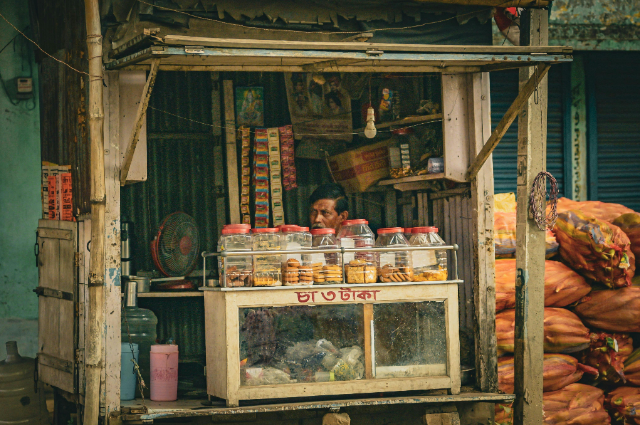
There is a sachet that costs five rupees and is available at every paan shop, every roadside kiosk, and every small general store in rural India. It is sold in cheerful packaging, marketed as a mouth freshener, priced low enough that a daily wage labourer does not need to think twice about buying it, and consumed with a casualness that suggests something harmless, even pleasant. It is gutka, and it is slowly draining the finances, the health, and the futures of the families least equipped to absorb either the cost or the consequences.
The numbers come not from a health advocacy organisation or a public interest litigation, but from India's own Household Consumption and Expenditure Survey 2023-24, the government's official tracking of how Indian households actually spend their money. What that data reveals is a story that sits uncomfortably alongside India's narrative of economic progress and poverty reduction. Rural households in India allocate approximately 2.5 per cent of their total consumption to education for their children. They allocate approximately 4 per cent to tobacco products. A meaningful portion of that 4 per cent is gutka. The government's own data confirms that across millions of poor Indian families, the mouth freshener is winning the budget battle against the schoolbook.
How Gutka took over
The scale of gutka's expansion in rural India over the past decade is remarkable by any measure. The share of rural households consuming gutka has risen nearly sixfold, from 5.3 per cent to 30.4 percent. Gutka now accounts for 41 per cent of total rural tobacco expenditure, making it the single largest tobacco product by value in rural India, more than bidis, more than cigarettes, more than any other form in which tobacco reaches the rural poor. It is not simply that gutka is popular. It is that it has become dominant with a speed that should have alarmed public health authorities, but did not alarm them sufficiently to produce any effective response.
The concentration of this consumption tells its own story about geography and poverty. Gutka consumption is heaviest in India's central belt, across Madhya Pradesh, Uttar Pradesh, Bihar, Chhattisgarh, and Rajasthan, the states that also consistently feature at the bottom of India's human development indicators. In rural Madhya Pradesh, more than six in ten households consume gutka. Uttar Pradesh has crossed the 50 per cent mark. These are not marginal numbers. They describe a majority behaviour in some of India's most populous and most economically vulnerable states.
And the trend is not stabilising. Between 2011-12 and 2023-24, adjusted for inflation, per capita spending on tobacco rose by 58 per cent in rural India and by a steeper 77 per cent in urban areas. The number of rural tobacco-consuming households grew from 9.9 crore, representing 59.3 per cent of rural households, to 13.3 crore, representing 68.6 per cent, a 33 per cent increase in just over a decade. India's rural economy has been growing in this period. The tobacco industry has been growing faster than the economy within it.
Who pays the price
The distribution of tobacco consumption across income groups destroys one of the most convenient assumptions in public health policy, which is that rising incomes will naturally push people away from unhealthy expenditures. In rural India, over 70 per cent of households in the bottom 40 per cent of the income distribution consume tobacco. In Uttar Pradesh, Madhya Pradesh, and Bihar, that figure exceeds 85 per cent. Poorer rural households spend a larger share of their income on tobacco, at 1.7 per cent, than the wealthiest 20 per cent of rural households, who spend 1.2 per cent. The burden, as with most things in India's rural economy, falls hardest on the people with the smallest margins.
The practical meaning of this is not abstract. If a smoker or gutka user in India's poorer income brackets redirected what they currently spend on tobacco toward food, they could add over 500 calories to the daily diet of one or two children. The family that spends on gutka is, in a measurable and direct sense, making a trade-off with nutrition. This is not a trade-off; they are consciously choosing. It is one that addiction, habit, cultural practice, and marketing have made for them, while the household budget absorbs the consequences invisibly.
The Five-Rupee logic
Understanding why gutka is so difficult to displace from the consumption patterns of India's poorest workers requires understanding what the five-rupee sachet actually represents in the life of an informal labourer or a migrant worker.
A man who breaks bricks for eight hours in a north Indian summer, or who loads and unloads goods at a mandi for twelve, or who works construction under a foreman who will replace him tomorrow with someone else if he slows down, does not have many available sources of relief at the end of or during that shift. He cannot afford a cold drink or a proper meal at regular intervals. He may be too tired to find conversation restorative. The gutka sachet does several things simultaneously. It provides a brief chemical stimulation through the nicotine and areca nut combination. It suppresses hunger, functioning as a cheap mechanism for getting through a shift when three meals a day are not financially guaranteed. It participates in a social ritual, the shared offering and acceptance of gutka between workers, that creates a moment of camaraderie in an otherwise exhausting and often lonely working life.
This is why the argument that poor people simply need to make better choices in their expenditure fails to engage with the actual conditions under which those expenditure decisions are made. The gutka sachet is not competing only with a school fee or a nutrition expenditure in the mind of the person buying it. It is competing with the absence of any other affordable form of relief at all. Until that absence is addressed, the sachet will win.
The cultural dimensions of gutka use run deeper than economic utility. In parts of rural India, tobacco products, including gutka, are present at wedding rituals and religious ceremonies, functioning as social currency rather than merely personal consumption. The myths surrounding gutka's properties, that it aids digestion, relieves dental pain, acts as a genuine mouth freshener, and manages stress, are deeply embedded and actively reinforced by peer networks. These beliefs do not yield easily to health warnings printed on packaging that the buyer often cannot read.
The health cost nobody budgets for
Gutka is an oral tobacco product, which means its primary health consequences are not the lung diseases associated with smoking. They are oral cancers, oesophageal cancers, and submucous fibrosis, a progressive condition that causes stiffening of the mouth lining, making eating increasingly difficult, and which carries a significant risk of malignant transformation. These are diseases that develop slowly and are diagnosed late in populations with limited access to preventive healthcare. By the time a rural gutka user presents at a public health facility with symptoms of oral cancer, the disease is frequently advanced, treatment is expensive, and the family's capacity to absorb the economic shock of a serious illness is already stretched beyond what it can bear.
Tobacco is responsible for 13 lakh deaths annually, according to India's own Ministry of Health and Family Welfare. It contributes to lung cancer, chronic obstructive pulmonary disease, heart disease, and the oral and oesophageal cancers that are the specific burden of smokeless tobacco users. The economic analysis of this burden is equally damning. For every 100 rupees the government receives in excise tax on tobacco products, a cost of 816 rupees is imposed on society through healthcare expenditure, lost productivity, and the cascading economic disruption that serious illness creates in households with no savings, no insurance, and no capacity to absorb an unexpected expense. The tobacco tax, in other words, does not come close to covering what tobacco costs. The difference is paid by the sick, by their families, and by the public health system that treats them.
The ban that was not really a ban
In 2012, the central government and multiple state governments banned gutka under the Food Safety and Standards Act, prohibiting the mixing of tobacco with food products. For a brief moment, this appeared to be a meaningful regulatory intervention. The manufacturers responded within months by splitting the product into two separate pouches, one containing pan masala, classified as a food product, and another containing plain tobacco, classified separately, sold together as a bundle for the consumer to mix at the point of use. The product that arrived in the consumer's hand was functionally identical to the gutka that had been banned. The regulatory framework had been outmanoeuvred by a packaging redesign.
The Supreme Court flagged this twin-sachet workaround as early as 2016, noting that the evasion was open, obvious, and ongoing. A decade after that observation, the practice continues without meaningful disruption. The enforcement infrastructure that should have closed this loophole, the food safety officials, the state licensing authorities, and the tax and excise bodies, have not done so at the scale required to make the ban functional. The result is that India has a gutka ban on paper and a gutka industry in practice, and the rural households that the ban was partly meant to protect are consuming more gutka than at any point in the country's recorded history.
The poverty trap hidden in plain sight
What makes the gutka crisis particularly difficult to address through conventional policy tools is that it is not simply a public health problem, an addiction problem, or a regulatory failure. It is all of these things operating simultaneously and reinforcing each other through mechanisms that span addiction biology, household economics, cultural practice, and political economy.
The household that spends 1.7 per cent of its income on tobacco is not making this choice freely in the way that economic theory imagines choice. Nicotine addiction creates a compulsion that operates below the level of deliberate budgetary decision-making. The cultural embeddedness of gutka use means that stopping is not only a matter of personal will but of social negotiation within communities where gutka sharing is a form of belonging. The hunger suppression function means that for some workers, gutka is partly a substitute for food they cannot afford, so that reducing gutka expenditure would not automatically free up money for nutrition because the hunger it was suppressing would then need to be addressed another way.
Public health experts have consistently warned that tobacco use is not just a consequence of poverty but an active mechanism of poverty reproduction. The household that spends on tobacco is not reallocating that money to nutritious food, to the child's school fees, or to savings that could cushion the next economic shock. The data from the HCES 2023-24 confirms that as incomes rise, households are not naturally moving away from tobacco expenditure. They are continuing to spend on tobacco while spending more in absolute terms on other things. The tobacco expenditure is sticky in a way that undermines the assumption that development and income growth will solve the problem without targeted intervention.
What actually works
The evidence on tobacco control globally is clearer than the Indian policy response would suggest. Significant and sustained tax increases on tobacco products, particularly on cheap smokeless tobacco products like gutka, are the single most effective tool for reducing consumption among price-sensitive, lower-income users. Plain packaging requirements reduce the product's social attractiveness, particularly among young people who are still forming consumption habits. Mass media campaigns that address specific myths, particularly the myth that gutka is a mouth freshener or a digestive aid, have shown effectiveness in contexts where they are adequately funded and sustained. Community health worker programmes that integrate tobacco cessation into existing maternal and child health contacts can reach populations that would never seek cessation support independently.
None of these interventions is being implemented at the scale that the problem demands. Tobacco taxes in India remain below the World Health Organisation's recommended threshold of 75 per cent of the retail price for tobacco products. The twin-sachet loophole has not been closed by legislation that would categorically prohibit the sale of pan masala and tobacco products in proximity to each other. The public health messaging on gutka, specifically, as opposed to smoking, is insufficient relative to the scale of smokeless tobacco's burden. And the deeper structural conditions that make gutka attractive to the informal labourer, the hunger, the exhaustion, the absence of affordable alternatives, are addressed by policies that sit in entirely different government departments with no mechanism for coordination.
The real Mistake
The title of this article describes what is happening in rural India as a mistake. It is worth being precise about whose mistake it is. The labourer who buys the five-rupee sachet is not making a mistake in the sense that a better-informed, less constrained version of himself would obviously have chosen differently. He is responding rationally to the conditions in which he finds himself, with the options available to him, against the backdrop of an addiction that many of his neighbours and coworkers share.
The mistakes are structural. The mistake of a regulatory system that bans gutka and then watches manufacturers openly circumvent the ban for a decade without consequence. The mistake of a tax policy that keeps smokeless tobacco cheap enough that price is no barrier to consumption among the poor. The mistake of public health campaigns that address smoking more vigorously than gutka, despite the latter's faster growth and disproportionate burden on the rural poor. The mistake of treating tobacco consumption as a personal health choice rather than as what the data shows it to be: a poverty trap operating within households, diverting income from nutrition and education toward an addiction that will eventually cost those same households far more in healthcare than it ever cost them in sachets.
The HCES 2023-24 data is a government document. It does not advocate. It does not editorialise. It simply records what Indian households spend their money on. What it records is that the poorest families in India's most economically vulnerable states are spending more of their money on gutka than on their children's education, that this share has been growing for over a decade, and that the policy response to this fact has been, at best, inadequate. The sachet costs five rupees. The cost to the family, to the child who needed that money for something else, and to the public health system that will eventually treat the consequences, is considerably higher.
References:
- Household Consumption and Expenditure Survey 2023-24, Ministry of Statistics and Programme Implementation, Government of India — https://mospi.gov.in
- Ministry of Health and Family Welfare, Government of India, Tobacco Control — https://mohfw.gov.in
- World Health Organisation, Tobacco Taxation and Pricing — https://www.who.int
- Food Safety and Standards Authority of India, Gutka and Pan Masala Regulations — https://www.fssai.gov.in
- Supreme Court of India, Twin-Sachet Tobacco Case Documentation, 2016
- Global Adult Tobacco Survey India 2016-17, Ministry of Health and Family Welfare — https://mohfw.gov.in