
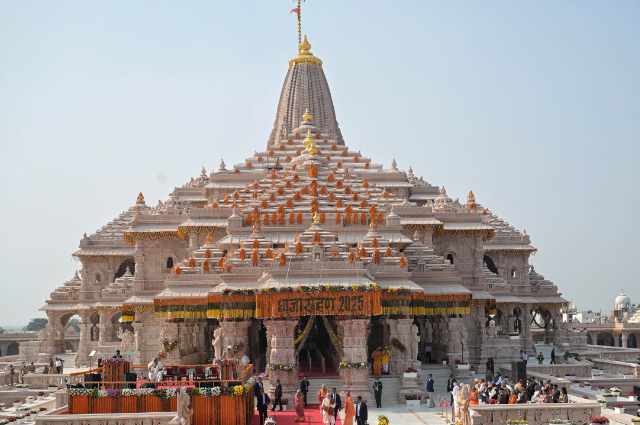
On January 9, 2024, two weeks before one of the most anticipated events in recent Indian public life, a monk in saffron robes sat before a camera and asked a question that nobody in power wanted to answer. Swami Avimukteshwaranand Saraswati, the 46th Shankaracharya of Jyotish Peeth in Uttarakhand, posed it: if Prime Minister Narendra Modi was going to inaugurate the Ram Mandir in Ayodhya, touch the idol, and serve as the ceremony's central figure, then what exactly was a Shankaracharya supposed to do there? Stand behind him and clap?
It was not a rhetorical question. It was a theological and constitutional one. And the fact that it landed like a political grenade says everything about the state of the relationship between religion and politics in India today.
The Institution Behind the Controversy
To understand what happened in January 2024 and everything that has followed since, it is necessary first to understand what a Shankaracharya actually is. The title, which translates as teacher of the ways of Shankara, refers to the heads of the four great Hindu monasteries, or mathas, established by the philosopher-monk Adi Shankara in the 8th century CE. Adi Shankara travelled the length and breadth of the Indian subcontinent, debating rival philosophical schools, consolidating the Advaita Vedanta tradition, and placing a monastery at each of the four cardinal points of the land: Jyotir Math in Badrinath to the north, Govardhan Math in Puri to the east, Sharada Math in Dwarka to the west, and Sringeri Math in Karnataka to the south. These four institutions, and the Shankaracharyas who lead them, represent the most ancient and formally structured religious authority within the Advaita tradition of Hinduism. Their heads are not elected by popular vote or appointed by any government. They are chosen through an internal process of spiritual succession within each monastery, and their authority derives entirely from their mastery of scripture, tradition, and dharma.
When all four Shankaracharyas speak on a matter of religious correctness, they are not offering one opinion among many. They are speaking from the deepest institutional roots of Sanatan Dharma. This is why what they said in January 2024 carried the weight it did.
An Incomplete Temple, A Very Timed Ceremony
The Ram Mandir in Ayodhya is built on ground that has been disputed for centuries. The Babri Masjid, a 16th-century mosque, stood on land that millions of Hindus believed to be the birthplace of Lord Ram. The legal dispute over this land ran through the Indian courts for decades. In November 2019, the Supreme Court of India delivered its verdict, awarding the site to the Hindu petitioners while explicitly condemning the demolition of the mosque in 1992 as an illegal act. A trust was constituted to oversee the construction of the temple. Construction began.
With the 2024 Lok Sabha elections scheduled for April and May, Prime Minister Modi announced that the Pran Pratishtha, the consecration ceremony of the Ram Lalla idol, would be held on January 22, 2024. The immediate problem, noted by religious scholars and then by the Shankaracharyas, was that the temple was not finished. Large portions of the complex remained under active construction. Under the Hindu Dharma Shastras, the sacred scriptures that govern ritual practice, the consecration of a deity in an incomplete temple is not a minor procedural irregularity. It is a violation of the foundational rules of the ritual itself.
On January 4, 2024, Swami Nischalananda Saraswati, the Shankaracharya of Govardhan Math in Puri, announced that all four Shankaracharyas would not attend the ceremony. He explained that the Prime Minister would perform the consecration, touch the idol, and serve as the principal host of the event. He was conscious, he said, of the dignity of his position as a Shankaracharya, which is recognised in the tradition as the highest religious office in Sanatan Dharma. He saw no role for himself at what was fundamentally someone else's event. Five days later, Swami Avimukteshwaranand of Jyotish Peeth made the theological dimension of the objection explicit. The shastras were being ignored. The temple was incomplete. There was, he said, no justification for the rush. Swami Sadananda Saraswati, the Shankaracharya of Dwarka, also declined his invitation, citing the anti-religious nature of some of the controversies surrounding the ceremony. The Shankaracharya of Sringeri, Swami Bharati Tirtha, chose a different path, neither publicly condemning the ceremony nor attending it, and issued a statement through his monastery's official website dismissing media reports that he was displeased with it.
Avimukteshwaranand, in an interview with journalist Karan Thapar for The Wire, went further. He drew a distinction that cut straight to the heart of the matter. Religious Hindus who understood and respected the shastras, he said, were not happy with the consecration of a half-built temple. Only political Hindus were celebrating it. He clarified, carefully and explicitly, that his position was not anti-Modi. He was not anti-Modi, he said. He was simply unwilling to be anti-dharma.
The government's response was instructive. Rather than engaging with the theological substance of the objection, BJP leaders accused the Shankaracharyas of introducing politics into a religious event. Fake content was circulated online, including a claim that Avimukteshwaranand had visited the Ajmer Sharif Dargah, implying he was secretly sympathetic to Islam. He denied ever having visited the city of Ajmer at all. Union Minister Narayan Rane publicly said the Shankaracharyas should bless the temple rather than criticise it.
The ceremony went ahead on January 22, 2024, with Prime Minister Modi in the role of chief host. Thousands of seers from across the country attended. The event was broadcast live across television channels and generated enormous public enthusiasm. Three months later, India went to the polls.
What the Ballot Box Said
The BJP had expected the Ram Mandir consecration to serve as the symbolic culmination of its Hindutva project and a major electoral dividend. In the Faizabad constituency, which includes Ayodhya itself, the sitting BJP MP Lallu Singh was defeated by Awadhesh Prasad of the Samajwadi Party, a Dalit leader, in what became one of the most symbolically significant results of the entire 2024 election. The BJP, which had won 303 seats in 2019 on its own majority, fell to 240 seats in 2024, short of the 272 needed for a parliamentary majority and forced to govern in coalition for the first time since 2014. In Varanasi, Prime Minister Modi's own constituency, his margin of victory fell sharply compared to previous elections.
Analysis by multiple institutions, including the Bloomsbury Intelligence and Security Institute and Georgetown University's India Politics Program, concluded that voters in Ayodhya and the surrounding region had chosen candidates based on local grievances about healthcare, employment, and economic development rather than on the Ram Mandir. The political scientist Irfan Nooruddin of Georgetown observed that what should have been the BJP's signature moment, the unveiling of the completed Hindu nationalist dream, failed to produce the electoral sweep the party expected because ordinary voters were weighing it against their daily economic realities.
After the results were declared, the BJP went almost entirely silent on the subject of Ram. In his first address to allied parties after the election outcome, Modi did not mention Lord Ram once. Chief Minister Yogi Adityanath, who had campaigned aggressively in Ram's name, also fell silent on the subject in his post-election communications. The Wire documented this abrupt silence and noted that BJP-affiliated social media accounts, which had spent months celebrating Ayodhya, pivoted rapidly to attacking the voters of the constituency for their result.
The Controversy Deepens: 2025 and 2026
If the Ram Mandir episode was the opening chapter of the Shankaracharya controversy, it was not the closing one. Swami Avimukteshwaranand continued to occupy a turbulent space at the intersection of religion and politics through 2024, 2025, and into 2026, in ways that illustrated how deeply tangled that intersection has become.
In June 2024, when the BJP attacked Congress leader Rahul Gandhi for remarks in his first speech as Leader of the Opposition, characterising the remarks as calling Hindus violent, Avimukteshwaranand came publicly to Gandhi's defence. He said he had listened carefully to the full speech and that Gandhi had clearly stated Hinduism does not endorse violence. This brought him sharp criticism from BJP-aligned figures and social media commentators who accused him of being an instrument of the Congress party. A year later, in May 2025, Avimukteshwaranand reversed course and formally excommunicated Rahul Gandhi from Hinduism, stating his monastery accused Gandhi of insulting the Manusmriti, a foundational Sanskrit legal text, in remarks made in the Lok Sabha.
In September 2022, he strongly opposed the demolition of ancient temples to make way for the Kashi Vishwanath Corridor development in Varanasi. In 2023, he publicly claimed that 228 kg of gold had gone missing from the Kedarnath temple in Uttarakhand, which he called a gold scam. He opposed the construction of a replica Kedarnath temple in Delhi, arguing the original temple belonged in the Himalayas. In early 2026, he held the Yogi Adityanath government responsible for mismanagement following a deadly stampede during the Kumbh Mela.
On Mauni Amavasya, January 18, 2026, Avimukteshwaranand travelled to the Triveni Sangam at Prayagraj's Magh Mela to take the sacred ritual bath. Police prevented him from proceeding, citing the absence of formal permission and the scale of his accompanying group, estimated at between 200 and 300 followers. His associates alleged he was physically manhandled by personnel at the site, a charge the district administration denied. He began a sit-in protest at the Sangam. The Prayagraj administration then issued him a legal notice questioning his right to use the title of Shankaracharya of Jyotish Peeth, citing a pending Supreme Court case regarding his appointment. The notice was widely seen as an act of official harassment against a critic of the ruling party.
The episode split the BJP itself. Uttar Pradesh Deputy Chief Minister Keshav Prasad Maurya publicly paid his respects to Avimukteshwaranand, described him as the Shankaracharya, and said any disrespect to a revered saint was unacceptable. Chief Minister Yogi Adityanath took an opposing position in the state assembly, supporting the administration's action and pointedly calling the entire controversy was politically motivated. Pro-government religious figures, including the Treasurer of the Shri Ram Janmabhoomi Trust, called Avimukteshwaranand a fake Shankaracharya. Meanwhile, the Congress and the Samajwadi Party rushed to defend the monk, sensing an opportunity to use a senior Hindu religious authority as a vehicle to deflect the BJP's Hindutva positioning.
A BJP leader, speaking to The Print anonymously, captured the party's dilemma with unusual honesty. If the BJP supported the Shankaracharya, its own cadre would be unhappy because of his criticism of the government. If it attacked him, it risked being seen as anti-Hindu, given that he held one of the highest religious positions in the faith.
The Deeper Question This Raises
The Shankaracharya controversy, in all its layers, is not simply a story about one monk and one ruling party. It is a story about what happens to a country's religious life when politics colonises it so thoroughly that even the most ancient and formally constituted religious authorities become pieces on a political chessboard.
The BJP's relationship with Hinduism has always been strategic rather than devotional, and the distinction matters. The Ram Mandir movement that carried the party to power in the early 1990s was powered by a genuine popular sentiment among millions of Hindus who regarded the temple as a matter of historical justice. The party channelled that sentiment with extraordinary political skill. But channelling religious sentiment for electoral purposes and actually respecting religious authority are very different things. The moment Avimukteshwaranand raised a legitimate theological objection to the consecration of an incomplete temple, the response from the party was not engagement with the argument but suppression of the critic, including the spread of fake content about his religious practices.
This is not a new pattern in Indian politics. The Congress, in its decades of power, also used religious symbolism selectively, mobilising pilgrims, inaugurating shrines, and crafting its own language of Hindu cultural identity when electoral conditions demanded it. What has changed under the current period is the scale and the systematisation of it. The BJP built its entire political architecture around Hindutva as an ideology, made it the frame through which national identity was to be understood, and then discovered that when actual religious authorities spoke from within that tradition in ways that complicated the political narrative, it had no graceful mechanism for responding.
The 2024 election results, particularly the loss of Faizabad, suggested that Indian voters are more sophisticated about this dynamic than the political class often gives them credit for. People in Ayodhya, who lived in proximity to the most celebrated temple inauguration in post-independence India, voted for their economic and social needs rather than the spectacle that had been built around them. They made a distinction, quietly, in the voting booth, between a political event staged in religion's name and the actual conditions of their daily lives.
That distinction is one that the Shankaracharyas had been trying to articulate from the start. Avimukteshwaranand said it most plainly when he observed that only political Hindus were happy with the consecration, not religious ones. He meant that those who understood what the shastras required, who measured the ceremony against the standards of the tradition rather than the standards of electoral optics, found it wanting. The country held a vote four months later. In the constituency where the temple stood, the voters seemed to agree.
Whether India can build a political culture in which religion is respected as a domain with its own internal standards and authorities, rather than harvested as a mobilisation resource, is one of the most consequential questions facing its democracy. The Shankaracharya controversy did not answer it. But it made the question impossible to look away from.
. . .
References:
- The Wire, Full Text of Shankaracharya Interview with Karan Thapar on Ram Temple Consecration — https://m.thewire.in
- The Week, All Four Shankaracharyas Not to Attend Ram Mandir Consecration — https://www.theweek.in
- The Print, Ram Temple Not Yet Complete, so Pran Pratishtha Against Shastras, Says Shankaracharya — https://theprint.in
- The Quint, It's Politics Not Sanatan: Ayodhya Saints Divided Over Ram Mandir Consecration — https://www.thequint.com
- WION, Ram Temple Four Shankaracharyas to Skip Inauguration — https://www.wionews.com
- The South First, Sringeri Shankaracharya Won't Attend Ram Mandir Consecration — https://thesouthfirst.com
- Business Today, All Four Shankaracharyas to Skip Ayodhya Ram Mandir Inauguration — https://www.businesstoday.in
- The Wire, BJP Forgets Ram After UP Debacle — https://m.thewire.in
- The Print, Avimukteshwaranand: Seer Who Skipped Ram Temple Consecration — https://theprint.in
- The Wire, UP Notice to Avimukteshwaranand Over Use of Shankaracharya Title — https://m.thewire.in
- The Print, UP Government Divided Over Avimukteshwarananda — https://theprint.in
- The Print, Congress Springs to Defence of Shankaracharya Who Expelled Rahul Gandhi — https://theprint.in
- The Federal, Shankaracharya Row Flares Again — https://thefederal.com
- Business Today, Govindananda Saraswati Calls Avimukteshwaranand Fake Shankaracharya — https://www.businesstoday.in
- Britannica, Bharatiya Janata Party — https://www.britannica.com
- Journal of Right-Wing Studies, UC Berkeley, Ayodhya, Hindu Nationalism, and India's 2024 Elections — https://jrws.berkeley.edu
- Council on Foreign Relations, Religion and Foreign Policy Webinar: India's 2024 General Elections — https://www.cfr.org
- Bloomsbury Intelligence and Security Institute, India's Evolving Political Landscape — https://bisi.org.uk
- The Diplomat: Has Hindutva Peaked in India? — https://thediplomat.com
- Foreign Affairs, The Staying Power of India's Hindu Right — https://www.foreignaffairs.com