
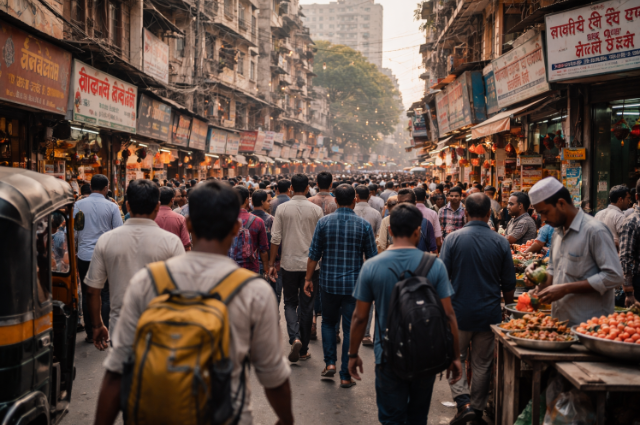
In a country as linguistically rich as India, language is usually a bridge—something that connects people across regions, cultures, and identities. But at times, it can also become a line of division. In Maharashtra, a state known for its strong cultural pride and deep-rooted linguistic identity, Marathi holds a special place. It is the language of the land, history, and everyday life for millions.
Yet, in recent years, a different conversation has been gaining ground—one that is less about pride and more about pressure. There have been growing concerns that in some situations, people are being compelled, directly or indirectly, to speak Marathi. More troubling is the pattern that seems to accompany these incidents: those who face harassment are often the most vulnerable—migrant workers, small shopkeepers, and daily wage earners—while those with influence and power remain untouched.
This is not just a debate about language. It is a story about power, inequality, and the way identity is enforced in everyday life.
Where It Starts: Everyday Interactions Turning Tense
For many migrants in Maharashtra, especially in cities like Mumbai, Pune, and surrounding areas, language is part of daily negotiation. A delivery worker might speak Hindi. A shopkeeper might speak a mix of languages. A construction worker may know only their native tongue.
Most of the time, people manage. India has always functioned on a kind of informal multilingualism—switching languages, mixing words, adjusting as needed. But sometimes, things take a different turn.
There have been repeated instances where individuals were stopped, questioned, or confronted simply for not speaking Marathi. What begins as a request—“Speak in Marathi”—can escalate into something far more uncomfortable, even aggressive.
And when it escalates, it rarely happens in a balanced way.
When Pressure Turns Into Abuse
In 2025, several incidents came into the spotlight that made people sit up and question what was happening.
In one case from Mira Road, a shopkeeper was physically assaulted by individuals linked to a political group because he refused to speak Marathi. The incident was caught on camera, and the video spread quickly, triggering outrage.
In another case in Vasai-Virar, an autorickshaw driver was tracked down and beaten after a video of him saying he wouldn’t speak Marathi went viral. He was forced to apologise publicly while being assaulted—a moment that was as disturbing as it was revealing.
In Pune, a man was confronted and made to apologise simply for speaking Hindi. The video again circulated widely, sparking debates about intolerance and identity.
What connects these incidents is not just the language issue, but the nature of the response—public humiliation, physical violence, and forced compliance.
And perhaps more importantly, the kind of people who were targeted.
Who Gets Targeted—and Who Doesn’t
A pattern becomes hard to ignore when you look closely.
The people who are confronted are almost always those with limited power:
- Small shopkeepers
- Drivers
- Street vendors
- Delivery workers
These are individuals who depend on a daily income. They cannot afford conflict. They are less likely to file complaints or pursue legal action. In many cases, they simply apologise and move on—because they have no other choice.
Now compare this with another reality.
Mumbai is home to some of the biggest celebrities in the country. Many of them primarily speak Hindi or English in public spaces. Corporate professionals, influencers, and business elites operate comfortably in non-Marathi environments every day.
But do we see them being stopped, questioned, or assaulted for not speaking Marathi?
Almost never.
This contrast has not gone unnoticed. Even political figures have pointed it out. Maharashtra minister Nitesh Rane questioned whether those enforcing Marathi dare to confront influential individuals who don’t use the language.
It’s a sharp observation—and an uncomfortable one.
Because it suggests that this isn’t just about language. It’s about who can be challenged and who cannot.
Political Messaging: Pride or Pressure?
Language has always been part of political identity in Maharashtra. Leaders across parties have spoken about the importance of Marathi, often framing it as something that must be protected.
Chief Minister Devendra Fadnavis, for instance, emphasised that Marathi would remain central in the state’s functioning. At the same time, he also condemned violence, clearly stating that hooliganism in the name of pride would not be tolerated.
Deputy Chief Minister Ajit Pawar, responding to rising tensions, suggested that non-Marathi speakers should at least express willingness to learn the language—an attempt to ease friction, but also a reflection of the expectation that adaptation should come from one side.
There have also been criticisms of more aggressive rhetoric in the past, particularly speeches that frame language as a marker of loyalty or belonging. While not all such statements directly call for action, they can influence how supporters interpret and act on them.
That’s the tricky part about political messaging. Even when it is not explicitly calling for coercion, it can create an environment where people feel justified in enforcing it themselves.
The Legal Reality
Legally speaking, the situation is very clear.
No one in Maharashtra is required by law to speak Marathi in personal or everyday interactions. While Marathi is the official language for administration, individuals are free to use any language in their daily lives.
Harassment, intimidation, or violence over language is not just wrong—it is illegal.
But the gap between law and reality can be wide.
When incidents happen on the street, in local markets, or in informal settings, enforcement becomes difficult. Victims often lack the resources or support to pursue justice. And so, the cycle continues.
Why This Hits the Poor the Hardest
Language, in this context, becomes a kind of gatekeeper.
For someone with money, education, or influence, language is flexible. You can choose what to speak, where to speak it, and with whom.
For someone struggling to make a living, language can become a condition for survival.
If speaking Marathi becomes an unspoken requirement for doing business or avoiding conflict, then those who don’t know it are automatically at a disadvantage.
And when enforcement is selective—targeting only those who are easy to intimidate—it deepens existing inequalities.
This is what makes the issue more than just cultural. It becomes structural.
The Bigger Problem: Fear vs. Respect
At its heart, the issue raises a simple question: can a language truly thrive if it is enforced through fear?
Marathi, like any language, carries immense cultural richness—literature, history, identity. People learn and embrace languages when they feel welcomed into them, not when they are forced.
When someone is slapped, threatened, or humiliated for not speaking a language, it doesn’t create respect. It creates resentment.
And that resentment doesn’t just affect individuals—it affects how entire communities perceive each other.
Finding a Better Way
None of this means that Marathi shouldn’t be promoted. It absolutely should be. Preserving language is important, and encouraging people to learn it is a valid goal.
But the method matters.
A more inclusive approach could look like:
- Making Marathi learning accessible and welcoming
- Encouraging its use without penalising other l
- Ensuring strict action against harassment
- Promoting pride without turning it into pressure
Because in a place as diverse as Maharashtra, coexistence is not optional—it’s essential.
What’s happening in parts of Maharashtra is not just about language. It’s about how power operates in everyday life.
When only the poor are questioned, when only the vulnerable are targeted, and when the powerful are left untouched, the issue stops being about cultural pride. It becomes about inequality.
Language should connect people, not divide them. It should be something people choose to embrace, not something they are forced into.
And if there’s one thing this debate makes clear, it’s this: respect cannot be demanded through fear—it has to be earned through inclusion.
References
- Times of India – Marathi slapgate row: CM Devendra Fadnavis says hooliganism will not be tolerated https://timesofindia.indiatimes.com
- India Today – Shopkeeper thrashed for refusing to speak Marathi https://www.indiatoday.in
- India Today – Nitesh Rane slams language-based violence https://www.indiatoday.in
- Hindustan Times – Ajit Pawar speaks out amid assault cases over Marathi row https://www.hindustantimes.com
- Times of India – Auto driver beaten for not speaking Marathi https://timesofindia.indiatimes.com
- IndiaTimes – Pune video: man forced to apologise for speaking Hindi https://www.indiatimes.com
- Wikipedia – Maharashtra Navnirman Sena https://en.wikipedia.org
- Constitution of India – Official Language Provisions