
India creates. The West commodifies. India is told to be grateful for the attention."
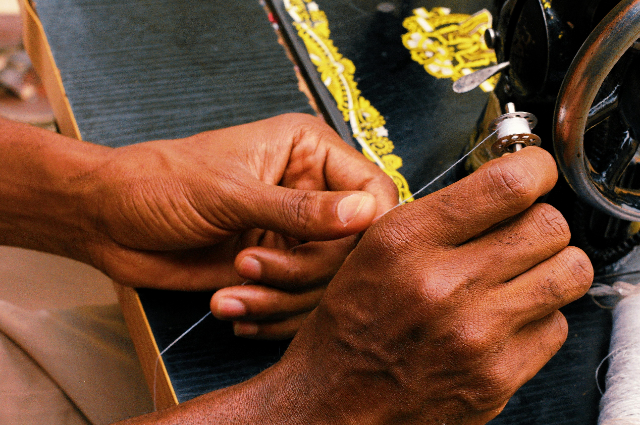
There is something deeply disorienting about watching the world fall in love with everything India created, while continuing to treat Indians themselves as somehow lesser. The yoga mat in a Manhattan studio. The turmeric latte on a London café menu. The Kolhapuri chappal on a Milan runway. The mirror-work dress was heralded by American magazines as the wedding guest dress of the summer. The jhumka on a Paris runway is described as a vintage aesthetic. The mehendi on a celebrity's hands at a music festival is called exotic body art. The bindi on a pop star's forehead at an awards show is treated as a spiritual accessory. Every one of these things came from India. Every one of them has been packaged, rebranded, stripped of its context, sold back to the world under someone else's label, and made into someone else's profit.
And the people who created the knowledge, refined it over centuries, and passed it through generations in homes and temples and forests and workshops across the subcontinent, are either not credited, not compensated, or not welcome in the very countries that built fortunes on what was theirs.
This is not a new story. It is a very old one, wearing new clothes. Colonial powers extracted India's physical wealth for centuries. It's spices, its textiles, its gold, its diamonds, the Kohinoor that still sits in a British crown despite repeated Indian demands for its return. What is happening now is the same extraction applied to intangible wealth: to knowledge, to craft, to design, to the intellectual and spiritual inheritance of one of the oldest civilizations on earth. The mechanism is different. The outcome is the same.
The Jhumka That Ralph Lauren Called Vintage
At Paris Fashion Week in early 2026, models walked the runway in Ralph Lauren's Fall 2026 women's collection wearing large silver bell-shaped earrings. The brand's caption described them simply as vintage accessories, part of a corporate dandy aesthetic. Anyone who had grown up in India recognised them immediately: they were jhumkas, one of the most distinctively Indian ornaments in existence, worn across the subcontinent for over two thousand years.
The jhumka is not a generic bell earring. It is a design with a documented history stretching back to 300 BC, visible in temple sculptures, classical dance iconography, and royal jewellery across South India and the Deccan. It evolved under the Chola dynasty, absorbed Mughal influence through centuries of court culture, and became a pan-Indian symbol of femininity, celebration, and cultural identity. When Ralph Lauren's team designed earrings that replicated this form precisely and described them as vintage without a single word of credit to the Indian tradition they were drawing from, it was not an oversight. It was a choice.
The brand's caption simultaneously highlighted Native American collaborators in the same collection, drawing immediate and pointed comment online: he is okay crediting Native American artists but not South Asians. The selective acknowledgement illustrated exactly how the hierarchy of cultural respect operates in Western fashion. Some stolen things get credit when the backlash is loud enough. Indian heritage, apparently, could still be called vintage and moved along.
The Kolhapuri Chappal That Prada Sold for a Lakh
At Milan Fashion Week's menswear presentations in June 2025, Prada sent models down the runway in brown leather sandals with distinctive toe rings and intricate stitching, which the brand initially described as leather flat sandals. Within hours of the show images appearing online, the Indian internet had a single, unified response: those are Kolhapuri chappals.
The Kolhapuri chappal is a handcrafted leather sandal with roots in Maharashtra and Karnataka stretching back to the 12th or 13th century. It holds a Geographical Indication tag that legally protects its authentic origin, and is sold in its original form by the craftspeople who make it for between ₹400 and ₹3,500. Prada's version was priced at over one lakh rupees. The artisans in Kolhapur who spend their working lives perfecting the craft received no credit, no collaboration fee, no acknowledgement of any kind.
Prada, after the outrage, did acknowledge the Indian connection and subsequently opened dialogue about potential collaboration. But the initial failure to credit, followed by a collaboration offer only after public pressure, captured the dynamic precisely: India's heritage is worth engaging with commercially, but only after it has been taken and only after the taking becomes inconvenient.
The Cost of Appropriation: A Comparison
| Product | Artisan Price(INdia) | Luxury Retail Price (West) | Markup |
| Kolhapuri Chappal | ₹400 – ₹3,500 | ₹1,00,000+ (Prada) | 2,400% |
| Mukaish Coat | ₹15,000 (Workmanship) | ₹2,00,000 (Dior) | 1,200% |
| Jhumka Earrings | ₹2,000 – ₹5,000 | ₹45,000+ (Ralph Lauren) | 800% |
Mirror work, known in its original form as shisha embroidery, is a traditional craft that originated in Gujarat and Rajasthan, where artisans attached tiny mirrors onto fabric using intricate decorative stitches. The technique has been practised for centuries, passed from mother to daughter and from master craftsperson to apprentice, embedded in the ritual and celebratory fabric of communities across western India.
In 2025, a popular American fashion media outlet ran a feature declaring that Gujarati mirror-work dresses were the wedding guest dress of the summer. The piece described the aesthetic with enthusiasm. It did not mention Gujarat. It did not mention Rajasthan. It did not mention shisha embroidery or the artisans who developed the craft. It presented the style as a trend, as if it had materialised from the general atmosphere of global fashion rather than from the specific hands and specific knowledge of specific communities in a specific part of India. Harper's Bazaar India, in its August 2025 issue, called this out directly, noting that the craft's origins were once again invisible in a Western celebration of the aesthetic it produced.
Dior's Two-Lakh Coat and the Mukaish That Built It
Mukaish is a form of embroidery that originated in Lucknow, Uttar Pradesh, in which fine metallic wire is passed through fabric to create a glittering, delicate surface. It is among the most skilled and labour-intensive of India's traditional textile arts, practised by a small number of artisans who have spent years learning a technique that takes extraordinary precision and patience to execute well.
In 2025, Dior showcased a coat at a major presentation that used Mukaish embroidery techniques. The coat was priced at approximately ₹2,00,000 at international retail prices. The show notes did not mention Mukaish. They did not mention Lucknow. They did not mention the Indian artisans whose specific, historically developed skill had produced the embroidery that made the coat what it was.
The same house had, in its Pre-Fall 2023 collection presented at the Gateway of India, partnered with the Chanakya School of Craft, highlighted 25 Indian embroidery techniques, and credited the artisans prominently. That moment was genuinely different in its intention. The 2025 Mukaish coat was a regression to the older pattern, suggesting that the acknowledgement of Indian craft is something Dior does selectively, rather than as a consistent standard.
The Bindi That Gwen Stefani Made Cool and Indians Got Mocked For
The bindi is not a beauty mark. It is not a festival accessory. It is a religious and cultural emblem with a documented history in Hindu tradition stretching back thousands of years, representing the Ajna chakra, the seat of hidden wisdom. In the 1990s, Gwen Stefani began wearing bindis as part of her stage aesthetic. Suddenly, the bindi was cool. It spread into festival fashion, onto the foreheads of Vanessa Hudgens and Kylie Jenner at Coachella, and into Claire's Accessories stores as a Halloween costume item. ASOS at one point listed bindis as Halloween accessories.
The particular cruelty of this pattern: when Hindu women in the West wear the bindi, they are mocked and called backwards. When a white pop star wears the same bindi, it is called a fashion statement. The object is the same. The treatment of the person wearing it is determined entirely by whether they are from the culture it belongs to.
Henna That Became Henna Art and Lost Its Story
Mehndi, the application of henna in intricate patterns, is a ritual practice centuries old in Indian, Pakistani, and Bangladeshi traditions. In Indian culture, it is applied to brides at pre-wedding ceremonies as a symbol of auspiciousness, fertility, and the binding of two families. The depth of colour the henna produces is traditionally said to reflect the depth of the husband's love.
The West discovered henna and rebranded it as henna art, a temporary tattoo, available at music festivals and shopping mall kiosks. The word mehndi disappeared. The context disappeared. What remained was the brown stain on the skin, separated from every meaning it had ever carried. It is worth noting, for accuracy, that henna use as a plant dye predates its Indian tradition, with evidence in ancient Egypt and the Middle East over 5,000 years ago. What India uniquely created is mehndi as a ceremonial art form with specific regional styles, ritual significance, and cultural meaning, and that is precisely what the West appropriated without credit.
The Paisley That Scotland Claimed and Kashmir Forgot
The teardrop-shaped curved motif that the Western world calls paisley originated entirely in India, specifically in the buta, a curved floral form developed over centuries in the Kashmiri shawl tradition. European traders, unable to replicate the quality of the Kashmiri original, mass-produced the pattern in textile mills in Paisley, Scotland, in the 18th century. The town gave the pattern its Western name. The Kashmiri artisans who created it were not credited, not compensated, and not remembered.
Etro, the Italian fashion house, has used a variant of the paisley print as its signature motif since the 1980s, crediting its founder's collection of Kashmiri shawls as the inspiration. The inspiration is acknowledged. The living artisan tradition in Kashmir receives no share of the value Etro built on their ancestors' craft.
The Cummerbund, the Bandana, and the Khaki
The cummerbund, a staple of black-tie dress codes across the Western world, derives directly from the kamarbandh, a waist binding worn in Mughal and Rajput court dress. British officers adopted it in India during the colonial period and it became institutionalised in Western formal wear with its Indian origin entirely unacknowledged. The bandana, ubiquitous in Western casual wear, originated directly from Bandhani, the tie-dye textile tradition of Rajasthan and Gujarat. Khaki, the colour that defines military uniforms and casual trousers globally, is a Hindi and Urdu word meaning dust-coloured, adopted by British colonial forces in India, whose practical innovation introduced it to the world.
The Gucci Turban and the Chanel Sari
In 2019, Gucci created what it called an Indy Full Turban, a headwrap listed for $790 on Nordstrom's website, marketed as a fashion accessory. The turban is not a fashion accessory in Sikh culture. It is a dastar, a sacred article of faith, a mark of honour, self-respect, courage, spirituality, and piety. Selling a version of it as a luxury accessory, with no context and no acknowledgement of what it means to the community for whom it is sacred, is not fashion-forward. It is erasure with a price tag.
Karl Lagerfeld's Paris/Bombay 2012 pre-fall collection for Chanel sent models down the runway in saris and bindis. The sari, one of the most complex and regionally specific garments in human textile history, was presented as a dramatic silhouette for a Western fashion house's collection rather than as what it is: a garment that carries within its draping traditions the specific cultural identity of specific communities across an enormous and diverse country.
The Patents That Should Never Have Existed
The most legally documented dimension of this story is biopiracy. In 1995, two scientists at the University of Mississippi were granted a US patent for the use of turmeric powder to heal wounds. The idea that this was a novel discovery would have been laughable to any Indian grandmother. Turmeric had been used for exactly this purpose since before recorded history, documented in the Charaka Samhita, which predates the American patent system by approximately two thousand years. India challenged the patent, compiled thirty-two pieces of documentary evidence from ancient texts, and the USPTO revoked it in 1997.
The neem patent, granted to W.R. Grace at the European Patent Office in 1994 for antifungal properties of neem that Indian farmers had been applying for generations, was revoked in 2000. The Basmati rice patent, granted to Texas-based RiceTec in 1997 for strains developed from Himalayan varieties cultivated for centuries, was partially challenged and amended. A country should not have to fight to prove it owns its own ancestral knowledge. India fought anyway and won.
From Library to Algorithm: India's AI-Powered Defence
In direct response to these biopiracy battles, the Indian government established the Traditional Knowledge Digital Library in 2001, a systematic translation and digitisation of ancient Indian medical and botanical texts into five international languages, specifically to make India's prior art accessible to patent examiners around the world who otherwise had no way to know it existed. The TKDL today contains over 5.2 lakh formulations and practices drawn from Ayurveda, Unani, Siddha, Sowa Rigpa, and Yoga, and has been used to block or withdraw close to 370 erroneous patent applications globally.
In July 2025, India became the first country in the world to launch an AI-powered version of the TKDL, praised by the World Health Organisation as a landmark step in global traditional knowledge protection. The upgraded system uses machine learning to automatically scan global patent filings in real time, flagging applications that attempt to claim rights over Ayurvedic formulations, Yogic practices, or other Indian traditional knowledge before those patents are granted rather than after. This is not a defensive library anymore. It is a proactive technological shield. AI is now being turned against the very mechanism that was used to steal India's knowledge, identifying suspicious applications instantly rather than waiting for a costly, years-long legal battle after the patent has already been granted. As of February 2026, eighteen patent offices across the world, including the European Patent Office, the US Patent and Trademark Office, and most recently Brazil's INPI, have signed access agreements with the TKDL. India has moved from defending its past to using the future as its weapon.
"India is not just defending its heritage. It is using Artificial Intelligence to make sure it can never be stolen again."
The Mathematics, the Zero, and the Surgery the West Forgot to Credit
The appropriation of Indian heritage runs into the foundations of modern knowledge itself. The decimal number system, which makes all modern mathematics and computing possible, is an Indian invention. It is now called Arabic numerals in Western education, a credit to the transmission route rather than to the origin. Plastic surgery was practised in ancient India, described in the Sushruta Samhita composed approximately in 600 BC. British surgeons observed nasal reconstruction being performed in India in the 18th century and brought the technique to Europe, where it became the foundation of modern reconstructive surgery, presented in Western medical history as a European development. The philosophy of treating the human being as a unified system of body, mind, and spirit, now marketed in the West as integrative or holistic medicine, is the foundational philosophy of Ayurveda, documented in texts that predate the Western concept of integrative medicine by two thousand years.
Earn From India, Look Down on Indians
The most galling dimension of all of this is that it coexists, with apparently no sense of contradiction, alongside rising racism and hostility toward Indians in the very countries that are most enthusiastically profiting from Indian cultural heritage. A study by Stop AAPI Hate found that more than 75 per cent of anti-Asian slurs on social media between December 2024 and January 2025 targeted South Asians, predominantly Indians. The Institute for Strategic Dialogue found that posts containing anti-South Asian slurs on X increased by over 1,350 per cent from 2023 to 2024. Moonshot tracked more than 44,000 slurs targeting South Asians in extremist online spaces during May and June of 2025 alone.
In Canada, hate crimes against South Asians increased by 143 per cent between 2019 and 2022. Indian students who paid high fees to study in Canadian institutions were scapegoated in a national political conversation about housing shortages. In Ireland in 2025, racially motivated attacks against the Indian community included violent assaults targeting children, prompting the Indian embassy to issue safety warnings. In the United Kingdom, a video of London's Mayor Sadiq Khan celebrating Diwali was met with comments including Deport button please and The UK is Christian, celebrate Christian holidays.
This is the same world that sells Golden Milk at a premium in London health food stores and calls it a superfood discovery. The same world whose fashion houses travel to India to source embroidery techniques and runway inspiration. The same world whose wellness industry is built on yoga, meditation, Ayurveda, and turmeric. When an Indian woman wears a bindi, she is conservative and traditional. When a Western pop star wears the same bindi, it is a fashion statement. When an artisan in Kolhapur makes a chappal by hand and sells it for ₹400, it is a local craft. When Prada presents the same chappal on a Milan runway, it is a luxury creation worth a lakh.
What Claiming It Back Looks Like
India is not passive in this story. The turmeric patent was fought and won. The neem patent was fought and won. The TKDL was built and upgraded with AI. The Geographical Indication registry now protects Darjeeling tea, Basmati rice, Kolhapuri chappals, Kanjivaram silk, Mysore silk, Alphonso mangoes, and hundreds of other Indian products and traditions from fraudulent foreign claims. The United Nations declared June 21 as International Day of Yoga in 2015, with India's proposal receiving support from a record 177 nations. Countries including China, South Korea, and Indonesia are now building their own traditional knowledge databases modelled on India's TKDL.
These are meaningful victories. They are also a measure of how much energy India has had to expend defending what should never have required defence. The knowledge was always Indian. The tradition was always Indian. The civilization that produced it was always one of the most sophisticated and richly developed in human history. The fact that it required legal battles, diplomatic campaigns, digital libraries, AI systems, and UN resolutions to establish itself formally is a commentary on the world that India has had to operate in, not on any weakness in India's claim.
"A country that gave the world its number system, its medical philosophy, and its spiritual practices does not need to be taught what civilisation looks like."
References
- The Bridge Chronicle, Ralph Lauren's Jhumka Controversy — https://www.thebridgechronicle.com
- CNN, India Beckons Western Fashion Brands, But Their Cultural Missteps Can Be Costly, July 2025 — https://www.cnn.com
- Outlook Luxe, Kolhapuris in Milan, Bandhani in Stockholm: Why Fashion Still Fails Indian Culture, July 2025 — https://luxe.outlookindia.com
- Harper's Bazaar India, India on the Runway: Where Inspiration Ends, and Appropriation Begins, August 2025 — https://www.harpersbazaar.in
- Mondaq, Traditional Knowledge and Patent Issues: Turmeric, Basmati, Neem Cases — https://www.mondaq.com
- WIPO Magazine, Protecting India's Traditional Knowledge — https://www.wipo.int
- CSIR, Traditional Knowledge Digital Library — https://www.csir.res.in
- Word of India, India Launches AI-Powered Traditional Knowledge Digital Library, July 2025 — https://wordofindia.com
- PIB India, India and Brazil Sign TKDL Access Agreement, February 2026 — https://www.pib.gov.in
- CNLU, Protecting AYUSH As A Traditional Knowledge In The AI Era, January 2026 — https://www.cnlu.ac.in
- Stop AAPI Hate, Keeping Count: Anti-South Asian Hate: It's Gotten Worse, 2025 — https://stopaapihate.org
- The AIDEM, Rising Tides of Hate: Anti-Indian Sentiment in the West — https://theaidem.com
- Centre for the Study of Organised Hate, Anti-Indian Racism on X: July to September 2025 — https://www.csohate.org
- Niles West News, Why Bindis Should Not Be a Fashion Trend — https://nileswestnews.org
- Everyday Feminism, 11 of the Most Culturally Appropriated South Asian Accessories — https://everydayfeminism.com
- The Print, Yoga, Haldi Doodh, Kolhapuris: Protect Indian Culture From West — https://theprint.in