
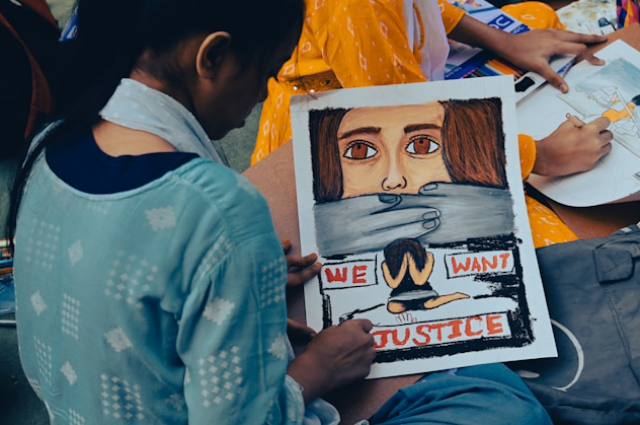
On August 9, 2024, a 31-year-old postgraduate trainee doctor went to rest in the seminar hall of RG Kar Medical College and Hospital in Kolkata after an exhausting shift. She was raped and murdered inside the hospital, in a space meant for healing, by a person who had access to the premises. Her body was found the next morning with severe injuries. Within days, hundreds of thousands of people took to the streets across West Bengal and across the country, holding candles, carrying placards, and asking the same question that Indians had asked in December 2012, and in September 2020, and in dozens of other moments before and between those dates: why does this keep happening, and why does the system keep failing the women it happens to?
India reported 33,356 rape cases in 2023 alone, according to the National Crime Records Bureau. That is an average of 91 rapes every single day. And that number represents only the cases that were reported. The National Family Health Survey found that upwards of 80 percent of women who experience sexual violence in India never report it. The actual scale of the problem, invisible in official data, is a multiple of what the NCRB records. For more than a decade, since the Nirbhaya case of 2012 triggered sweeping legal reforms, the reported numbers have rarely fallen below 30,000 cases a year. The laws changed. The crime did not.
Understanding why requires looking at something that sits deeper than legislation, deeper than policing, and deeper than the courts. It requires looking at the mindset that decides, before a case is ever filed, before a police station is ever entered, before a lawyer is ever briefed, that the woman who was violated is somehow, in some part, responsible for what was done to her.
The Numbers Behind the Crisis
The NCRB's data, analyzed in a comprehensive October 2024 report by the Commonwealth Human Rights Initiative, reveals patterns that should be impossible to ignore. Between 2014 and 2022, rape cases registered under the SC/ST Prevention of Atrocities Act, covering crimes against Dalit women, more than doubled as a proportion of total rape cases, from 6.08 percent to 13.46 percent. Between 2015 and 2021, sexual violence crimes against Dalit women rose by 45 percent. Dalit women are not just overrepresented among rape victims. They are specifically and disproportionately targeted, and when they are, the criminal justice system fails them at a rate that the data describes as a clear mockery of justice.
The conviction rate for rape in India has remained below 28 percent across the years studied, and in the category of rape and gangrape with murder, it has remained closer to 16 percent across the six-year period from 2017 to 2022, touching as low as 9.12 percent in 2020. The acquittal rate in special courts for crimes against Dalit women under the SC/ST Act stands at 63.1 percent for rape. The pendency rate, cases that remain undecided, stands at 89.44 percent for rape in these courts. Cases wait for years. Witnesses lose memory or lose courage. Accused men walk free on bail and threaten survivors and their families. In Unnao, a rape survivor was set on fire on her way to court by her attackers, one of whom had been released on bail. The system that was supposed to protect her had, in effect, put her in the path of the people who would kill her.
The Cases That Told a Country About Itself
The 2012 Delhi gangrape, which killed Jyoti Singh after thirteen days of fighting injuries that her doctors described as the worst they had ever seen, produced the Criminal Law Amendment Act of 2013, the most comprehensive reform of rape law in India's post-independence history. The definition of rape was expanded. Minimum sentences were increased. Fast-track courts were established. The death penalty was made available for the most aggravated cases. The legal architecture, after Nirbhaya, was more robust than it had ever been.
And then, in September 2020, a 19-year-old Dalit girl in Hathras, Uttar Pradesh, was gang-raped by four upper-caste men in a field. The attack left her with a severed tongue, a fractured spine, and internal injuries so severe that she died in a Delhi hospital on September 29, 2020. When her family went to the police station to file a report, officers significantly delayed the process. No arrests were made in the first ten days after the crime. And then, in the early hours of September 30, 2020, before her family could perform their own final rites, police cremated her body at the site, reportedly without her family's consent, in an act that independent observers and legal experts described as a deliberate destruction of forensic evidence.
Only one of the four accused was eventually found guilty, of culpable homicide rather than rape, after the forensic evidence that could have conclusively established the sexual nature of the assault had been eliminated in the cremation. The elected officials of Uttar Pradesh initially sided with the accused, a response that political analysts linked to the vote-bank importance of upper-caste communities in the state. The Hathras case was not just a story about sexual violence. It was a story about how caste, political power, and institutional failure collaborate to ensure that certain women, specifically women from the lowest rungs of a hierarchical society, are denied justice as a matter of systemic practice, not just individual failure.
The Kolkata doctor's case in August 2024 added another dimension. She was not a Dalit woman in a rural field. She was an educated professional in a major metropolitan hospital, in a workplace governed by institutional rules and equipped with security. Her case demolished the most common argument used to dismiss rape as a problem of specific circumstances: that it happens to women who are in the wrong place, at the wrong time, wearing the wrong things, doing the wrong things. She was at work. In a hospital. Doing a night shift. The rape culture that killed her did not care about any of that.
The Mindset That Protects Perpetrators
Victim blaming is not an informal social attitude that exists despite the legal system. In India, documented instances show that it exists within the legal system, expressed through the mouths of lawyers and judges who are supposed to administer justice neutrally.
Mukesh Singh, one of the Nirbhaya convicts, told a documentary filmmaker from prison: you can't clap with one hand, it takes two hands. A girl is far more responsible for rape than a boy. His defense lawyer, AP Singh, made the same argument from the other side of the bar: should I not ask what she was doing with her male friend out so late at night? These statements were made in connection with a case in which a woman was violated with an iron rod and thrown from a moving bus onto a road. The suggestion that she bore some responsibility for what was done to her was not considered professionally disqualifying for the lawyer who made it.
This is not an isolated attitude. Dr. Madhumita Pandey, a criminologist, conducted firsthand interviews with 100 convicted rapists in Tihar Jail. The finding she documented was consistent across her subjects: most of them believed they had done nothing wrong. Their reasoning, drawn directly from the culture around them, was that a woman who was out at night, or who smiled, or who was in a relationship with the man, or who was wearing particular clothes, had communicated consent through those facts. They had absorbed, from the society that produced them, a framework in which a woman's body was available to men under circumstances that men got to define, and in which rape was not a crime against a person but a misunderstanding about what the circumstances meant.
Courts have produced rulings that reflect a similar framework. In a 2021 case, a judge granted bail to a government employee who raped a minor and suggested the accused consider marrying the victim. In another ruling, a judge asked a rape victim whether she would agree to marry her attacker, saying that if she agreed the matter would be settled. Judges have reduced sentences in rape cases because the survivor was in a prior relationship with the accused, treating prior consent as ongoing consent. Courts have granted bail to accused men on the grounds of the young man's future, a concern that was not extended to the survivor whose future had been irrevocably altered.
Marital rape remains legal in India. The law does not recognize that a wife can be raped by her husband, on the grounds that marriage constitutes ongoing consent to sexual activity. This position, maintained in the law despite repeated challenges, tells every married woman in India that her body is not fully her own, and tells every man in a marriage that the law agrees with him if he believes the same. The Supreme Court has heard petitions on this, and the question remains unresolved in formal jurisprudence as of early 2026.
What Bollywood Teaches and What Society Absorbs
Victim blaming does not emerge fully formed from individual personalities. It is manufactured and continuously reinforced by cultural products that hundreds of millions of people consume from childhood. Bollywood, which is the largest film industry in the world by number of films produced and among the most culturally influential in India, has spent decades presenting a version of courtship in which a woman's refusal is the opening move of a romance. The hero pursues the woman who says no. He follows her, teases her, touches her without permission, and is eventually rewarded when she relents. This pattern, repeated across generations of films, teaches its audience that a woman who says no does not mean it, that persistence is attractive rather than threatening, and that the boundaries a woman draws around herself exist to be overcome rather than respected.
It also manufactures the conditions in which victim blaming feels natural. If the culture tells you that women who go out at night are inviting attention, that women who dress in particular ways are communicating availability, and that women who interact with men outside their families are making a choice about what happens to them, then the person who absorbs that culture and commits a rape has a ready-made vocabulary for dismissing his responsibility. And crucially, so does everyone around him.
The social stigma that attaches to rape victims in India, rather than to perpetrators, is the most powerful enforcer of underreporting. A woman who has been raped faces the possibility of being considered unmarriageable in communities where marriage is an economic necessity. She faces the possibility of being blamed by her own family for bringing shame on them. She faces the possibility of being disbelieved by the police officer she tells, questioned about her character and her past relationships, and told that she should settle the matter within the family. She faces the possibility that if she persists, the accused will be granted bail and will return to threaten her. She faces the realistic prospect, given the conviction rate data, that even if she endures all of this, the outcome will be an acquittal. The calculation that makes 80 percent of survivors choose silence is entirely rational, given what the system and the society around it have shown them about what speaking will cost.
What Changed, What Did Not, and What Still Needs To
The Criminal Law Amendment Act of 2013 was a genuine and substantive improvement in the law. The POCSO Act, protecting children from sexual offences, introduced in 2012 and strengthened since, has created a more robust framework for prosecuting crimes against minors. Fast-track courts for rape cases, established after Nirbhaya and expanded through the Nirbhaya Fund, have improved the speed of some trials in some states. One Stop Centres for survivors, providing medical, legal, and psychological support under one roof, handled 1,058 cases in 2024 alone, up from 651 in 2023, a meaningful increase in reach even if the absolute number remains a fraction of the need.
What has not changed is the culture that produces the crime and then protects the perpetrator from its consequences. A law that criminalizes rape does not automatically produce a police officer who takes a complaint seriously. It does not produce a judge who does not ask a survivor whether she will marry her attacker. It does not produce a community that does not blame a woman for what was done to her. It does not produce a film industry that stops teaching young men that no means try harder. Legal reform is necessary. It is not sufficient.
The conviction rate data makes the gap between law and practice visible in its starkest form. India has had a law against rape since before independence. It has strengthened that law repeatedly, in 1983, in 2013, and through the Bharatiya Nyaya Sanhita of 2024 which replaced the Indian Penal Code. And yet fewer than 28 percent of the men tried for rape are convicted. The law exists. The culture that ensures its non-enforcement also exists, and it is older, more deeply rooted, and more resistant to amendment than any statute.
Jyoti Singh's mother, Asha Devi, who named her daughter publicly because she refused to let the shame rest on the victim, said after the hangings of the four adult convicts in March 2020 that the battle was not over. She was right. The doctor in Kolkata in August 2024 was raped and murdered twelve years after Jyoti Singh. The legal framework that governed her case was stronger than the one that existed in 2012. The mindset that made her unsafe, in a hospital, at work, in a city that was supposed to be safer than the rest, had not changed enough. It has not changed enough because changing a law is something a parliament can do in a session. Changing a culture requires confronting, honestly and persistently, the beliefs that the culture has been teaching for generations, in films, in classrooms, in courtrooms, and in the conversations that families have at home about what their daughters should and should not be allowed to do, and what their sons are and are not allowed to expect.