
For more than four decades, the war between Iran and Israel existed everywhere except on a battlefield. It lived in proxy militias and assassination programs. It emerged in uranium centrifuges spinning underground and in Hezbollah rockets fired across borders. The language of annihilation that Iranian leaders used publicly always maintained a careful distance from direct confrontation. Both sides understood, implicitly, that crossing the line from shadow war to open conflict would be a point of no return.
On June 13, 2025, Israel crossed it.
What followed was twelve days that permanently altered the strategic landscape of the Middle East — the most consequential short-duration conflict of the early 21st century, fought across thousands of miles of airspace, through layers of missile defence systems, inside hardened underground bunkers, and in the cities where ordinary people were simply trying to live. By the time the ceasefire took effect on June 24, the nuclear program Iran had spent thirty years building was in ruins. Three of its most senior military commanders were dead. And the United States, which had publicly stayed out, had quietly entered the war in its final days with the largest stealth bombing mission since Iraq.
This is the story of those twelve days.
The Road to June 13
To understand why Israel struck when it did, you have to understand what the months before June 2025 looked like from Jerusalem.
The JCPOA — the 2015 nuclear agreement that had placed limits on Iran's enrichment program — had been effectively dead since America's withdrawal in 2018. Years of sanctions, maximum pressure, and failed negotiations had not stopped Iran's centrifuges. By early 2025, Iran was enriching uranium to 60 per cent purity — a level with no credible civilian justification, sitting one technical step below weapons-grade. IAEA inspectors were being restricted. A new hardened enrichment facility had been announced. Netanyahu was telling anyone who would listen that Iran could have a functional nuclear weapon within months, possibly less than a year.
When Donald Trump returned to the White House in January 2025, he asked Israel to hold off. His administration wanted to try diplomacy first. They sought a new nuclear deal, negotiated from a position of maximum economic pressure. Israel agreed to wait. Talks began. Then, in early June, they stalled. Iran began ramping up enrichment again. The window, in Israeli military planners' judgment, was closing.
The assassination of Hezbollah's leader Hassan Nasrallah in early 2025 had already removed what many analysts considered the most credible deterrent against a direct Israeli strike on Iran. Hezbollah's top leadership had been systematically decimated. Hamas had been militarily degraded in Gaza. Iranian proxy networks in Syria had been hollowed out. For the first time in years, Israel calculated that it could strike Iran without triggering a catastrophic response from its northern and southern flanks simultaneously.
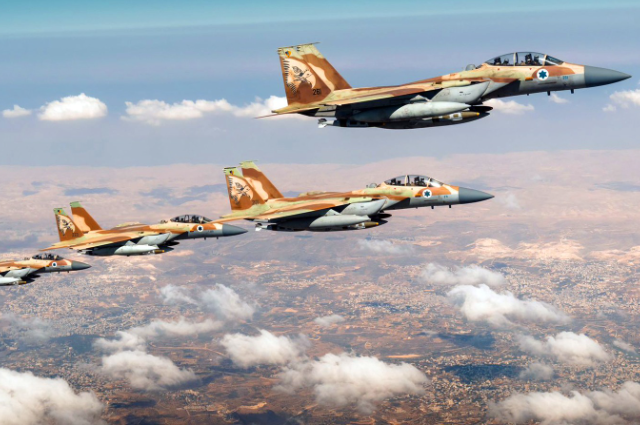
Netanyahu later said publicly that he personally chose the name Operation Rising Lion, drawn from a biblical prophecy about Israel rising like lions from adversity. In the pre-dawn hours of June 13, 2025, more than 200 Israeli fighter jets lifted off and surged across Iraqi airspace toward Iran.
June 13 — The Opening Hours
The strikes began before most of Tehran was awake.
By 6:30 in the morning Israeli time, the Israeli Air Force had already launched five separate waves of strikes. More than 200 fighter jets dropped more than 330 munitions on approximately 100 targets across Iran. These were not symbolic strikes. They were the product of what analysts later described as years of sustained intelligence preparation — a systematic infiltration of Iranian air defences, communication networks, and facility layouts so thorough that by the time the first munition fell, Iran's ability to track and respond to the attack was already compromised.
The opening salvo hit simultaneously in multiple locations. Natanz, Iran's primary uranium enrichment facility north of Isfahan, was struck and significantly damaged. Air defence installations were taken out in a suppression campaign designed to blind Iran before the main waves arrived. Ballistic missile storage sites and launch infrastructure were targeted. And in a set of coordinated assassinations carried out in the opening minutes — some by air, some by Mossad operatives on the ground — the operation killed three of the most senior figures in Iran's military hierarchy simultaneously.
Hossein Salami, the commander-in-chief of the Islamic Revolutionary Guard Corps, was killed. Mohammed Bagheri, the chief of staff of Iran's armed forces, was killed. Amir Ali Hajizadeh, the commander of the IRGC's aerospace and missile forces — the man directly responsible for overseeing Iran's ballistic missile program — was killed. Along with them, multiple nuclear scientists whose names Iran would not confirm for weeks were also killed in their homes and in meetings. On June 28, state funerals in Tehran buried 60 people, including military commanders and scientists killed in the opening strikes. Two regional sources later reported the death toll of Iranian nuclear scientists at 14.
Iran's air defences, already compromised by Israeli strikes in October 2024 that had destroyed nearly all of its Russian-supplied S-300 missile systems, were unable to mount an effective response. Israeli warplanes flew uncontested over the skies of Tehran. They refuelled freely above Syria before returning to base. Loitering drones hunted Iranian missile launchers for hours across multiple provinces, eliminating more than half of Iran's total missile arsenal within the first two weeks.
Netanyahu addressed the Israeli public hours after the strikes began. Iran's nuclear efforts, he said, were "a clear and present danger to Israel's very survival." The operation would continue, he said, "for as many days as it takes."
Iran Fires Back
Tehran did not wait to absorb the blow before responding. By the evening of June 13, Iran had launched the opening wave of what would become an unprecedented retaliatory barrage — codenamed Operation True Promise III, continuing the naming convention from Iran's two previous, more limited strikes on Israel in April and October 2024.
Over the twelve days of the conflict, Iran fired more than 550 ballistic missiles and launched over 1,000 suicide drones at Israel. The Israeli air defence network — Iron Dome, David's Sling, and the Arrow systems working in layered coordination, assisted by U.S. naval assets in the region — intercepted the vast majority of them. The overall interception rate against ballistic missiles stood at 86 per cent. Against drones, it was 99 per cent.
But 86 per cent is not 100 per cent. Between 50 and 60 Iranian ballistic missiles struck Israeli territory. Eight missiles caused civilian deaths. Iranian missiles hit Tel Aviv, Haifa, and other cities. A hospital was struck. High-rise apartment buildings were damaged. By the end of the conflict, 28 Israeli civilians had been killed and 1,472 injured — 15 of them in serious condition.
Iran also struck back across the region. Israeli cities, including Tehran, Tabriz, Kermanshah, and Shiraz, were targeted in successive days of Israeli strikes. Iran hit strategic and industrial sites, including the massive South Pars gas field. An Israeli-linked vessel, the MV Zion Star, was seized by the Revolutionary Guard near the Strait of Hormuz. The Houthis, despite earlier expectations, fired only two or three missiles. Hezbollah — its leadership decimated, its arsenal depleted — did not fire at all. The broader proxy network that Iran had spent decades building as its strategic insurance policy was simply not functional enough to matter when the moment came.
The Americans Enter
The United States had publicly insisted it was not involved. Secretary of State Marco Rubio said clearly in the first days that U.S. forces had not participated in Israel's strikes and warned Iran not to target American facilities. The posture was: this is Israel's operation, not ours.
That posture lasted nine days.
On the night of June 22, 2025, the United States Air Force and Navy launched Operation Midnight Hammer — the most significant American military strike on Iranian soil since a naval offensive in 1988, and the first attack on an Iranian target since the assassination of Qasem Soleimani in January 2020.
Seven B-2 Spirit stealth bombers from the 509th Bomb Wing at Whiteman Air Force Base in Missouri flew continuously for 18 hours, refuelling mid-air three times, maintaining minimal communication throughout the flight. They were preceded into Iranian airspace by F-35 and F-22 stealth fighters, deployed specifically to draw any surface-to-air defensive fire and protect the B-2s on their approach. According to Trump, no launches were detected. The bombers reached their targets uncontested.
Fourteen GBU-57A/B Massive Ordnance Penetrators — the largest non-nuclear bombs in the American arsenal, each weighing 30,000 pounds and designed specifically to destroy deeply buried fortified structures — were dropped on three targets: the Fordow Uranium Enrichment Plant, the Natanz Nuclear Facility, and the Isfahan Nuclear Technology Centre. Tomahawk cruise missiles fired from a submerged U.S. submarine struck simultaneously.
The Fordow facility, buried deep inside a mountain near Qom and long considered immune to conventional strikes, was hit directly. Natanz, already damaged in the Israeli opening strikes, was struck again. Isfahan's conversion and research complex was targeted. The IAEA's Director-General, Rafael Grossi, would later tell a CNN interviewer that the agency "did not have proof of a systemic effort by Iran to move into a nuclear weapon" — and he condemned the strikes directly, telling the UN Security Council that armed attacks on nuclear facilities should never take place.
Iran retaliated to the American strikes by firing missiles at a U.S. military base in Qatar. No American casualties were reported.
Inside Iran — What the War Looked Like on the Ground
The Iranian government ordered internet blackouts as the strikes escalated, the same tool it had used during the 2019 fuel protests and again during the 2022 uprising. The blackouts were designed to limit the spread of information about strike locations, casualty counts, and the scale of the damage. They worked partially. Videos circulated on messaging platforms and through VPNs. Satellite imagery filled in what state media refused to show.
Between 1,060 and 1,190 Iranians were killed during the twelve days. Thousands were wounded. Tens of thousands were displaced. The dead included military commanders and scientists, but also civilians who lived near targeted facilities, residents of neighbourhoods where missiles fell wide, people in a hospital that was struck, and people in high-rise apartments that collapsed.
Iran accused Israel of deliberately targeting civilian areas. Israel accused Iran of the same. Both accusations had evidence. Neither side's air war was clinically precise in its effects on the population.
Iran's state media described Khamenei as defiant throughout. He remained out of public view for weeks after the conflict ended, fuelling intense speculation — later confirmed — that he had been in hiding throughout the twelve days, moved between secure locations as Israeli intelligence hunted for him. He finally reappeared on July 5, attending a mourning ceremony in Tehran, gaunt and visibly aged.
Iran suspended cooperation with the IAEA, accusing the agency of passing information about nuclear facilities and scientists to Israeli intelligence. The IAEA denied it. The relationship between Tehran and international nuclear inspectors, already badly frayed, effectively collapsed.
June 24 — The Ceasefire
On June 23, Trump announced on his social media platform that a ceasefire between Israel and Iran would begin in approximately six hours. The phrasing was Trump's own — approximate, informal, posted online rather than delivered through diplomatic channels — and it set the tone for what followed.
The ceasefire formally took effect on June 24, 2025. There was an immediate dispute over its terms and timing. Israel later stated that Iran had fired missiles after the ceasefire had technically begun. Iran denied this. A previous Trump post appeared to put the start time at approximately 1:00 AM Israeli time. The confusion was never cleanly resolved.
What was resolved, at least temporarily, was the shooting.
Trump labelled the conflict the "12-Day War" in his ceasefire announcement — a name that stuck. Israel had achieved what most analysts considered extraordinary operational results. More than half of Iran's missile arsenal had been destroyed. Three of its top military commanders were dead. Fourteen nuclear scientists were dead. The Natanz, Fordow, and Isfahan facilities had been damaged to the point that independent assessors struggled to fully quantify the damage. Iran's air defence network, already degraded from October 2024, had been functionally dismantled.
But Iran's nuclear program had not been eliminated. The question of how much of the program remained — how much had been moved, how much had survived underground, how much could be rebuilt — would dominate intelligence assessments for the months that followed. In June 2025, Khamenei claimed that the strikes could not achieve "anything significant." Most outside analysts disagreed but acknowledged significant uncertainty about the actual extent of the damage.
What the Twelve Days Changed
The Foreign Policy Research Institute, in an October 2025 analysis, described the Twelve-Day War as having "transformed a 45-year proxy struggle into direct confrontation" and having "accelerated the regime's loss of strategic coherence." The conflict had exposed the limits of Iran's vaunted deterrence architecture. Its proxies had not fought. Its missile systems had been largely neutralised. Its commanders were dead. Its nuclear scientists were dead. Its most hardened facilities had been struck by American bunker busters.
And yet the regime survived. Khamenei survived. The Islamic Republic, battered and humiliated, remained standing.
That unresolved tension — a military campaign of extraordinary success that nonetheless fell short of decisive strategic conclusion — would define the eight months between the June 2025 ceasefire and the next escalation. By late December, mass protests were erupting across Iran again, fuelled by an economy in freefall, a rial that had lost most of its value, and a population that had watched its government spend enormous resources on a military program that had just been publicly demolished.
The regime responded to the protests with a massacre. Trump responded to the massacre by promising that help was on the way. And on February 28, 2026, the second act began.
The Twelve-Day War was not the end of the story. It was the end of the first chapter.
References
- Britannica — The 12-Day War: https://www.britannica.com
- Wikipedia — Twelve-Day War: https://en.wikipedia.org
- Wikipedia — List of Attacks During the Twelve-Day War: https://en.wikipedia.org
- Wikipedia — 2025 United States Strikes on Iranian Nuclear Sites: https://en.wikipedia.org
- JINSA — Operation Rising Lion: Insights from Israel's 12-Day War Against Iran: https://jinsa.org
- Foreign Policy Research Institute — Humiliation and Transformation: The Islamic Republic After the 12-Day War: https://www.fpri.org
- Al Jazeera — Visualising 12 Days of the Israel-Iran Conflict: https://www.aljazeera.com
- Alma Research and Education Centre — Summary of Iran-Israel War on the Israeli Front: https://israel-alma.org
- The Dialectics — All You Need to Know About the 12-Day War: https://thedialectics.org
- Region Plus — Twelve-Day War Overview: https://regionplus.az
- 12daywar.org — Complete Timeline Archive: https://12daywar.org