
On the night of April 7, 2026, a rocket projectile struck a home in the Moirang Thongkhongloubhi area of Bishnupur district in Manipur. Inside were a family asleep. A five-year-old child and her five-month-old sister were killed instantly. The two children were not fighters. They were not near a military target. They were asleep in the supposed safety of their home, and they died because someone fired a rocket into it in the dark.
The next morning, most of India's prime-time television channels led with something else.
This is the story of Manipur in 2026 — a conflict now in its fourth year, with a confirmed death toll of over 217 people by government's own conservative count, nearly 59,000 people displaced from their homes, thousands of houses burned, and an information environment so deliberately choked that the rest of the country has been able to look away without even feeling the effort of looking away. The silence is not accidental. It has been constructed, carefully and systematically, by a combination of state power, political calculation, media ownership, and geography. And it is one of the most consequential failures of Indian journalism in living memory.
How It Started, and Why It Has Not Stopped
The violence in Manipur began on May 3, 2023, when a tribal solidarity march in the Churachandpur district descended into clashes between two communities that had been building toward open conflict for years. On one side, the Meitei community — predominantly Hindu, concentrated in the Imphal Valley, politically dominant in the state. On the other, the Kuki-Zo tribal communities — predominantly Christian, largely occupying the hill districts — who had been watching the Meitei push for Scheduled Tribe status with deepening alarm. ST status, they feared, would give the Meitei access to reserved land in the hills that had historically been tribal territory.
That spark set off something that had been accumulating for a long time. Within days, the violence had spread across the state. Houses burned. People fled. A Meitei mob intercepted two Kuki-Zo women, stripped them naked, and paraded them through a village while police personnel stood by. The women were subsequently gang-raped. A formal complaint was filed. The Manipur state police registered no case for more than two months. A government-imposed internet blackout prevented video of the assault from circulating. It was only on July 19, 2023 — 76 days after the incident — that the footage surfaced online and spread widely enough that authorities made seven arrests.
That gap — 76 days in which a video of a sexual assault committed in front of police went unprosecuted because the internet was shut down and no one outside Manipur could see it — tells you something essential about how this conflict has been managed.
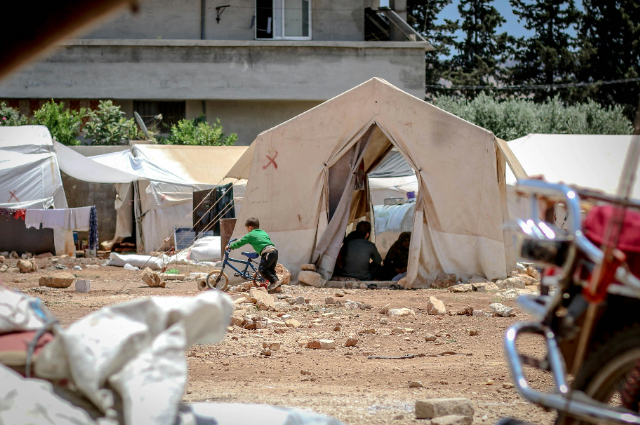
By the time the current situation is counted: over 217 dead by official government figures. Nearly 59,000 people displaced and living in relief camps or prefabricated government housing. Nearly 5,000 homes burned. Hundreds of religious structures — churches and temples both — vandalized or destroyed. And the conflict has not ended. It has not even stabilized. It has simply continued, at a lower intensity than its peak, punctuated by the kind of horror that April 7 represented — a rocket fired into a house where children were sleeping.
The Political Architecture of the Silence
To understand why national media has largely abandoned this story, you have to understand what covering it would require politically.
The conflict in Manipur implicates the ruling Bharatiya Janata Party at both the state and central government level. The BJP government in Manipur, led until February 2025 by Chief Minister N. Biren Singh, was widely perceived — including by the International Crisis Group, by the UN High Commissioner for Human Rights, and by independent investigative journalists — as having sided with the Meitei community in the conflict. Evidence from multiple independent sources, including an audio recording attributed to Biren Singh himself, points to a degree of state complicity in facilitating violence against Kuki-Zo communities that goes far beyond negligence.
The central government under Prime Minister Narendra Modi was slow to respond. Modi did not visit Manipur for months after the violence began. When opposition leaders raised the issue in Parliament, sessions were repeatedly disrupted. President's Rule was finally imposed on February 13, 2025 — nearly two years after the initial violence — following Biren Singh's resignation. A new state government under Yumnam Khemchand Singh was formed in February 2026. A peace meeting between Meitei and Kuki-Zo representatives was held in March 2026. Stability remains, as of this writing, elusive.
For much of India's national television media — particularly the large Hindi-language channels that dominate prime-time viewership — sustained critical coverage of the BJP-governed response to Manipur would mean sustained critical coverage of the BJP. The ownership structures of many of these channels, and the advertising dependencies that shape editorial decisions, make that a difficult calculation. It is not that editors sit in rooms and explicitly decide not to cover Manipur. It is that the institutional incentives consistently point away from the story, and the story is far away, and the people dying are from communities that do not have powerful lobbies in Delhi's media circles.
The result is what analysts have called attention fatigue weaponised as political protection. Leaders focus their energies on election rallies in states like West Bengal and Tamil Nadu while Manipur burns. Channels follow the leaders. The cycle reinforces itself.
The Information Siege
Even for journalists who want to cover Manipur, the obstacles are extraordinary and deliberate.
Reporters Without Borders documented that Manipur was subjected to 210 days of internet blackouts between May 2023 and mid-2024 alone — a total that has continued to grow. These shutdowns cut off Manipur's 2.8 million residents from news and information, obstruct the work of journalists on the ground, and prevent footage and testimony from reaching audiences outside the state. India has consistently ranked as one of the world's most frequent imposers of internet shutdowns — the global leader for several consecutive years. Manipur has been the most extreme expression of that strategy.
Beyond the blackouts, the Manipur government passed an order explicitly barring the sharing of videos or images depicting violent incidents in the state — a measure the Internet Freedom Foundation called a direct violation of fundamental rights and a barrier to public access to essential information. The order effectively made citizen journalism illegal. The footage that did circulate — the video of the assault on the two women in 2023, the images of burning villages — did so despite the law, not because of any transparency from authorities.
Journalists who tried to cover the conflict faced physical intimidation from both sides. In February 2025, a journalist was abducted from his home by around 20 members of a Meitei armed group, forced to record a video apology for his critical reporting, and then released. Afrida Hussain, a senior journalist with India Today who covered the conflict in its early weeks, had to be evacuated by the Indian Army from her hotel in Imphal after an angry mob surrounded the building following her reporting on armed clashes involving a Meitei militia. She resigned from her position and relocated to Assam. She has not returned to Manipur since, citing ongoing threats.
In August 2024, armed men intercepted a truck carrying newsprint from Guwahati to Imphal — the physical paper needed to print local newspapers — and burned it on National Highway 2. Electronic media in Manipur went on strike. Print media shut down for a day. The people who torched that truck did not just burn paper. They burned the infrastructure of local journalism in a state that desperately needed it.
One anonymous journalist described to Al Jazeera what working in Manipur actually looked like: phones seized by security forces when covering violence, while locally-aligned journalists could film freely because communities trusted them not to identify perpetrators. The mob, the journalist said, knew it would not be identified even when armed members walked openly alongside local police. That is not a press environment. That is a performance of reporting in a space from which accountability journalism has been evacuated.
The Communities the Story Is About
The people caught inside this conflict are not abstractions. They are communities that have lived in Manipur for generations, now unable to cross into each other's territory, unable to go home, living in camps that were meant to be temporary and have become semi-permanent.
The Meitei community, concentrated in the Imphal Valley, has its own legitimate grievances and its own dead. Meitei civilians have been killed by Kuki-Zo armed groups. Meitei homes have been damaged. Meitei people have been displaced from hill areas. The conflict is not a simple story of one-sided aggression.
The Kuki-Zo communities in the hills have suffered disproportionate destruction, as documented by every independent international body that has examined the situation. The US Commission on International Religious Freedom specifically documented the targeting of Kuki-Zo Christians and called for accountability for the destruction of places of worship. The UN High Commissioner for Human Rights expressed alarm at threats against rights defender Babloo Loitongbam, whose home was vandalized by members of a Meitei militia after he documented human rights abuses.
Approximately 60,000 Nepali-speaking Gorkha residents of Manipur — who have taken no side in the conflict — now live in constant fear and uncertainty, caught between communities they are not part of and a conflict they did not choose.
The conflict has also taken on a religious dimension that makes it harder, not easier, for national media to engage with. The Meitei are largely Hindu. The Kuki-Zo are predominantly Christian. In the current political climate of India, where Hindu nationalism is a dominant political force, sustained coverage that highlighted attacks on a Christian minority by a Hindu-majority community — with possible state complicity — was never going to be a comfortable story for channels that depend on political access and advertising relationships with power.
The Failure That Cannot Be Unnamed
There is a sentence from an analysis published by The Logical Indian this week that stays in the mind: "The lack of consistent national coverage is not just a media failure, it is a tool that effectively shields those in power from accountability."
That framing is correct, and it is uncomfortable, because it asks us to consider media silence not as negligence but as function. When a conflict that has killed hundreds of people, displaced nearly 60,000, and continues to kill children in their beds remains below the fold of national attention for three years, the silence is doing something. It is giving political actors room to manage the crisis on their own terms, without the pressure of a watching public demanding resolution. It is allowing humanitarian conditions in relief camps to deteriorate without consequence. It is allowing the question of who bears responsibility — for the initial violence, for the state response, for the ongoing failure to reach a political settlement — to remain permanently deferred.
The Editors Guild of India sent a fact-finding team to Manipur in 2023. Members of the team subsequently faced FIRs — criminal complaints — for their report. The Press Club of India condemned the charges. The FIRs were a message, sent clearly, about the cost of documenting certain things.
What Is Happening Right Now
As of April 2026, three years into the conflict, this is the situation on the ground:
Fifty-eight thousand, eight hundred and twenty-one people remain displaced, according to government figures released this week. Two hundred and seventeen deaths are confirmed by the same government count — a number that independent observers consider a significant undercount. A new state government, formed in February 2026, has attempted preliminary peace dialogues. A peace meeting between Meitei and Kuki-Zo representatives was held in March under the new Chief Minister. The April 7 rocket attack that killed two children came three weeks after that peace meeting. Torch rallies erupted across the Imphal Valley following the children's deaths, leading to clashes in which three security personnel were injured by petrol bombs.
The conflict is not over. It has not entered a final phase. It exists in a state of managed, intermittent violence that is stable enough to allow the people responsible for resolving it to do other things — to attend election rallies, to appear on panel discussions about other topics, to govern a country that has largely been persuaded that Manipur is a regional problem, a distant problem, someone else's problem.
It is not someone else's problem.
Two children were asleep in a house in Bishnupur, and a rocket killed them. Their names should be in every newspaper in the country. The silence around their deaths is not an oversight. It is a system.
References:
- Deccan Herald — Over 58,800 people displaced since May 2023, Manipur govt: https://www.deccanherald.com
- The Logical Indian — Why Manipur's Violence Keeps Fading From National Headlines: https://thelogicalindian.com
- Homegrown India — All Eyes On Manipur: https://homegrown.co.in
- News Karnataka — Manipur Stands Still: https://newskarnataka.com
- Kathmandu Post — Fresh violence erupts in Manipur, Nepali-speaking community fearful: https://kathmandupost.com
- International Crisis Group — Finding a Way Out of Festering Conflict in Manipur: https://www.crisisgroup.org
- Wikipedia — 2023–2026 Manipur Conflict: https://en.wikipedia.org
- Reporters Without Borders — Journalists Targeted, Reporting Restricted in Manipur: https://rsf.org
- RSF — India: Systemic Repression of Manipur's Media: https://rsf.org
- CIVICUS Monitor — India: Raids on Journalists and Activists, Manipur and Kashmir Silenced: https://monitor.civicus.org
- Al Jazeera — Press Freedom Concerns as India Editors' Body Charged Over Manipur Report: https://www.aljazeera.com
- NE Now News — Media Blackout in Manipur as Newsprint Truck Torched: https://m.nenow.in
- Ekalavya Hansaj — State of Press Freedom in 2025 and 2026: https://hansajekalavya.com