
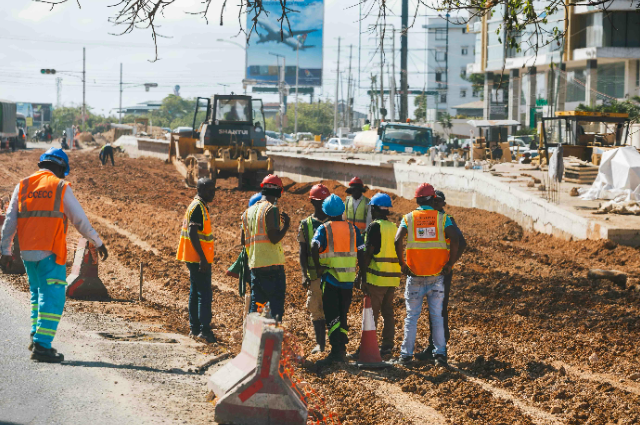
From ₹500 a day and no toilet break, to stone pelting and a Pakistan conspiracy — the story of the Noida workers' protest and what it reveals about the contradictions at the heart of Uttar Pradesh's economic ambition
The factories of Noida's industrial belt do not look, from the outside, like the kind of place where a political crisis begins. They are unremarkable — low buildings in functional greys and beiges, packed into the sectors of Gautam Buddha Nagar, manufacturing garments, electronics components, auto parts, and consumer goods. They employ hundreds of thousands of workers — men and women who commute in from the urban periphery, from cramped rooms in Sahibabad and Ghaziabad, who clock in before dawn and leave after dark, who have, in many cases, been doing so for years.
What happened inside those factories in the months leading up to April 2026 was not unremarkable. Workers were denied weekly holidays, double overtime pay, bonuses, and gratuity. Employers even refused restroom breaks during work hours. Labour laws were being openly violated. (Jammukashmirnow) And when those workers finally took to the streets — first peacefully, then with a fury that surprised even some of its participants — the government of Uttar Pradesh responded first with lathi charges, then with mass arrests, then with a narrative about Naxalites, and then, remarkably, with a conspiracy theory involving Pakistan.
The Noida workers' protest of 2026 is, on the surface, a dispute about wages. Underneath it sits something larger — a collision between two versions of the state that Chief Minister Yogi Adityanath has spent nearly a decade building. One version is the Uttar Pradesh that appears in investment summits and government brochures: a business-friendly, law-and-order state that has attracted trillions of rupees in industrial investment and positioned itself as the manufacturing engine of a rising India. The other version is the one the workers of Sector 62 lived in — a state where the minimum wage had not been revised in over a decade, where labour inspectors looked the other way, and where the legal protections that exist on paper were enforced on no one.
Both versions are real. That is Yogi's dilemma.
The Wages That Were Never Paid
To understand why tens of thousands of workers eventually blocked the highway from Sector 62 to NH-9 and brought traffic to a standstill across Noida and at the Akshardham entry into Delhi, you have to understand what they were being paid and for how long.
Workers across the industrial units claimed they were paid at the rate of ₹500 to ₹700 per day and were made to work 10 to 12 hours, making it impossible to make ends meet. (Rohittikoo) At ₹700 per day across 26 working days, a worker earns roughly ₹18,200 per month. This, in a city where a single room in a shared flat costs ₹5,000 to ₹8,000, where food, transport, and any medical expense must come from the remainder.
In Uttar Pradesh, there had been no wage revision since 2014, twelve years during which the cost of living rose substantially while the floor beneath workers' incomes stayed fixed. By the time of the protests, the wage should have been ₹26,000 per month at the state level, and ₹32,000 at the national level under the Minimum Wages Act of 1948, which requires revisions every five years. (Jammukashmirnow)
This was not a gap that the workers kept secret. Trade unions had been raising the issue for years. Workers had filed complaints. Labour inspectors had been informed. The Deputy Labour Commissioner in Noida admitted, eventually, that hundreds of contractors had violated workers' rights and had even diverted their ESI and EPF contributions — provident fund money that had been deducted from salaries and simply not deposited. (Jammukashmirnow) The state, in other words, was aware. Its enforcement apparatus had chosen, for years, not to enforce.
The immediate trigger for the April protests was reportedly the Haryana government's decision to hike minimum wages — a move that made Noida workers acutely aware of exactly how far behind they had fallen. Workers demanded their minimum salary be raised to ₹26,000 per month, adherence to labour laws, and a weekly off. (Rohittikoo) These were not radical demands. They were the legal baseline.
The Streets Fill Up
The protests began peacefully. Workers staged sit-ins outside factory gates. They gathered in Sector 62 and the surrounding industrial areas. Representatives of the state government met with trade union leaders and, on Sunday, April 12, reportedly accepted several demands — overtime at double rate, Diwali bonuses, and other benefits.
But the workers' central demand — a meaningful raise in minimum wages — remained unaddressed. On Monday, April 13, thousands of factory workers took to the streets again. The protest turned violent: workers set ablaze vehicles, damaged offices, and engaged in heavy stone pelting, prompting police to use tear gas shells and conduct a lathi charge. Several police personnel were injured. The protests triggered a massive traffic jam across Noida, with police diverting traffic at multiple points. (Rohittikoo)
The epicentre was Sector 62, with protests spreading across the industrial belt. Workers blocked the corridor from Sector 62 to NH-9 and the Akshardham entry from Delhi. Police registered seven FIRs covering stone pelting, arson, vehicle vandalism, and highway blockades. (Wikipedia)
By April 14, around 300 protesters had been arrested. Eventually, the number would climb beyond 350. Among those detained were women workers and, according to labour groups, minors. The CPI(M)'s general secretary, M.A. Baby, said there was no official confirmation on the status of 400 workers and a CITU district secretary who had been arrested, with the government claiming all detainees had been released — a claim the unions had not been able to verify. (Rohittikoo)
Chief Minister Yogi Adityanath said the government was committed to protecting the interests of workers but warned against violence. (Rohittikoo) It was the kind of statement that contained two true things in uncomfortable proximity — a commitment to workers' welfare, and a warning to workers who expressed that welfare too loudly.
The Narratives That Followed
What happened in the week after the initial protests is where the story of the Noida workers' protest becomes something more than a labour dispute.
First came the Naxal label. Chief Minister Yogi Adityanath publicly linked the protests to Naxalite elements — framing working-class industrial unrest in a manufacturing suburb of Delhi as an insurgent conspiracy. The label carried specific legal implications: it allowed police to invoke provisions used against Maoist militants in the treatment of factory workers demanding minimum wage compliance.
Then, a day later, came Pakistan. Authorities flagged the role of two X handles operating from Pakistan for allegedly spreading misleading information and attempting to disrupt law and order. Gautam Buddh Nagar Police Commissioner Laxmi Singh said FIRs had been registered and investigations were underway. Officials claimed the accused had mobilised workers through WhatsApp groups and delivered provocative speeches ahead of the April 13 protest. (HinduPost)
The shift in narrative — from alleged Naxal links to a Pakistan angle — intensified debate over accountability, with critics arguing that the focus was moving away from core worker grievances. (HinduPost) Trade unions called the framing a deliberate strategy to delegitimise genuine demands by attributing them to a foreign or ideological conspiracy. Labour groups warned that anger among contract and temporary workers was rising due to issues such as unpaid overtime, job insecurity, and restrictions on unionisation, and that portraying labour unrest as a conspiracy risked erasing the legitimate grievances of workers facing rising living costs and stagnant wages. (HinduPost)
Satyam Verma, son of historian Professor Lal Bahadur Verma and a senior journalist formerly with UNI, was abducted by Noida police for two days and then imprisoned. Opposition leaders, human rights organisations, and lawyers were prevented from meeting detained workers. The government alleged that organisations like Mazdoor Bigul and Disha had created WhatsApp groups and written pro-worker articles in a registered newspaper. (The Daily Jagran) Writing about workers' wages in a registered newspaper had become, in this framing, evidence of a conspiracy.
Uttar Pradesh Police also prevented a 10-member Samajwadi Party delegation led by Leader of Opposition Mata Prasad Pandey from entering Noida when they attempted to meet protesting factory workers at the DND Flyway. SP and CPI(M) delegations subsequently staged a sit-in at the same location after being denied entry. (Rohittikoo)
Pandey's response to the Pakistan allegation was the most pointed political observation of the entire episode: if the government was convinced there was a Pakistan connection, he said, then let them fight Pakistan — why were they creating obstructions for people who had simply come to inquire about the welfare of workers who had suffered injustice?
The Government Blinks — Partially
The political and economic pressure of sustained protest eventually produced a response. A high-powered committee formed by Chief Minister Yogi Adityanath announced a significant interim hike in minimum wages for industrial workers in the region. The state government approved a 21 per cent increase in minimum wages for workers in Noida and Ghaziabad, effective from April 1, 2026. (Rohittikoo) On April 18, the Uttar Pradesh government approved modified minimum wage rates throughout the state.
By April 16, the protests had spread further — domestic workers joined the movement demanding wage hikes and better conditions. The 21 per cent raise was real. But it was also, by any reckoning, long overdue. Twelve years without revision, followed by a 21 per cent increase announced under pressure — this is not labour policy. It is crisis management.
Noida Police Commissioner Laxmi Singh expressed gratitude to Chief Minister Yogi Adityanath for approving the interim wage increase and establishing a wage board. She stated that of 83 protest sites across Gautam Buddha Nagar, only two had experienced violence — a framing that cast the unrest as contained and the resolution as orderly. (Newslaundry) The Director General of Police declared the situation had returned to "absolute normalcy."
Workers and unions described the situation rather differently. The wage increase helped. The criminal cases filed against hundreds of workers had not been withdrawn. The people still in detention had not been fully accounted for. The structural conditions — contractors who had been stealing ESI contributions for years, labour inspectors who had looked the other way, factories that denied workers toilet breaks — remained unaddressed. Normalcy, in this context, meant the resumption of a status quo that had produced the protest in the first place.
The Contradiction at the Centre
Yogi Adityanath has staked a substantial part of his political identity on the proposition that Uttar Pradesh is open for business. The UP Global Investors Summit in 2023 attracted investment pledges exceeding ₹33 lakh crore. Infrastructure is being built. Expressways, data centres, logistics parks, and new industrial corridors. The pitch to investors is explicit: Uttar Pradesh has land, labour, logistics, and a government that does not let agitation interfere with business.
That last part is what makes the Noida protests so uncomfortable to accommodate within Yogi's preferred narrative. Because the workers who blocked NH-9 and torched vehicles were not external agitators or Pakistani saboteurs or Naxalite conspirators. They were the labour force that the investment pitch was selling — the hundreds of thousands of workers whose availability and affordability make Uttar Pradesh attractive to manufacturers. They were people who had been denied the legal minimum wage for twelve years, who had their provident fund contributions stolen by contractors, who could not take a toilet break, and who had been told repeatedly by every institutional actor — the labour commissioner, the labour inspector, the courts, the state government — that their situation was being looked into.
The investment story and the exploitation story are not two separate stories about Uttar Pradesh. They are the same story. The conditions that attract labour-intensive manufacturing — low wages, weak enforcement, compliant workforce — are the conditions that produced the protest. A state serious about sustainable industrial development would enforce its own labour laws, ensuring that workers who produce the goods also earn enough to participate in the economy. A state that treats enforcement as a threat to investment is building on a foundation that, as April 2026 demonstrated, eventually cracks.
This is Yogi's dilemma — not a choice between investment and workers' rights, but the reality that a model of development that systematically suppresses one will eventually be destabilised by the other.
The Lessons That Will Not Be Learned
The Noida workers' protest ended in the only way institutional conflict in India tends to end: with a partial concession large enough to restore order, small enough to leave the underlying structure intact, accompanied by criminal cases against the people who forced the concession, and a narrative manufactured to explain away the causes.
The 21 per cent wage hike is real and will improve lives. The Pakistan conspiracy theory is not real and will not improve anything. The hundreds of workers who remain charged with criminal offences for demanding their legal wages will carry those charges forward. The labour inspectors whose negligence enabled twelve years of wage theft will continue in their posts.
What the protests did accomplish, beyond the wage increase, was visibility. For a few weeks, the conditions inside Noida's industrial sectors — conditions that had existed for years, documented by unions and quietly acknowledged by officials — became undeniable. They were on the highway, in the smoke of burning vehicles, in the testimony of women workers who described working 12-hour shifts without toilet access.
That visibility matters. It is not justice, but it is a precondition for justice. And the workers who produced it — who walked off factory floors across Sector 62 knowing what would come, who blocked highways knowing about the lathi and the FIR — understood that better than any government communique written to manage them.
They were not Pakistani agents. They were not Naxalites. They were people who had been waiting twelve years for the law to apply to them, and had decided to stop waiting.
References:
- Wikipedia — 2026 Noida Workers Protest: https://en.wikipedia.org
- Deccan Herald — 50 arrested as salary hike protest in Noida turns violent: https://www.deccanherald.com
- National Herald India — Pakistan link, Urban Naxal: Noida protest narratives: https://www.nationalheraldindia.com
- The News Mill — Samajwadi Party and CPI(M) protest in Noida over workers' rights: https://thenewsmill.com
- Big News Network — SP, CPI(M) delegations stage sit-in over Noida workers' protest: https://www.bignewsnetwork.com
- Countercurrents — Protest Against Modern Slavery: The Noida Workers' Movement: https://countercurrents.org
- Prime Legal — Noida Labour Protests 2026: The Legal Limits of Trade Union Action: https://blog.primelegal.in