
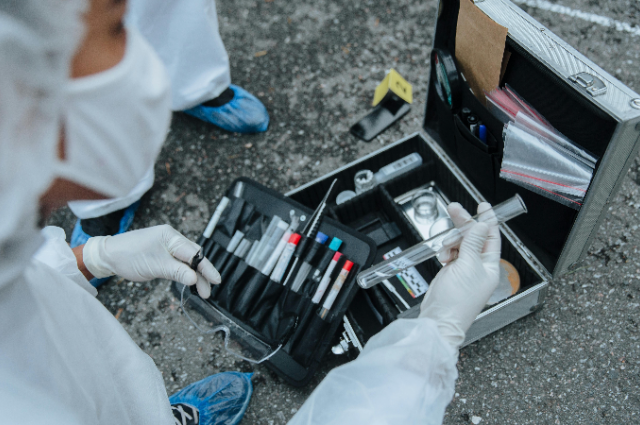
Crime scene investigation plays a crucial role in the administration of criminal justice by acting as the foundation for forensic analysis and legal proceedings. The effectiveness of an investigation largely depends on the proper identification, collection, preservation, and documentation of physical evidence. Any lapse in these processes may compromise the integrity of evidence, ultimately affecting its admissibility before a court of law. A key concept that ensures the reliability of evidence is the chain of custody, which refers to the systematic documentation and handling of evidence from the crime scene to the courtroom. This process involves multiple stakeholders, including first responders, investigating officers, and forensic experts, all of whom share the responsibility of maintaining evidentiary integrity. This article examines the significance of crime scene management and the chain of custody in safeguarding the authenticity of evidence and ensuring fair trial standards within the judicial system.
Crime scene investigation forms the backbone of forensic science, enabling the systematic collection and analysis of evidence for the resolution of criminal cases. The effectiveness of this process depends on the proper identification, documentation, and preservation of evidence while ensuring its integrity is not compromised. A crucial safeguard in this regard is the chain of custody, which maintains continuous and documented control over evidence from the scene to the courtroom. Together, these principles uphold the reliability of evidence and ensure fairness in the administration of justice.
Keywords:
- Forensic Protocol Compliance
- Chain of Custodial Continuity
- Crime Scene Reconstruction
- Evidence Preservation Standards
- Judicial Admissibility Thresholds
What is a crime scene?
A crime scene refers to any place where a crime has occurred, including locations, persons, vehicles, or even areas connected to the incident. Usually, there are at least two crime scenes—the main location where the crime happened and other related places. According to the principle that every contact leaves evidence, materials can transfer between individuals and the environment. Crime scenes are classified as primary (actual place of occurrence) and secondary (related but not the exact location).
Components of Crime Scene Management:
- Information & Communication
- Manpower
- Technology
- Logistics
This involves the systematic control, supervision, and collection of evidence at the scene, carried out by a responsible officer to maintain order and evidentiary integrity.
“CRIME SCENE MANAGEMENT AND INVESTIGATION PROCEDURES IN FORENSIC SCIENCE”
Crime Scene Manager
A crime scene manager is a senior investigating officer responsible for supervising and coordinating all activities at the crime scene. The manager ensures that investigative procedures are properly planned and executed, assigns duties to forensic and investigative personnel, and maintains overall control of the process. Effective crime scene management depends on a well-trained and coordinated team under the guidance of the manager.
Interview with First Responding Officer
The initial step in crime scene processing involves interviewing the first responding officer. This helps the manager gather essential details about the incident, actions taken at the scene, and any alterations made prior to the arrival of the investigation team. Information regarding scene security, entry and exit points, and possible disturbances is also obtained. If necessary, victims or witnesses may be interviewed to gain a preliminary understanding of the events.
Scene Assessment
Scene assessment involves a careful examination of the crime scene and its surroundings to plan evidence collection. Investigators identify key elements such as the victim, weapons, and physical evidence, while also considering environmental factors like lighting and weather conditions. The use of protective measures is essential to prevent contamination and ensure the safety of personnel.
Initial Walk-Through
Following the briefing, the crime scene manager conducts an initial walk-through with the investigation team. This process helps in observing the scene, noting critical details, and planning further investigative steps. Photographic documentation is carried out to preserve the condition of the scene. The walk-through also assists in identifying important evidence and determining the need for specialised expertise.
ADVANCED PROCEDURES IN CRIME SCENE MANAGEMENT:
Risk Assessment in Crime Scene Management:
Risk assessment is a critical component of crime scene management, aimed at ensuring the safety of investigators and preserving evidentiary integrity. Crime Scene Investigators must identify and evaluate potential hazards, including environmental dangers such as elevated surfaces and exposure to biological or hazardous materials. The mandatory use of Personal Protective Equipment (PPE) minimises risks of contamination and safeguards both personnel and evidence.
Systematic Examination of the Crime Scene:
The examination of a crime scene is a decisive stage in validating investigative hypotheses. It involves identifying physical evidence, determining entry and exit points, and analysing the spatial layout of the scene. Investigators establish control by defining boundaries, securing the area, and organising operational zones for effective coordination. This structured approach ensures a thorough and methodical investigation.
Comprehensive Documentation of the Crime Scene:
Accurate documentation is fundamental to preserving the authenticity of a crime scene and supporting judicial scrutiny. It creates a permanent record that assists in reconstruction and legal proceedings. All observations must be recorded before any disturbance of evidence, as inadequate documentation can compromise the evidentiary value.
Documentation methods include written notes, sketches, photography, videography, and advanced technologies such as 3D scanning, depending on the complexity of the scene.
Investigative Note-Taking:
Note-taking is a continuous and indispensable aspect of crime scene documentation. It begins at the initial point of arrival and continues throughout the investigative process. Notes should capture critical details such as time, location, environmental conditions, and initial observations, including any unusual sensory inputs. Additionally, all procedural actions undertaken during the investigation must be systematically recorded, as these notes may later serve as admissible evidence in court.
Forensic Photography and Videography:
Photography plays a pivotal role in preserving the original condition of the crime scene. It provides a visual and chronological record through overall, mid-range, and close-up images of the scene and evidence. Photographs must be taken before any alteration, with close-ups often captured both with and without measurement scales for accuracy. While videography offers a dynamic representation, still photographs remain indispensable for detailed analysis and evidentiary purposes.
ROLE OF MEDICAL EXAMINER AT A CRIME SCENE
Systematic Examination:
Assesses the body, clothing, and surroundings in a structured manner.
Collaboration: Coordinates with investigators and follows standard procedures.
Evidence Preservation:
Prevents contamination and protects evidentiary value.
Scene Interpretation: Links injuries with scene conditions to aid reconstruction.
Cause of Death:
Forms preliminary opinion based on observations.
Safety Measures: Uses protective gear and identifies potential hazards.
CSI IN SPECIAL CASES:
Falls from Height:Determines manner (accidental, suicidal, homicidal).
Correlates injuries with fall height and scene conditions.
Involves autopsy, medical history, and scene analysis.
Evaluates environmental factors to rule out foul play.
- Burn Cases Assesses injury patterns and caregiver explanation. Uses scene reconstruction to identify the cause.
- Fall Injuries Examines height and surface.
Checks consistency between injuries and explanation.
CRIME SCENE INSPECTION AND EVIDENCE EVIDENCE SEARCH TECHNIQUES
Crime scene inspection involves systematic observation and methodical searching to identify and recover all relevant evidence while ensuring its integrity. Since each crime scene varies, appropriate search techniques are selected to achieve complete and accurate coverage.
Common Search Methods:
- Line/Strip Method: Investigators move in parallel lines to cover large, open areas efficiently.
- Grid Method: The area is searched twice in perpendicular directions for greater accuracy, suitable for smaller scenes.
- Spiral Method: The search follows a circular path, inward or outward, ideal for unobstructed areas.
- Zone/Quadrant Method: The scene is divided into sections, with each area searched individually; effective for complex or indoor scenes.
COLLECTION OF BLOOD AND SALIVA SAMPLES:
- Venous Blood Collection: Approximately 5–10 ml of blood is drawn using venous puncture and stored in EDTA tubes to prevent clotting.
- Finger Prick Method: Blood drops obtained from a fingertip puncture are placed on a filter or blotting paper and air-dried. Specialised papers, such as FTA cards, enable long-term storage at room temperature.
- Saliva Collection: Sterile swabs are used to collect saliva from the inner cheeks. The swabs are dried before storage to preserve DNA integrity. Treated filter papers may also be used for preservation.
Note: Saliva sampling is widely preferred due to its non-invasive and convenient collection process
EVIDENCE TRANSPORTATION AND STORAGE
- Evidence Transportation:
- Ensures preservation of evidence integrity and identity during transfer.
- Requires protection from environmental factors such as heat, moisture, and light.
- Must be securely handled with restricted access to prevent tampering.
- Involves accurate documentation of time, date, handlers, and transfer details.
- Transport methods should comply with legal standards and practical considerations.
- Evidence storage:
- Maintains evidence under appropriate environmental conditions based on its type.
- Prevents deterioration, contamination, or loss of evidentiary value.
- Ensures proper handling for long-term preservation and reliability.
MARK UNGER
Mark Unger and his wife, Florence, appeared to have a stable life until financial stress and Mark’s addiction issues developed. During a 2003 trip to a Michigan lake resort, Florence was found dead in the water near a dock. Investigation showed she had severe injuries (fractured skull, broken hip) and blood was found on nearby concrete, indicating she was likely pushed, knocked unconscious, and then placed in the water. Suspicion fell on Mark due to his behaviour and circumstantial evidence.
Outcome: He was convicted of premeditated murder and sentenced to life without parole.
ROGER REECE KIBBE –“ 1-5 STANGLER”
- Background: Over 10 years, several women were murdered along Interstate 5 near Sacramento, California. The victims were strangled, bound similarly, and had their hair and clothing cut in unusual ways, indicating a serial offender.
- Investigation: Roger Reece Kibbe became a suspect in the murder of 17-year-old Darcie Frackenpohl. Forensic experts conducted microscopic and fibre analysis.
- Key Evidence: The rope found in Kibbe’s car matched the rope used on the victim. Comparison microscope confirmed similarities. Electron microscopy revealed 10 common elements between fibres. Paint and air contaminants were consistent in both samples.
- Outcome: Kibbe was convicted and, on May 10, 1991, sentenced to 25 years to life in prison, with parole eligibility after 16 years and 8 months.
GILLIGAN FAMILY MURDER (1980)
- Facts: In January 1980, an intruder entered a family home in Indiana, tied up the parents and their two children, and killed all four. He also stole weapons and electronic items from the house.
- Investigation: Police identified the accused through an eyewitness. Bloodstained clothes found in his house matched the victims'. Witnesses stated that he had confessed, and stolen items were recovered from him.
- Trial: The accused was first declared mentally unfit and sent to a mental institution. Later, he was found competent to stand trial.
- Judgment: He was convicted and sentenced to death. Before execution, he admitted the crime and revealed that he had faked mental illness to avoid punishment.
Crime scene investigation represents the critical link between scientific inquiry and legal truth. The accuracy of an investigation depends on disciplined observation, structured procedures, and the careful handling of evidence at every stage. From scene management to documentation, analysis, and preservation, each step safeguards the authenticity of findings. The continuous control of evidence through proper protocols ensures its credibility in judicial proceedings. Ultimately, a well-executed investigation not only reconstructs events with clarity but also strengthens the foundation of justice by ensuring that conclusions are based on reliable and uncompromised evidence.
. . .
REFERENCES:
- Federal Bureau of Investigation. Forensic Science Handbook and Evidence Collection Guidelines. Washington, D.C.: U.S. Department of Justice Publications, 2015.
- Fisher, Barry A. J. Crime Scene Investigation Methods and Techniques. Revised Edition. Boca Raton: CRC Press, 2011.
- Saferstein, Richard. Foundations of Criminalistics and Forensic Science. Latest Edition. New York: Pearson Learning, 2017.
- Gardner, Ross M., and Tom Bevel. Crime Scene Analysis and Reconstruction Principles. Boca Raton: CRC Press, 2008.
- Lee, Henry C., et al. Crime Scene Investigation: Scientific Approaches and Practices. Academic Press, 2002.
- Weston, Paul B., and Kenneth M. Wells. Introduction to Criminal Investigation and Evidence Handling. Upper Saddle River, N.J.: Prentice Hall, 2010.
- Horswell, John. Applied Crime Scene Investigation Techniques. Boca Raton: CRC Press, 2005.
- James, Stuart H., and Jon J. Nordby. Forensic Science and Investigation: Concepts and Applications. Boca Raton: CRC Press, 2013.