
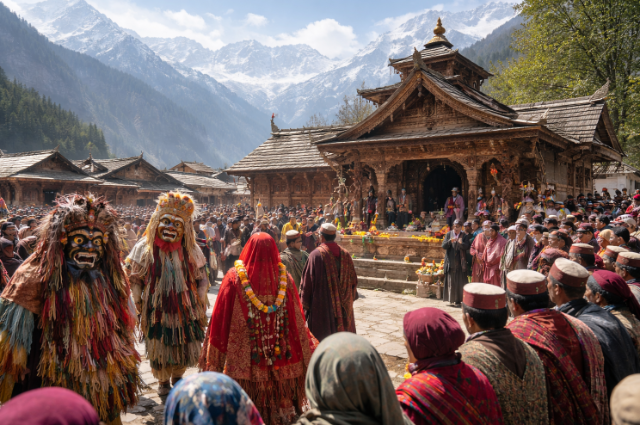
The Raulane Festival, a deeply rooted cultural tradition of Himachal Pradesh, stands as one of the oldest surviving ritual practices in the Himalayan region. Celebrated primarily in Kalpa, a village in the Kinnaur district, the festival is believed—through oral tradition—to date back nearly 5,000 years. Though its origins remain unwritten, Raulane continues to function as a living archive of Kinnauri beliefs, blending mountain folklore, spirituality, and communal identity into a ritual that has endured across generations.
At its core, the festival reflects the intimate relationship between the Kinnauri people, nature, and the divine. Central to this belief system are the Saunis—celestial fairy-like spirits who, according to local lore, descend from the high mountains during winter to protect villagers, their homes, and livestock from the harsh Himalayan cold. As winter recedes and the snow begins to melt, the community gathers to bid these spirits farewell, marking a significant seasonal and spiritual transition.
Usually held around March or April, often shortly after Holi, Raulane spans between five and seven days, although the exact timing may vary depending on local temple customs and astrological considerations. The main rituals take place in sacred spaces such as the Nagin Narayan Temple, where the quiet village transforms into a site of intense cultural and spiritual activity. Through prayers, processions, and ritual performances, the festival expresses gratitude for survival through winter, seeks protection from misfortune, and welcomes the beginning of a new agricultural cycle.
In recent years, Raulane has gained wider attention due to its striking visual elements and mysterious atmosphere, with images and videos circulating widely on social media. Despite this growing visibility, the festival remains a deeply respected and sacred tradition among the people of Kinnaur, preserving a way of life that continues to resist the passage of time.
Origins and Legend of the Saunis
The Raulane Festival is deeply rooted in the Kinnauri belief in the Saunis—celestial fairies described as radiant, gentle, and protective spirits of the mountains. In Kinnauri tradition, the Saunis are regarded as holy guardians who watch over the villages of the Kinnaur district in Himachal Pradesh. They are believed to descend from the high-altitude meadows known as Kandas during the harsh winter months when the mountains are covered in snow and life becomes difficult for the community.
According to local folklore, the Saunis come down to protect villagers, their livestock, and their crops throughout winter. Their presence is seen as a divine assurance of safety during a time when isolation, cold, and limited resources make survival challenging. In this way, the Saunis symbolise both spiritual protection and the close relationship between the people and the natural environment they depend on.
As winter progresses, the Saunis are believed to remain within the villages, offering their guardianship until the arrival of spring. With the melting of snow and the reopening of mountain paths, the community prepares to bid them farewell. This departure is not seen as abandonment but as a natural cycle, where the spirits return to their place in the mountains after fulfilling their duty of protection.
The Raulane Festival, which is often described as a 5,000-year-old tradition passed down through generations, marks this symbolic farewell to the Saunis. It represents the transition from winter to spring and the release of the protective spirits back to the mountains. Although the origins of the festival are not recorded in written history, it has been preserved through oral tradition, making it one of the most enduring cultural practices in the region.
In the Kinnauri belief, the Saunis are not just mythological figures but an essential part of the seasonal and spiritual rhythm of life. Their story reflects the deep connection between the people, the land, and the unseen forces they believe guide and protect them.
Rituals and the Symbolic Marriage
The Raulane Festival centres on a symbolic ritual that brings together two figures—the Raula (groom) and the Raulane (bride). Both roles are played by men chosen from different village divisions known as Saring. Their pairing represents the connection between villagers and the protective spirits, while also reflecting the collective nature of the festival, where elders guide decisions, families prepare rituals, and the entire community participates in some form.
The origins of this ritual are understood through a blend of folklore and inherited ritual memory rather than a single documented history. Over time, Raulane has become an accumulation of centuries of cultural expression, shaped by agricultural rhythms, oral narratives, and shared traditions.
Different interpretations exist regarding its beginnings. Some believe the festival was created to appease a protective mother goddess associated with fields and agriculture, while others trace it to fertility rites connected to sowing and harvesting cycles. There are also accounts linking it to a wandering saint who unified scattered seasonal practices into a structured form of worship. What remains consistent, however, is that no single story dominates—the festival belongs entirely to the community.
On the day of the ritual, the Raula and Raulane are led in a solemn procession toward the Nagin Narayan Temple, accompanied by masked figures known as Zannpundulu. These figures wear fearsome masks believed to ward off malevolent forces, ensuring spiritual safety during the ritual.
Inside the temple courtyard, the symbolic couple performs a slow, deliberate, trance-like dance. Each movement feels like a prayer, and locals believe that during this moment:
- The boundary between the human and spirit world becomes thinner
- The Saunis are spiritually acknowledged
- The dance becomes a form of communication rather than performance. The symbolic marriage represents:
- The union between human beings and the divine world
- Balance between masculine and feminine energies
- A spiritual bridge between the physical and unseen worlds
- A collective act of gratitude and harmony
Costume, Performance, and Festival Atmosphere
One of the most striking aspects of the Raulane Festival is the elaborate costumes and deeply symbolic appearance of the performers. The central figures, Raula and Raulane, are both played by men selected through traditional customs, and their roles carry significant spiritual meaning.
The choice of men to represent both bride and groom is not about gender in the conventional sense but about embodying spiritual energies. The festival expresses:
- Balance between masculine and feminine forces
- Human connection with the divine
- Transformation of individuals into ritual vessels
Both performers undergo complete transformation through attire and concealment. Their faces are covered with masks or cloth, and their bodies are fully dressed, ensuring no part of their identity is visible. This is rooted in belief:
- Direct eye contact with these spiritually empowered figures is avoided • Such contact is believed to create attachment or bring misfortune
- Covering the face protects both the villagers and the performers
The attire reflects both environment and culture. The performers wear layered woollen garments suited for the Himalayan cold, including traditional shawls (Dohrus) and colourful caps (Thepang). These garments are not just practical but represent:
- The weaving heritage of Kinnaurx
- Cultural identity and craftsmanship
- The importance of tradition in daily life
The Raulane (bride) wears traditional Kinnauri attire, such as:
- Doru
- Cholli
- Pattu
- Heavy silver and gold jewellery
These symbolise purity, prosperity, and ancestral heritage. The Raula (groom), on the other hand, is often covered in vibrant red cloth, representing spiritual energy and anonymity.
The festival takes place in temple courtyards, particularly the Nagin Narayan Temple, where the atmosphere becomes deeply immersive. The sound of traditional instruments such as the dhol, bugal, and shenhai fills the air, creating a powerful soundscape. These sounds guide processions and enhance the spiritual energy of the space.
Villagers participate through slow, circular dances such as the Kinnauri Nati, performed to devotional songs. The music and movement together:
- Express gratitude to the Saunis'
- Reinforce spiritual connection
- Strengthen communal participation
Cultural Meaning and Community Role
The Raulane Festival holds deep cultural and symbolic meaning for the people of Kinnaur. It functions as a community thanksgiving ritual, where villagers express gratitude to the Saunis for protecting them throughout winter.
It also marks a major seasonal transition:
- The end of winter
- The beginning of spring
- Renewal of agricultural life
The festival reinforces the belief that human survival is closely tied to nature. Saunis represent guardians of the cold months, and the festival acknowledges their role in sustaining life during difficult times.
Beyond spirituality, the festival preserves Kinnauri culture by passing down:
- Oral traditions
- Folklore
- Ritual practices
- Ancestral knowledge
It also strengthens community unity. The entire village participates through:
- Folk songs
- Traditional music
- Processions
- Shared rituals
This creates a strong sense of belonging and identity, making the festival both cultural and communal.
Preservation and Challenges
The Raulane Festival is preserved through oral tradition, making it a living cultural practice passed down across generations. However, it faces challenges such as:
- Modernization
- Migration of youth
- Risk of losing traditional knowledge
- Increasing influence of tourism
Social media has brought attention to the festival, but also risks:
- Loss of sacredness
- Misrepresentation
- Disrespectful behaviour from outsiders
Despite these challenges, the festival continues to survive due to strong community involvement. Its future depends on:
- Respectful engagement
- Cultural awareness
- Active participation from younger generations
By maintaining these elements, the Raulane Festival will continue to thrive as a living tradition and a powerful symbol of Himalayan cultural identity.
References
- India Today https://share.google
- Bhuttico Shawls https://share.google
- JustWravel https://share.google
- Jokta Academy https://share.google
- Cholan Tours https://share.google
- LinkedIn https://share.google