
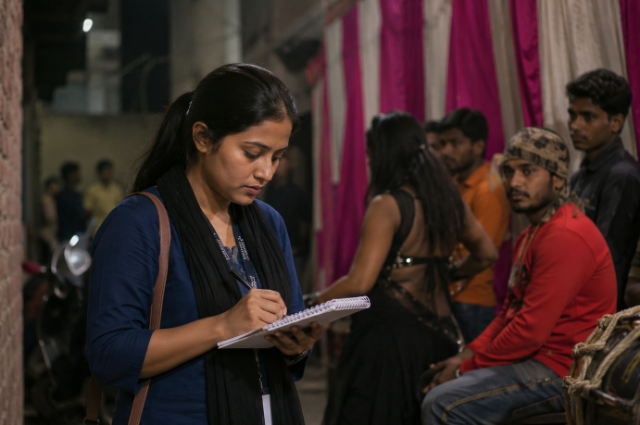
Mahima Singh is widely recognised as one of India’s fearless investigative journalists, currently working with the Hindi newspaper Dainik Bhaskar. In May 2026, she gained national attention after conducting “Operation Red Light,” an undercover investigation that exposed a human trafficking network operating through orchestra groups in Bihar. Her reporting revealed how women and minor girls were being exploited under the disguise of cultural entertainment and performance work.
Dainik Bhaskar is one of India’s most influential media organisations and the country’s largest-circulated daily newspaper. It ranks among the biggest newspapers globally by circulation. Published in Hindi and owned by D B Corp Ltd, it is widely known for its strong regional reporting and investigative journalism that often highlights corruption, crime, and social issues affecting rural India.
In Bihar, orchestra groups—locally referred to as “arkestra parties”—are mobile entertainment troupes that perform at weddings, religious festivals, and social gatherings. These groups are particularly popular in rural and semi-urban regions, where live music and dance performances are a major part of cultural celebrations. A typical orchestra setup includes singers, musicians, loud sound systems, and female dancers hired to perform at events such as weddings and festivals like Chhath Puja.
Although these groups are publicly presented as entertainment units, several investigations have revealed that some function as fronts for organised trafficking networks. Women and minor girls are often recruited from economically disadvantaged families in Bihar and neighbouring states such as West Bengal, Assam, Jharkhand, and Odisha. They are typically promised legitimate employment opportunities as dancers or performers, but are instead trapped in cycles of exploitation involving forced labour, debt bondage, physical abuse, and sexual violence.
Human trafficking in Bihar has become a deeply rooted issue due to widespread poverty, limited access to education, and weak social protection systems. Many families facing financial hardship are easily deceived by traffickers offering false job opportunities or fraudulent marriage arrangements. The vulnerability of children, especially girls, is further increased by low school attendance and child labour practices common in rural areas.
Geographically, Bihar’s location also contributes significantly to trafficking risks. The state shares an open border with Nepal and is connected by extensive railway networks, allowing traffickers to move victims easily across states and international borders. Northern Bihar has been identified as a particularly high-risk region for trafficking activities due to its proximity to border crossings and transport routes.
Across the region, trafficking patterns have become increasingly complex. Minor girls are often recruited into orchestra groups and later forced into prostitution. In other cases, traffickers arrange fake marriages, transporting girls to states such as Haryana and Rajasthan, where they are exploited and frequently abandoned after childbirth. Bihar also continues to record high levels of child labour, with many underage workers trafficked to other parts of India for forced labour.
The involvement of organised criminal networks has made the issue even more difficult to control. These groups operate through deception, intimidation, and corruption, forming structured systems that exploit vulnerable populations while avoiding detection.
The Investigation
To expose the trafficking network operating through orchestra groups in Bihar, Mahima Singh conducted a high-risk undercover operation for Dainik Bhaskar. She infiltrated the orchestra industry by posing as a woman searching for employment, allowing her to observe the system from within and document its internal operations.
During the investigation, Singh reportedly spent five consecutive days embedded within trafficking environments. To gain deeper access and avoid suspicion, she allowed herself to be “sold” multiple times between different orchestra handlers. This strategy enabled her to understand how victims were transferred, controlled, and exploited across different locations.
Throughout the operation, she used hidden recording devices to document conversations, transactions, and abusive practices. The evidence collected revealed that many orchestra groups were not legitimate entertainment businesses but structured systems involved in trafficking women and minors.
Her findings confirmed that minor girls were being transported from different Indian states and neighbouring countries into Bihar’s entertainment circuits under false promises of employment and financial stability. Once inside the system, many victims were subjected to long working hours, intimidation, and sexual exploitation.
The investigation also revealed that these operations were highly organised. They involved recruiters who targeted vulnerable families, transporters who moved victims across regions, handlers who controlled performances, and intermediaries who coordinated transactions. This network functioned as a coordinated criminal ecosystem rather than isolated incidents of abuse.
However, the investigation also exposed the severe risks associated with undercover journalism. Mahima Singh reportedly faced physical assault, threats at gunpoint, and intimidation by armed individuals during her operation. At one point, she was allegedly detained and threatened with death after being discovered recording evidence. She was later rescued by her team, highlighting the extreme dangers faced by journalists working on trafficking investigations.
How Girls Are Recruited into Trafficking Networks
Traffickers use multiple strategies to recruit girls into exploitation networks. One of the most common methods involves false job offers, where victims are promised work as dancers, domestic workers, factory employees, or performers in cities. These offers are particularly attractive to families living in poverty.
Social media has also become a growing recruitment tool. Traffickers use platforms such as Facebook, Instagram, and messaging apps to build trust with potential victims. In many cases, they pose as recruiters or romantic partners to emotionally manipulate girls before persuading them to leave home.
Another widely used method is sham marriages. In such cases, traffickers arrange fake marriages with girls from economically weak families, often paying money to parents as dowry. Once the girl is taken away, she is frequently sold into prostitution or forced labour.
Debt bondage is another significant tactic, where families are pressured into sending their daughters away to “work” to repay loans or financial obligations. These arrangements often result in long-term exploitation rather than legitimate employment.
Traffickers also target vulnerable groups such as economically marginalised communities, girls with limited access to education, and families affected by natural disasters such as floods. In some cases, they use the “lover-boy” strategy, forming fake romantic relationships to emotionally isolate victims before trafficking them.
Police Action & Rescue: The Saran District Operation
Following growing concerns about trafficking through orchestra groups, law enforcement agencies conducted a major rescue operation in the Saran district, Bihar. During a nightlong raid, authorities rescued 21 children, including seven girls from Nepal, from multiple orchestra groups operating in the region.
The operation was led by Saran Senior Superintendent of Police Vineet Kumar and carried out jointly by the Saran Police, the Anti Human Trafficking Unit (AHTU), local police teams, and child protection organisations, including the Association for Voluntary Action (AVA) and Narayani Sewa Sansthan.
The rescued victims were between the ages of 15 and 17 and had been trafficked from Nepal, Assam, West Bengal, Odisha, Jharkhand, and Madhya Pradesh. During counselling, many victims reported that they were lured with promises of high-paying jobs, glamorous lifestyles, and better living conditions.
However, after recruitment, they were allegedly forced into exploitative conditions where they were made to perform for long hours at weddings and private events. One survivor from Jharkhand described how she was deceived by individuals who promised her a better future but instead sold her into the orchestra network, where she remained trapped for years before being rescued.
Following the operation, 11 individuals linked to the orchestra groups were arrested. Investigations suggested that several of these groups were operating as fronts for trafficking and exploitation networks. The rescued minors were placed under protective care while authorities continued to investigate recruitment routes and cross-border trafficking links.
Investigative journalism plays a crucial role in exposing human trafficking because it brings attention to criminal networks that operate in secrecy. These systems often persist due to corruption, weak enforcement, and a lack of awareness. Through undercover reporting and in-depth research, journalists are able to uncover how victims are recruited, transported, and exploited across regions.
One of the key strengths of investigative journalism is its ability to expose hidden structures. Trafficking networks are often highly complex, involving recruiters, transporters, intermediaries, and safe locations across multiple regions or countries. By connecting evidence from fieldwork, interviews, and documentation, journalists help map these systems in a way that isolated reporting cannot achieve.
Investigative reporting also often triggers official action. Many law enforcement operations begin after credible reports bring attention to previously hidden crimes. This can result in raids, arrests, and the rescue of victims who might otherwise remain trapped.
Additionally, such journalism plays an important role in exposing corruption and institutional complicity that allows trafficking networks to operate. Highlighting these issues, it increases pressure for accountability and reform.
Beyond enforcement, investigative journalists give a voice to victims by documenting their experiences safely and ethically. This helps raise public awareness about the realities of trafficking, including forced labour, sexual exploitation, and manipulation tactics used by traffickers.
In the context of Mahima Singh’s investigation, “Operation Red Light” demonstrates how journalism can expose deeply rooted exploitation systems, influence law enforcement action, and contribute to broader efforts to combat human trafficking in India.
References
- Rediff https://share.google
- DW.com https://www.dw.com
- Springer Nature Link https://link.springer.com
- Instagram https://share.google
- STAR Journals https://share.google
- National Institutes of Health (.gov) https://share.google
- Illustrated Daily News https://share.google