
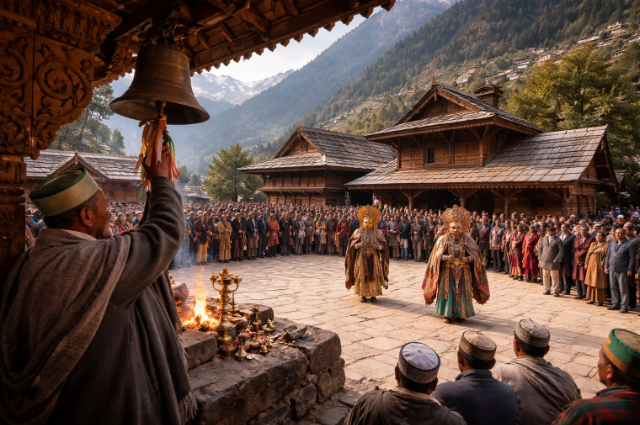
The culture of a small town differs significantly from that of a large city, particularly in how traditions, beliefs, and shared practices are maintained. Culture consists of shared values, behaviours, and systems that guide how people live and interact within a community. Among these, rituals stand out as one of the most consistent and universal elements of human society.
Rituals exist in all cultures and take many forms, including:
- Religious practices such as worship rites and sacraments
- Social customs like marriages, funerals, and oaths
- Ceremonial events such as coronations
- Everyday gestures like greetings and handshakes
At their core, rituals are structured and repeated patterns of behaviour that carry symbolic, emotional, or social meaning. They are guided by tradition and performed in ways that maintain continuity over time.
Beyond their structure, rituals shape both individual and collective experiences. They create meaning, provide stability, and connect individuals to something larger than themselves. In communities, they act as a powerful unifying force—especially in small, close-knit societies where they are deeply embedded in everyday life.
A strong example is the Raulane Festival of Kalpa in Himachal Pradesh’s Kinnaur district. This ancient festival, preserved through oral tradition, involves the entire village in honouring the Saunis—protective mountain spirits—through shared practices and symbolic performances.
Rituals like Raulane strengthen communities by:
- Creating shared experiences and collective memory
- Reinforcing belief systems and cultural values
- Passing knowledge across generations
- Understanding Rituals Through the Raulane Festival
In anthropology, a ritual is a prescribed sequence of actions performed within a cultural context, often carrying symbolic meaning. These actions are repeated, structured, and guided by tradition, helping reinforce identity and social cohesion.
The Raulane Festival reflects this clearly. It is not just an event but a repeated system of practices honouring the Saunis. The ritual includes:
Selection of Raula and Raulane
- A solemn procession led by elders
- Masked figures participating in the ceremony
- A slow, trance-like dance at the temple
Each element follows a fixed pattern across generations, reinforcing its meaning and importance.
Rituals like Raulane allow communities to express beliefs, maintain continuity, and strengthen social bonds. In this case, the ritual also marks a seasonal transition, expressing gratitude for survival and hope for renewal.
Social Structure of Small Communities: The Kinnaur Case Study
The strength of rituals like Raulane is closely tied to the social structure of small communities such as those in Kinnaur. The region is culturally diverse:
- Lower Kinnaur – predominantly Hindu
- Middle Kinnaur – blend of Hindu and Buddhist traditions
- Upper Kinnaur – influenced by Mahayana Buddhism and Lamaism
Despite these differences, the villages share strong communal characteristics. Life is interconnected, and traditions are maintained through collective participation.
Key features of the Kinnauri community life include:
- Strong kinship ties and communal living
- Agrarian lifestyle (apples, barley, apricots)
- Environmental dependence (irrigation systems like Khul)
- Oral tradition for passing on knowledge
Cultural elements such as traditional clothing, architecture, and folklore further strengthen identity. Within this framework, the Raulane Festival reflects not just ritual practice, but the functioning of the entire community.
Why Rituals Are Stronger in Small Communities
The Raulane Festival helps explain why rituals remain stronger in small communities. One major reason is participation—everyone is involved, from elders to families to selected individuals with sacred roles.
Another reason is the connection between ritual and real life. Raulane is directly tied to seasonal change, representing survival during winter and hope for spring.
The strength of such rituals comes from:
- Collective participation
- Direct connection to the environment and survival
- Oral transmission of knowledge
- Strong emotional significance
- Structured traditions with strict rules
What truly sustains Raulane is the emotional and spiritual attachment of the people. It is not entertainment, but a meaningful connection between the community and the spiritual world.
Contrast with Urban Life
If the Raulane Festival were brought into a city, its meaning would likely change. While its visual elements might remain appealing, the deeper spiritual and communal aspects would be affected.
Urban life is typically:
- Fast-paced
- Diverse in beliefs
- More individualistic
As a result, participation becomes optional rather than collective.
In cities, Raulane would likely:
- Be viewed as a cultural or artistic event
- Involve smaller, selective groups
- Face commercialisation and media influence
The sacred, silent, and trance-like nature of the ritual would also be difficult to maintain. Additionally, without the natural context of harsh winters and agricultural cycles, its meaning could weaken and shift toward performance.
Cultural Identity, Emotion, and Belief
The Raulane Festival is a strong expression of cultural identity, reflecting a deep connection between belief, environment, and community.
At its core is the belief in the Saunis as protective spirits, showing a worldview where nature is spiritually alive. The ritual of welcoming and bidding farewell to these spirits reinforces this bond.
The emotional significance of the festival includes:
- Gratitude for surviving harsh winters
- Relief as the season ends
- Hope for renewal and prosperity
These emotions are shared collectively, strengthening community bonds.
Symbolic elements such as masks, silence, and trance-like movements create a sense of separation from everyday life, reinforcing the sacred nature of the ritual.
Modern Challenges and Changing Dynamics
Despite its strength, the Raulane Festival faces modern challenges. Increased exposure through social media has both benefits and risks:
- Promotes cultural awareness and tourism
- Risks turning ritual into spectacle
- Other challenges include:
- Migration of younger generations
- Reduced participation
- Shift toward individualistic values
To preserve such traditions, efforts must focus on:
- Encouraging youth participation
- Maintaining the role of elders
- Promoting respectful engagement by visitors
- The goal is to allow adaptation without losing meaning.
The Raulane Festival shows why rituals remain stronger in small communities. In places like Kalpa, rituals are not occasional—they are essential parts of life, deeply tied to belief, environment, and social structure.
In contrast, cities often weaken these connections, turning rituals into symbolic or performative acts. Ultimately, rituals survive where they are actively practised, shared, and believed in. Small communities provide the conditions that allow such traditions to continue as living expressions of identity and cultural memory.
References
- Foundation for Family and Community Healing https://share.google
- Cholan Tours https://share.google
- Instagram https://share.google
- JustWravel https://share.google
- District Kinnaur https://share.google
- Bhuttico Shawls https://share.google
- ZoyoTrip https://share.google