
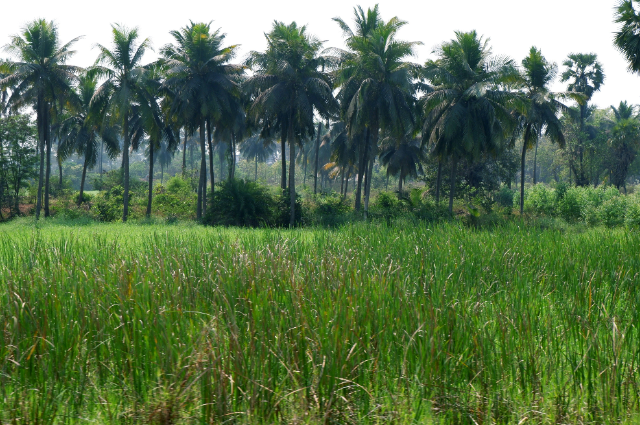
Comedy, wit, and humour are often associated with prosperity. The best example of this is the prosperous and evergreen Godavari delta region and its people. Back in the day, blessed by the river Godavari and its fertile lands, crop yields were abundant. Whatever they cultivated turned to gold. The people had sufficient food grains to eat and water to drink—and a little more than they needed. So free time became their time for wit. Not only in leisure, but in everyday activities, simple conversations became humorous rather than bland exchanges of words.
This was not accidental. Before 1852, the Godavari delta was a land of drought and famine so severe that families sold their daughters at weekly markets. British engineer Sir Arthur Cotton transformed the region, completing an anicut at Dowleswaram with 10,000 workers daily. By 1982, the barrage irrigated over 10 lakh acres, turning the delta into India's rice bowl. Today, the region is described in academic literature as "the zone where everything grows plentifully, luxuriously, a cornucopia". So profound was this transformation that even today, priests in Delta funeral ceremonies include a stanza in their hymns: "May Cotton's soul rest in peace".
In such a place, humour was not a performance. It was a way of being. When survival is assured, the mind is freed to play. Words become toys. Conversations become art. The people of the Godavari delta did not need to be taught wit—it grew naturally from the soil of their sufficiency.
But comedy is paradoxical. It can also emerge from the depths of misery—not as a luxury, but as a coping mechanism. A way to make suffering bearable. A way to reclaim dignity when everything else has been taken. This is why comedy is not the exclusive property of the prosperous. It belongs to everyone. Because everyone, in some way, suffers.
There is a saying: "The deepest form of sadness is laughter."
Poverty is insufferable—but it can be humoured. Oppression crushes—but it can be mocked. Discrimination isolates—but it can be made visible through a punchline.
One voice that embodies this paradox is Manjeet Sarkar
Born in a remote village on the Chhattisgarh-Odisha border, Sarkar grew up in a family of Matua Dalit refugees who had fled East Pakistan during Partition. He worked as a child labourer and only began attending school when mid-day meals were introduced. Caste violence was so normalised in his childhood that he "thought it was normal".
When he moved to Berhampur College in Odisha, he experienced a new kind of isolation. On his first day, what excited him most were the benches and chairs—he had spent years studying on the floor. But he soon found himself sitting alone. There were no other Dalit students in his class. He recalled: "Earlier, all of us Dalit kids would face abuse together. I didn't feel alone. Now, I started developing this thing called self-respect. It made me feel alienated".
This alienation turned into anger. Anger turned into comedy. At 19, while still in college, he discovered a club in Bhubaneswar that allowed performances. He hounded the manager for months to get a slot. When the call came, he had an important exam that day. He chose the stage. His first performance bombed. But something clicked. "I can't explain what happened, but that day, I just knew that my place was on the stage," he said.
Today, Manjeet Sarkar is the first Indian comedian to perform at the United Nations. His documentary Untouchable: Laughing Out Caste has been screened internationally. The International Dalit Solidarity Network, reviewing his work, wrote: "The mic has not just been passed, it has been snatched away".
His comedy is not the gentle wit of the Godavari delta. It is sharp, uncomfortable, and confrontational. His signature opening line: "I am Dalit but identify as Brahmin." In one viral bit, he recalls a woman who threw stones at him when he tried to drink water from a handpump, then used Gangajal to "purify" it after his touch. He laughs on stage and says: "I am a ha***i. I went and touched the gangajal."
He is tired of people approaching him after shows to ask: "But Dalit people are getting better, aren't they?" His response: "It's not a disease… So now I do a bit about how I used to be too Dalit, but I'm getting better."
Sarkar does not want sympathy. He has said: "I noticed that many movies based on Dalits were made by upper castes, but they depicted only the sad stories, as if Dalits did not have any other emotions besides sadness. I wanted to show how cool Dalits are" . When audiences hear sad stories, he argues, "they feel good about it. Rather, I want to show them how good life is—he has an iPhone, he has an iPad, he flies business class—because then they feel bad about it" .
The Godavari delta and Manjeet Sarkar seem to occupy opposite worlds. One is a land of rice paddies and coconut palms, where abundance bred wit. The other is a world of caste violence and economic deprivation, where comedy was forged in the fire of suffering. Yet both produced humour. Both produced laughter.
What does this tell us?
Comedy is neither prosperity nor misery. It is what humans do with both. The people of the delta turned sufficiency into play. Manjeet Sarkar turned oppression into resistance. Both are valid. Both are human. Both are comedy.
Perhaps the deepest truth is this: humour is not a luxury of the fortunate, nor merely a symptom of suffering. It is a universal human response to the human condition. Whether we laugh because we have enough or because we have survived what should have destroyed us, laughter is how we make sense of our lives—and how we bear them.
The Godavari delta teaches us that wit can flourish when life is good. Manjeet Sarkar teaches us that comedy can also flourish when life is brutal. In both cases, laughter is not frivolous. It is essential.
Poverty is insufferable—but it can be humoured. Prosperity is delightful—but it finds its fullest expression in shared laughter. Comedy, then, is neither a child of joy nor merely a survivor of suffering. It is something more: the human spirit's refusal to be defeated by either.