
A discovery in the Swabian Jura
In a cave in the Swabian Jura of southwest Germany, archaeologists found what is now regarded as the oldest widely accepted musical instrument in the world. The Hohle Fels flute was recovered by a University of Tübingen team led by Nicholas Conard and announced in 2009 (Conard, Malina and Münzel, 2009). Its discovery gave tangible form to an idea long suspected but hard to prove: that people living in Ice Age Europe made music.
What the flute is
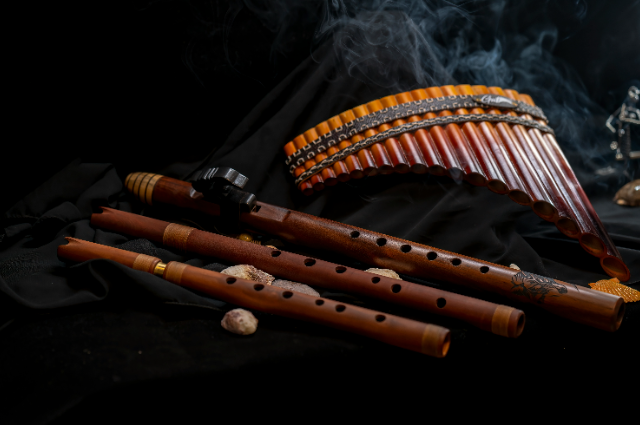
The instrument is made from the hollow wing bone of a griffon vulture. It has five finger holes and a V-shaped mouthpiece cut into one end, which a player would have blown into. Two laboratories dated the find to at least 35,000 years ago, and Conard has said the true age is probably close to 40,000 years. That places it in the Aurignacian, the archaeological culture associated with the earliest anatomically modern humans in Europe.
The flute was not found in isolation. Fragments of mammoth-ivory flutes came from the same cave, and eight flute fragments have been found in the region's Aurignacian layers. Taken together, the finds suggest not a single curiosity but an established musical tradition in southwestern Germany (Conard, Malina and Münzel, 2009).
The reassembled vulture-bone flute was too fragile to play. Researchers therefore made a copy, and it was the replica that was played to show how the original would have sounded.
Why “widely accepted”?
The flute is usually described as the oldest widely accepted instrument because an older candidate exists but remains contested. The Divje Babe bone from Slovenia, a perforated cave bear bone, was claimed to be a Neanderthal flute some 50,000 to 60,000 years old (Turk, 1997). If correct, it would push the origin of music back by tens of thousands of years and credit it to another human species.
Most specialists are unconvinced. They argue that carnivore teeth, not human hands, made the holes, and the case for this is set out in a well-known critique of the find (d’Errico et al., 1998). Because the Hohle Fels flute shows clear signs of deliberate manufacture, with carefully shaped holes and a mouthpiece, it is the benchmark that the older claim has not displaced.
Music and the Neanderthal question
Conard has suggested that music may have helped early modern humans in Europe compete with Neanderthals, for instance by strengthening social bonds within groups. This is best understood as a hypothesis, not a proven finding. The archaeological record shows that music existed; it cannot show that music conferred a competitive advantage. Broader surveys of the evidence treat the origins and function of prehistoric music as open questions (Morley, 2013).
Why it matters
The Hohle Fels flute shows that by about 40,000 years ago, people in Europe were investing skill and time in making instruments to precise designs, using materials as different as bird bone and mammoth ivory. Alongside the figurative carvings found in the same region, this points to a rich symbolic and artistic life among the first modern humans on the continent. Whether or not music helped them outcompete their rivals, it was clearly part of how they lived.
References:
- Conard, N.J., Malina, M. and Münzel, S.C. (2009) ‘New flutes document the earliest musical tradition in southwestern Germany’, Nature, 460, pp. 737–740. doi:10.1038/nature08169.
- d’Errico, F., Villa, P., Pinto Llona, A.C. and Ruiz Idarraga, R. (1998) ‘A Middle Palaeolithic origin of music? Using cave-bear bone accumulations to assess the Divje Babe I bone “flute”’, Antiquity, 72(275), pp. 65–79.
- Morley, I. (2013) The Prehistory of Music: Human Evolution, Archaeology, and the Origins of Musicality. Oxford: Oxford University Press.
- Turk, I. (ed.) (1997) Mousterian Bone Flute and Other Finds from Divje Babe I Cave Site in Slovenia. Ljubljana: Znanstvenoraziskovalni center SAZU.