
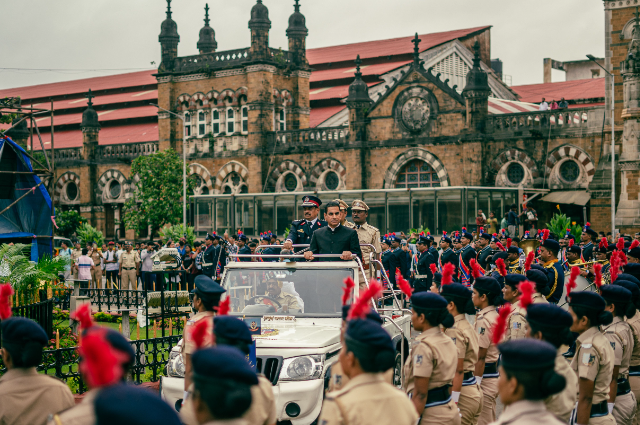
On Friday, 2 October 2026, on Gandhi Jayanti, thousands of people gathered at Mumbai’s Shivaji Park to demand the resignation of India’s Chief Election Commissioner, Gyanesh Kumar. Mumbai Police had refused permission for the event, yet the crowd came anyway. In Delhi, student activists and Aam Aadmi Party leaders held parallel protests with the same demand, and reports put the number of people detained there at well over 700, with some accounts saying more than 1,000. A little over a year after taking charge of the country’s election machinery, Kumar had become the focus of the most sustained public campaign against an election chief in recent memory. What follows separates what is documented from what is merely alleged.
A career that led to the Commission
Kumar is a 1988-batch IAS officer of the Kerala cadre and an alumnus of IIT Kanpur. He served in the Union Home Ministry, where he was involved in the Article 370 changes in Jammu and Kashmir and in setting up the Ram temple trust, and he retired as Cooperation Secretary in January 2024 before being named an Election Commissioner that March. He took over as the 26th Chief Election Commissioner on 19 February 2025 and was the first to be appointed under the 2023 appointment law, with a selection committee led by the Prime Minister. Rahul Gandhi, who sat on that committee as Leader of the Opposition, filed a dissent note objecting to the process [1]. His term runs until January 2029.
The Special Intensive Revision and the court
The Special Intensive Revision (SIR) is a house-to-house verification and re-enumeration of electoral rolls. After its first run in Bihar, Kumar announced in October 2025 that it would be extended to other states. The Commission argues that rolls had not been intensively revised for roughly two decades and carried errors from migration and demographic change. Critics counter that the process places the burden of proof on voters and has removed genuine electors.
The legal question was settled, at least on paper, on 27 May 2026. The Supreme Court upheld the SIR, holding that the Commission has the power to order it under Article 324 of the Constitution and the Representation of the People Act. The Court added that deleting a name from the roll is an electoral decision and does not amount to a declaration that a person is not a citizen, and it pointed to safeguards such as notice, hearing and appeal. That ruling addressed the legality of the exercise. It did not rule on every allegation about how it has been carried out in practice.
“Vote chori” and the Aland question
Gandhi’s sharpest accusation came at a press conference on 18 September 2025, where he alleged that Kumar was shielding people behind “vote chori.” His main example was Aland in Karnataka, where, he said, 6,018 applications to delete voters were filed through impersonation and automated means in the run-up to the 2023 Assembly election. He added that the Karnataka CID had written to the Commission 18 times over 18 months for technical details such as IP addresses, device ports and OTP trails, without receiving them. Reports at the time said the CID probe had stalled for lack of that data. The Election Commission rejected Gandhi’s claims as baseless and incorrect. The criminal investigation, rather than either side’s press statements, is where any firm facts about Aland will eventually come from.
Impeachment attempt and the “14 objections” report
In April 2026, opposition MPs submitted notices in both Houses seeking Kumar’s removal. It was the first such attempt. The Rajya Sabha Chairman and the Lok Sabha Speaker declined to admit the notices. Trinamool Congress MP Derek O’Brien has since said that more than 60 Rajya Sabha members had signed the notice.
The pressure rose sharply on 23 September, when The Indian Express reported, citing internal notes spanning October 2025 to August 2026, that Election Commissioners Sukhbir Singh Sandhu and Vivek Joshi had put at least 14 objections on record over ten months. Many were copied to Kumar, and one note reportedly called a step “unauthorised and illegal”. Opposition leaders such as Kapil Sibal read this as proof that Kumar lacked a majority within the Commission. The Commission’s position is that no commissioner recorded dissent, that every decision carries the signatures of all three members, and that the two had made observations which were examined. It also said the report highlighted such instances selectively and that disagreement is part of normal deliberation. Even Chirag Paswan, a minister from the ruling alliance, said Kumar should explain himself publicly. On 26 September, the three commissioners met in full and announced that meeting agendas would in future be circulated in advance and minutes issued. It is worth noting that the dispute concerns process and consultation inside the Commission. The reporting, as summarised so far, does not by itself show that any roll deletion was wrongful.
Old allegations resurface, unproven.
As the SIR row grew, two older matters returned. The first dates to 2006, when Kumar was Kerala’s Public Works Department secretary. A Malaysian official linked to a World Bank-assisted road project, Lee See Ben, died by suicide, and reports say a note named Kumar; Kumar was moved out of the department soon afterwards. Former minister T. M. Thomas Isaac revisited the episode, and in early October Kerala’s Home Minister Ramesh Chennithala ordered a fresh vigilance inquiry after a complaint by Congress leader Malayinkeezhu Venugopal, who alleged that earlier inquiries had been closed without proper investigation. The second matter is former Kerala Chief Secretary Jiji Thomson’s claim that Kumar once asked whether he would contest the 2019 Lok Sabha election as a BJP candidate. That claim is Thomson’s account of a private conversation. Gulf News reported that Kumar had not publicly responded to it, and no public response from him to the PWD allegations has been reported in the sources reviewed. None of these claims has been proven, and the Kerala inquiry is at an early stage.
The protests and a neighbourhood’s objections
The Cockroach Janta Party (CJP) is a young organisation. Founded online on 16 May 2026 by political communications strategist Abhijeet Dipke, it began as satire of the political establishment. It threatened an agitation if Kumar did not quit, and on 2 October it delivered one in Mumbai, billed as a “Jail Bharo Andolan,” with Shiv Sena (UBT) and the MNS extending support. Mumbai Police cited a Bombay High Court order in refusing permission, and a local advocate who has lived in the area for a decade filed a complaint calling the protest illegal. Some residents and businesses near the park said repeated demonstrations disrupt daily life and commerce, and writer Javed Akhtar backed concerns about noise. The episode illustrates an old tension in Mumbai between the right to protest and the claims of a residential neighbourhood, one that now plays out against a national political fight.
Where this leaves the debate
Three things can be said with reasonable confidence. The Supreme Court has upheld the SIR’s legal basis. Questions about how the Commission itself is run are now being raised by two of its own members, whatever label the Commission gives their notes. And the protest movement has broadened from opposition parties to student and civic groups. What remains unproven is the central charge that voters were deleted at scale to favour one party, as is the personal conduct alleged from Kumar’s Kerala years. Ending the dispute will need Aland-type investigations to get the data they have asked for, a clear public account from Kumar and the Commission, and independent scrutiny of deletions on the rolls. Until then, each side will keep reading the same facts in the light of its own priors.
References:
- Tribune India, “Gyanesh Kumar assumes charge as CEC; Vivek Joshi as EC.” https://www.tribuneindia.com
- Tribune India, “Gyanesh new CEC, Haryana CS Joshi his deputy.” https://www.tribuneindia.com
- Wikipedia, “Special Intensive Revision.” https://en.wikipedia.org
- Tribune India, “Rahul Gandhi accuses CEC of shielding ‘vote chors’ in ‘centralised deletion’ scam” (18 September 2025). https://www.tribuneindia.com
- The South First: “Karnataka may form SIT to probe Rahul Gandhi’s mass voter deletion allegations in Aland.” https://thesouthfirst.com
- The Quint, “Supreme Court upholds SIR, clarifies ECI’s electoral roll powers” (27 May 2026). https://www.thequint.com
- Sabrang India, “SC greenlights SIR, upholds ECI’s power to revise electoral rolls” (27 May 2026). https://sabrangindia.in
- All India Radio News, “RS Chairman and LS Speaker reject impeachment notice of motion against CEC Gyanesh Kumar” (6 April 2026). https://www.newsonair.gov.in
- The Quint, “2/3 Election Commissioners Objected to SIR Process 14 Times in 10 Months: Report.” https://www.thequint.com
- Khaleej Times, “What is the Election Commission controversy in India? Viral report, impact explained.” https://www.khaleejtimes.com
- Telangana Today, “ECI rejects report of dissent by Election Commissioners” (23 September 2026). https://telanganatoday.com
- Deccan Chronicle, “All decisions taken in unanimity: ECI denies rift over SIR.” https://www.deccanchronicle.com
- The Wire, “CEC must present stance clearly: Chirag Paswan” (25 September 2026). https://thewire.in
- The Morung Express (IANS), “CEC Gyanesh Kumar, ECs Sandhu-Joshi meet; Form 6, SIR decisions clarified” (26 September 2026). https://morungexpress.com
- The South First, “A suicide note and BJP MP offer: Gyanesh Kumar’s Keralam trail comes under scrutiny.” https://thesouthfirst.com
- Gulf News, “India’s CEC Gyanesh Kumar offered me BJP ticket, ex-Kerala chief secretary claims.” https://gulfnews.com
- Business Standard, “Kerala reopens probe against Gyanesh Kumar in 2006 graft case: What we know” (5 October 2026). https://www.business-standard.com
- The News Minute, “Kerala orders fresh probe into 2006 graft, harassment allegations against Gyanesh Kumar.” https://www.thenewsminute.com
- Wikipedia, “Cockroach Janta Party.” https://en.wikipedia.org
- National Herald, “Thousands gather at Shivaji Park for CJP protest against CEC Gyanesh Kumar” (2 October 2026). https://www.nationalheraldindia.com
- Outlook India, “Gyanesh Kumar Row: CJP’s Mumbai Protest Draws Objections From Shivaji Park Residents.” https://www.outlookindia.com
- Gujarat Samachar (English), “Complaint filed against CJP leaders over Shivaji Park protest demanding Gyanesh Kumar’s resignation.” https://english.gujaratsamachar.com
- Tribune India, “Gyanesh Kumar to take over as 26th CEC on Feb 19.” https://www.tribuneindia.com
- The Indian Eye, “Supreme Court upholds SIR, confirms ECI’s power to revise electoral rolls” (28 May 2026). https://theindianeye.com