
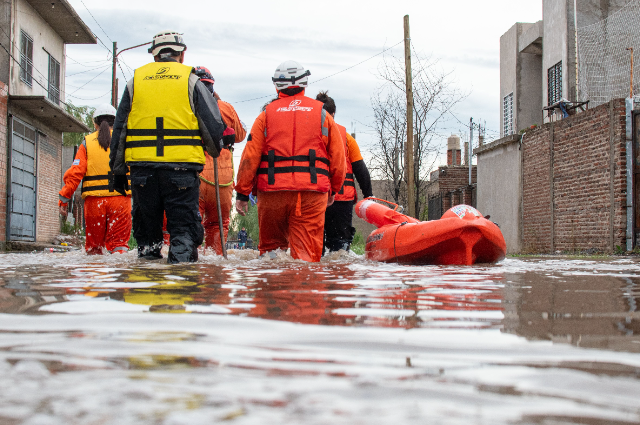
On August 1, as monsoon floodwaters tore through Kannur district in northern Kerala, a farmer named Benny found himself trapped. He had gone to check on his coffee plantation on a small river islet near Meenthulli, in Cherupuzha, after hearing of a landslide across the border in Karnataka's forests. Within hours, the Kariyangode River began to rise. It reached his waist, then his neck, sweeping away his shed and his tools as he clung to a coconut tree, waiting.
Help came from R. Rajesh, a 36-year-old disaster-response trainer and swimming instructor from Kalliyoor in Thiruvananthapuram, roughly 300 kilometres south. Rajesh was no stranger to Kerala's disasters — he had volunteered during the catastrophic 2018 floods and again during the 2024 Wayanad landslides, and had trained with the Congress party's Disaster and Search Response Force. When word reached him of a man stranded in the floodwaters up north, he went.
Rajesh swam across the swollen river along with two fellow rescuers, Shibin and Jithin, and threw Benny a rope. As Benny tried to tie it to the tree, his finger got caught, so Rajesh swam over to free him. The three began the return journey together, holding the safety rope against the current.
Partway back, Rajesh saw Benny struggling. He took off his own life jacket and put it on the older man. Moments later, without the jacket's protection, Rajesh lost his grip on the rope near the bank and was pulled under. The search for him took three days; his body was eventually recovered from a small island several kilometres downstream.
His funeral, held at his family home in Kalliyoor, drew Kerala's Leader of the Opposition V.D. Satheesan along with ministers, elected representatives, and hundreds of mourners, and Rajesh was given full state honours. At the funeral, his young children clung to his coffin, crying and asking that the cloth covering their father's face be removed so they could see him. Satheesan, who came to pay his respects, stood in visible silence, moved by the family's grief.
Leader of the Opposition V.D. Satheesan described Rajesh as a dedicated volunteer who had answered the call during earlier disasters as well, calling his death heartbreaking. The state government has since announced it will accord Rajesh formal state honours and complete the construction of the house he left unfinished — a promise made good on the fact that, as his wife Shafiya later told reporters, finishing their home and clearing their debts was the one thing Rajesh had told her he wanted before they could finally live in peace. He had come home just a week before the flood and told her they should clear their debts, finish building the house, and then live happily together.
Local leaders have also moved to support the family further: a minister who visited them assured that the next cabinet meeting would consider a government job for Shafiya, and Rajesh's popularity in Kannur — where residents had organised food, lodging, and a dedicated coordination group to help the search for him — was said to extend well beyond his own hometown.
Alongside the honours for Rajesh, Kerala's Cabinet also expanded financial assistance for flood-affected families more broadly — raising compensation for destroyed and damaged homes, and approving emergency aid, rent assistance, crop-loss compensation, and soft loans for small businesses and farmers hit by the disaster.
Not everything around Rajesh's death has been free of controversy. A senior CPI(M) leader publicly accused state Revenue and Health department officials of showing a careless attitude toward the handling of Rajesh's body, saying it was only returned to his family late in the evening after the postmortem, and demanded action against those responsible.
For Kerala, a state that has now lived through the 2018 floods, the 2024 Wayanad landslides, and this year's monsoon emergency in close succession, Rajesh's death has become something of a distillation of a familiar pattern: ordinary volunteers, often with no obligation beyond their own sense of duty, repeatedly stepping into the state's worst moments to pull others out. He did that three times over the better part of a decade. The third time, it cost him his life — and he spent his last act of it making sure it didn't cost Benny his.
References
- Khaleej Times — "Kerala floods: Rescue volunteer gives life jacket to drowning man, gets swept away"
- Onmanorama — "Kerala accords state honours to Rajesh who died during rescue operation, vows to complete unfinished house"
- Onmanorama — "Rescue hero Rajesh's wife remembers her late husband's dream of clearing debts, living peacefully"
- Assam Tribune — "Flood hero's farewell leaves Kerala in tears"
- National Press Union of India — "Hero of Kerala floods gives away life jacket, dies trying to save drowning farmer"
- The Daily Pioneer — "CPI(M) alleges 'unpardonable disrespect' to body of flood rescuer Rajesh"
- Kerala Kaumudi — "Rajesh's family needs govt's helping hand" (Editorial)