
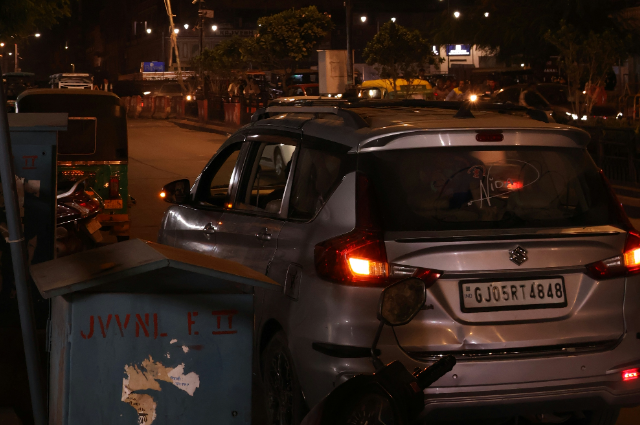
The Crash
Late on the night of May 18, a speeding Toyota Fortuner SUV struck three motorcycles near Pushkar Ghati on the Pushkar-Ajmer highway in Rajasthan, killing one person and leaving four others with injuries. The driver, Digvijay Singh Chauhan, was allegedly intoxicated at the time of the collision. He has since been taken into custody by the Pushkar police.
The victim, identified as Ravi — a painter and resident of Dholabhata in Ajmer — was travelling on one of the motorcycles with his brother-in-law, Jitendra alias Sonu, a resident of Nagra. Jitendra sustained injuries and was rushed to JLN Hospital. On a second motorcycle, Rohit (22) of Shastri Nagar was riding with his uncle Madhusudan Vaishnav (29). Both were also injured. A third motorcycle rider was additionally hurt and hospitalised. Ravi is survived by four sisters. His father, Kishore Kumar, a retired railway employee, filed a formal complaint at Pushkar police station.
“Several cartons and bottles of alcohol were recovered from the car during the investigation,” As reported by multiple media outlets citing police sources.
The Vehicle and Its History
The Fortuner involved in the crash is registered in the name of the Khatu Shyam Mandir Seva Samiti, a committee associated with one of Rajasthan’s most visited pilgrimage sites. The vehicle already had nine pending overspeeding challans against it at the time of the accident — a troubling record that raises serious questions about the oversight of temple trust vehicles and the enforcement of traffic violations.
Chauhan is identified in police records and media reports as a sevadar — a volunteer or devotee — associated with the Seva Samiti. Videos circulating on social media purportedly show him performing duties inside the Khatu Shyam Temple premises, including what appear to be VIP-related services.
Several headlines and social media posts have described Chauhan as a “priest” or “pujari.” This appears to be imprecise. Available reports describe him as a sevadar — a volunteer or attendant associated with the temple committee — a role distinct from that of a pujari in the traditional religious sense. The distinction matters for accurately characterising his affiliation with the institution.
Context and Public Reaction
The Khatu Shyam Temple, located in the Sikar district, is among the most revered pilgrimage sites in Rajasthan, drawing millions of devotees each year. The institution carries significant religious and social weight in the region, which is part of why the incident has generated considerable public outrage. Critics have pointed to the apparent contradiction between the vehicle’s association with a religious trust and the discovery of large quantities of alcohol inside it.
The case has also reignited debate around accountability for trust- and institution-owned vehicles, particularly when those vehicles accumulate unaddressed traffic violations. Nine pending challans represent a systematic failure — both by the vehicle’s custodians to respond to prior notices, and potentially by enforcement agencies to follow through. Chauhan has been taken into custody, and further investigation is ongoing.
The Two Faces: Identity, Shadow, and Society
How the Sevadar Constructed His Identity as “God’s Person”
Digvijay Singh Chauhan built a very visible religious identity. As a sevadar — a devotee-volunteer — of the Khatu Shyam Mandir Seva Samiti, he was not just passively associated with a holy institution; videos reportedly show him performing duties inside the temple itself, including VIP-related services. This placed him at the centre of a sacred space, in front of millions of devotees.
The vehicle itself was registered in the name of the temple trust. So even his car was wrapped in religious identity. Driving it was, in a symbolic sense, driving under the banner of God.
Identity Performance
This is what sociologists call identity performance — you are not just what you are, but what you display. His uniform was devotion. His stage was one of Rajasthan’s holiest institutions. The institution provided him not only with purpose but with a ready-made public face that carried enormous social trust.
The Two Sides of the Same Person — The Internal Contradiction
This is where it gets psychologically interesting. The article reveals that inside that same temple vehicle, police found several cartons and bottles of alcohol. Not one bottle hidden — cartons. This suggests a parallel, hidden life running alongside the public one.
Side A — The Public Self
- Sevadar at a temple visited by millions
- Serves devotees and VIPs on holy grounds
- Drives a vehicle bearing a temple trust’s name. Side B — The Shadow Self
- Allegedly drunk and speeding at night
- 9 pending challans already ignored
- Kills an innocent man; leaves four sisters without a brother
The nine pending challans are particularly telling. This was not one bad night. The recklessness had a history, quietly accumulating while the religious identity was being loudly performed. The two sides did not just coexist — they were actively running in parallel for a long time.
Moral Licensing
Psychologists refer to this through the concept of moral licensing — where people who strongly identify as “good” (religious, charitable, virtuous) sometimes unconsciously feel permitted to behave badly in private, as if their public virtue creates a kind of moral credit they can spend elsewhere. The more visible the goodness, the deeper the shadow it can cast.
How Society Handles Both Sides — and Where It Fails
The article shows society dealing with this contradiction in a very characteristic way: it collapsed both sides into one headline (“Priest arrested for drunk driving”), which the article itself critiques as imprecise. Calling him a pujari rather than a sevadar flattened the nuance — society reached for the most dramatic framing available.
But more importantly, society had already been handling the shadow side poorly long before the crash:
- Nine overspeeding challans went unaddressed — both by the temple committee (who owned the vehicle) and by traffic enforcement (who issued but never followed through on the notices).
- The institution that gave him his public identity also shielded his private recklessness, perhaps unintentionally.
- Public reaction was outrage at the contradiction, not just at the death, but at the alcohol in a temple vehicle. The symbolism hit hard: people can accept a sinner. What they struggle to accept is a sinner wearing the costume of a saint.
The victim, Ravi — a painter, a common man — represents the side of society that has no dual identity to hide behind. He was just travelling. He had no institutional cover, no trust-registered vehicle, no religious branding. And he died.
In Summary
The Deeper Lesson: This article is a story about how institutions can create halos around individuals — halos that make their shadow side invisible until a collision, literal or otherwise, forces society to look at both at once. The real failure here is not just one man’s private life. It is a system of social trust that elevated a public face without ever checking what drove it.
Sources & References
- DNA India — “Who is Digvijay Singh Chauhan? Khatu Shyam sevadar alleged of ramming SUV into 3 bikes killing 1 in Pushkar; Alcohol bottles recovered” (May 2025)
- Wikipedia — Khatu Shyam Temple (background on the institution)
- Complaint filed by Kishore Kumar at Pushkar police station (reported across multiple media outlets)
- Social media posts and videos cited in coverage by Zee Media and others (May 2025)