
A Seven-Foot Deity Reduced to a Foot
For three summers running, pilgrims arriving at the Amarnath cave have found themselves gazing at a puddle where a sacred glacier once stood. This year was no exception — and by most accounts, it was the worst yet.
The naturally forming ice stalagmite inside the Amarnath cave, worshipped by Hindus as a self-manifested form of Lord Shiva and popularly called Baba Barfani, stood close to seven feet tall when photographed by the Border Security Force in late May 2026. Within days of the 2026 Yatra opening on July 3, that figure had collapsed. Photographs circulating from the cave on July 6 showed the formation reduced to roughly a foot; by July 7, officials and pilgrims described it as having shrunk by nearly 90 to 99 per cent, leaving only a faint outline in parts of the cave. More than four lakh devotees had registered for the pilgrimage, and huge numbers were still en route when the ice effectively disappeared, just four to five days into a 57-day Yatra.
This was not a one-off. Shrine officials and recent reporting confirm the ice formation has failed to survive beyond a single week for three consecutive years — a sharp break from its traditional pattern of waxing and waning gently through the Shravan month, in step with the lunar cycle, well into the pilgrimage season.
The Climate Explanation
The most commonly cited culprit is a warming Himalaya. Climate scientists have repeatedly flagged that the Himalayan region is heating faster than the global average, and 2025 saw Srinagar record its highest temperature since 1953. Sitting at roughly 3,880 to 3,888 metres, the cave is not insulated from this trend — weak winter snowfall reduces the water available to freeze into the stalagmite in the first place, and warmer spring and early-summer air accelerates its collapse once the pilgrimage begins and the cave is repeatedly opened to outside air and body heat from tens of thousands of visitors a day.
That crowd factor is not incidental. Even a modest human body radiates warmth, and multiplied across the daily footfall the Amarnath cave now receives, the enclosed rock chamber effectively becomes a heat sink during peak Yatra hours — compounding whatever damage a warmer regional climate has already done to the ice.
The Governance Question Nobody Wants to Answer
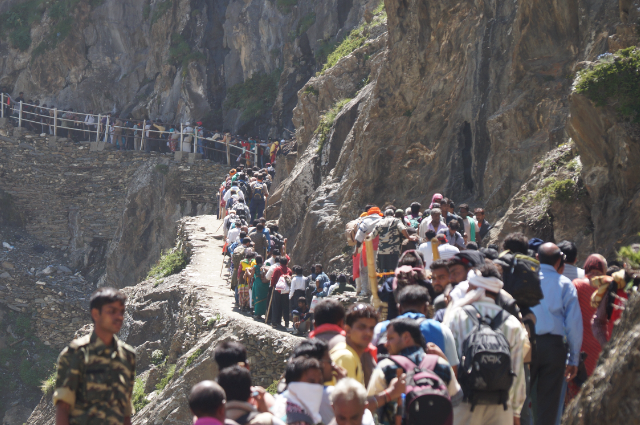
But framing this purely as a climate story lets an uncomfortable second explanation off the hook. The Lidder Valley leading to the cave has an assessed carrying capacity of around 4,300 people a day, according to an Environmental Impact Assessment (EIA) of the valley carried out some years ago — yet actual daily footfall has routinely exceeded that limit for more than a decade, at times running to over 12,000 pilgrims a day. The Supreme Court has separately set a cap of 10,000 pilgrims per day, a limit critics say is treated as aspirational rather than binding.
More strikingly, the Shri Amarnath Shrine Board (SASB), the statutory body that runs the Yatra, does not appear to operate under the environmental compliance framework that would normally govern activity of this scale in a fragile, glacier-fed ecosystem. A former scientist with the Jammu and Kashmir Pollution Control Board has publicly stated that the Board has no Environmental Management Plan and no fresh Environmental Impact Assessment of its own, calling this a standing violation of the Environment Protection Act (1986), the Water Act (1974), the Air Act (1981) and the Solid Waste Management Rules (2016). Local political voices, including PDP leader Iltija Mufti, have separately raised alarms this year over construction activity, expanding infrastructure and a proposed ropeway project in the same ecologically sensitive zone.
This is not a new complaint. As far back as 2017, an NGO-led study describing the Yatra as a “militarised pilgrimage” accused the Shrine Board of functioning like a state within the state, and called on the Jammu and Kashmir government to rein in its autonomy. The National Green Tribunal has also previously directed the Board to address pilgrim facilities and cave-area management. Nearly a decade on, the core demand — a scientifically established, enforced carrying capacity for the route — remains unmet.
Faith, Undisturbed
None of this appears to be denting pilgrim enthusiasm. The Shrine Board has not indicated that the Yatra's schedule or arrangements will change because of the melted ice, and officials say footfall this year has, if anything, exceeded previous years. Many devotees, including those who arrived after the ice had gone, say the cave itself remains the object of devotion regardless of what is or isn't inside it — one pilgrim put it simply: Baba resides in the devotee's faith, not only in the ice.
That resilience of belief is genuine and worth respecting. But it shouldn't be allowed to quietly absorb a governance failure. Rising Himalayan temperatures are a global problem no single shrine board can solve. An unassessed, uncapped, and seemingly unaccountable pilgrimage operating in one of the world's most fragile mountain ecosystems is not a global problem — it's a local, fixable one. Conflating the two lets everyone off the hook a little too easily.
References
- Vibrant Colours, "Amarnath Ice Shivling Disappears Within Days Of Yatra: Could Global Warming Be A Reason?" (July 2026) — https://vibrantcolours.in
- Free Press Journal, "Amarnath Ice Shivling Disappears Within Days Of Yatra: Could Global Warming Be A Reason?" (July 2026) — https://www.freepressjournal.in
- Nagarjuna Travels, "Amarnath Yatra 2026: Ice Shivling Melts Just 5 Days In — What Happened, Why It Keeps Happening, and What It Means for Pilgrims" (July 2026) — https://nagarjunatravels.com
- The News Now, "Amarnath Ice Shivling melts 90 per cent within four days of Yatra 2026, pilgrims alarmed" (July 2026) — https://www.thenewsnow.co.in
- Down To Earth, "Amarnath ice lingam melts early again: Experts urge shrine board to cut yatra duration, regulate pilgrim numbers" (July 2025) — https://www.downtoearth.org.in
- Dialogue Earth, "Amarnath Cave: A pilgrim trail littered with pollution" (2021) — https://dialogue.earth
- Kashmir Times, "Amarnath Yatra: Ecological Questions Kashmir Can No Longer Postpone" (July 2026) — https://kashmirtimes.com
- Outlook India, "Iltija Mufti Claims Amarnath Ice Lingam Melted Within a Week, Flags Environmental Concerns" (July 2026) — https://www.outlookindia.com
- The Swipe Up, "Five days into the 57-day Yatra, Amarnath Ice Lingam evaporates. Who is at fault" (July 2026) — https://www.theswipeup.com
- Greater Kashmir, "Amarnath tragedy exposes limited holding capacity of fragile Himalayan ecosystem" (2022) — https://www.greaterkashmir.com
- PressReader (The Sunday Guardian), "NGOs want Amarnath Yatra to be cut short to a fortnight" (2017) — https://www.pressreader.com
- PressReader (Hindustan Times), "NGT raps Amarnath board for lack of facilities for pilgrims" (2017) — https://www.pressreader.com